Boulevard vs Mangomint: the first front desk to top our scorecard , and the one that would not let us in
Mangomint scored 22 of 32 in our lab, the highest of seven salon tools, with a client ledger that remembers a no-show debt and a trial that cannot set a deposit, send a reminder, or state your own cancellation policy. Boulevard is demo-only and never answered our request for a test account, so its half of this comparison is its own documentation, dated. Same salon, same week, one tool tested.
Some links below are affiliate links — if you subscribe through one, we earn a commission at no extra cost to you. It never changes a verdict; every tool runs the same test salon. Full disclosure
Boulevard and Mangomint are the two names a salon hears once it has outgrown the six tools we have already tested. Both are built for a multi-chair business with a front desk, both price well above the independents, and both are sold the way enterprise software is sold: Boulevard only through a demo, Mangomint through a trial that an onboarding manager is meant to steer. Search boulevard vs mangomint and you find each vendor’s page about the other, and roundups assembled from both. Nobody on that page has run a salon week through either one.
We ran it through one of them. The salon is the same fictional business every tool in this series gets: Willow & Main, five providers including a booth renter and an esthetician, twelve services with add-ons, one membership, forty clients, and a scripted 34-appointment week with six traps planted in advance. The dataset and policy sheet are downloadable. Mangomint got the identical configuration, the identical week, and the identical second identity booking, rescheduling, no-showing and paying from the client’s phone.
Boulevard did not, and this review says so in the title because it changes what the comparison is. Boulevard has no self-serve trial. We wrote to its press desk on 5 October 2026, as a testing publication, asking for a sandbox, a trial, or a driven demo for roughly three weeks, and set out exactly what we would and would not do with it. We followed up on 12 October. We have had no reply of any kind. So Boulevard’s half of this review is its own published pricing and support documentation, read and dated 9 November 2026, with no score and no recommendation. It is a comparison between a tool we tested and a tool we read about, and we have tried to keep the two kinds of knowledge visibly apart.
Mangomint scored 22 out of 32, the highest of the seven tools we have run. That number needs its context before it needs its celebration, because a good part of what we learned is about the trial rather than the product.
The verdict, up front
Mangomint is the first tool of seven to hold the whole policy sheet in one product. Add-ons that carry their own price and duration, turnover time between facials, an intake form scoped to the two services that need it, a booth renter modelled in six permission toggles plus a setting the vendor describes in its own words as being for booth renter business structures, a membership that redeems itself at checkout, and, uniquely, a client ledger that can carry a no-show debt forward. Walk-in entry at the desk took fifteen seconds, the second fastest we have timed. Its pricing is one line and the in-app subscription screen matched it to the dollar.
Client-side booking
out of 8
Policy enforcement — the six traps
out of 12
Front-desk operations
out of 8
True cost
out of 4
TOTAL
out of 32
On the twelve points that matter most to us, enforcing the policy a salon actually publishes, Mangomint scored seven. That is the same seven GlossGenius, Vagaro, Fresha and Acuity scored, and no tool has beaten it in seven trials. Mangomint double-booked a walk-in into an occupied chair without a word. It moved a next-morning appointment for free from the desk with the client notification switched off by default, then emailed the client a policy that said the move counted as a late cancellation. It stranded a cancelled deposit on an open sale. It computed a no-show fee only when the desk typed it. The one thing it did that no other tool has done is remember the result: the $66 Marcus Webb owes sits on his record as a negative balance, in a report, with a history.
And the trial, which is the only thing a salon owner can test, is not the product. On a standard Mangomint trial, no reminder is ever sent, no deposit or card requirement can be switched on, the cancellation policy shown to your clients is Mangomint’s stock text and not yours, and checkout stops after ten sales. We will explain what the vendor switched on for us, when, and what that means for every finding below.
How we tested, and what we couldn’t
Mangomint. We opened the self-serve trial on 30 October 2026 at 16:37 Pacific, built the salon over two evenings, loaded the week on 1 November, booked three appointments from the client’s phone on 2 November, and ran the trap week from 3 to 7 November with the data fuse on the Friday. Every finding has a capture and a timestamp in our published score file. Two limits were ours. We never process real money, so Mangomint’s payment application, which asks for a tax-document address and an EIN, was never submitted, and everything behind it is documented from the vendor’s pages rather than tested. And text messages are unobservable in our lab, because every scripted client has a 555 number; email is the only client channel we can watch.
One limit was the vendor’s, and then was not. On 30 October, in the in-app chat, we told Mangomint’s support team who we were and what we were doing, and asked two questions: could a trial import a client list, and could a trial send confirmations and reminders. Four humans answered over four days. The import answer was no: if you are staying in trial mode, all clients will need to be manually entered, so forty clients were typed in by hand. The messaging answer arrived on 2 November from Mangomint’s marketing team, not support: they would make some updates to your account so that you’re able to test these features, on one condition, that the review say some of these features are not available in a standard trial. The changes landed the morning of 3 November. We asked them to leave the subscription and payment-processing side untouched, and they did.
So this review runs on two accounts, and we have dated the seam. Every finding about the trial as a salon owner would experience it comes from 30 October to the morning of 3 November. Everything from 4 November on, which is the whole trap week, ran on an account Mangomint had modified for us. Where that matters we say so in the sentence, not in a footnote. What the modification did, in the vendor’s own words on 4 November: we could now customize your automated messages, including your own cancellation policy wording, instead of staying on the default text. What it did not do, same message: sales are capped, appointment reminders (first and second) don’t send to clients, the pre-appointment please confirm request does not send, and marketing features won’t send during the trial. All of them lift on the first successful subscription payment. The confirmation at booking, they said, still does send, and it did. That is vendor-provided access, disclosed, and it did not change a single score, because every item it could have touched scored on what was sent or saved, not on what was promised.
Boulevard. There is no trial. The pricing page’s only call to action is Book a free demo, and its FAQ says the team will be in touch within a day or two to schedule. Our rule for demo-gated tools is to ask for access as what we are, never as a salon, and to walk a real business’s public booking page no further than the confirm step. We asked on 5 October and again on 12 October, and received silence. So Boulevard’s half of this comparison is built from its pricing page and fourteen articles in its support centre, read on 9 November 2026, with each article’s own date noted where it shows one. Where the documentation is silent we say not published, and we have not guessed. Nothing in Boulevard’s half is a score, a timing, or a screenshot of the product; the only captures are of its public pricing page.
Boulevard vs Mangomint pricing: three tiers against one line
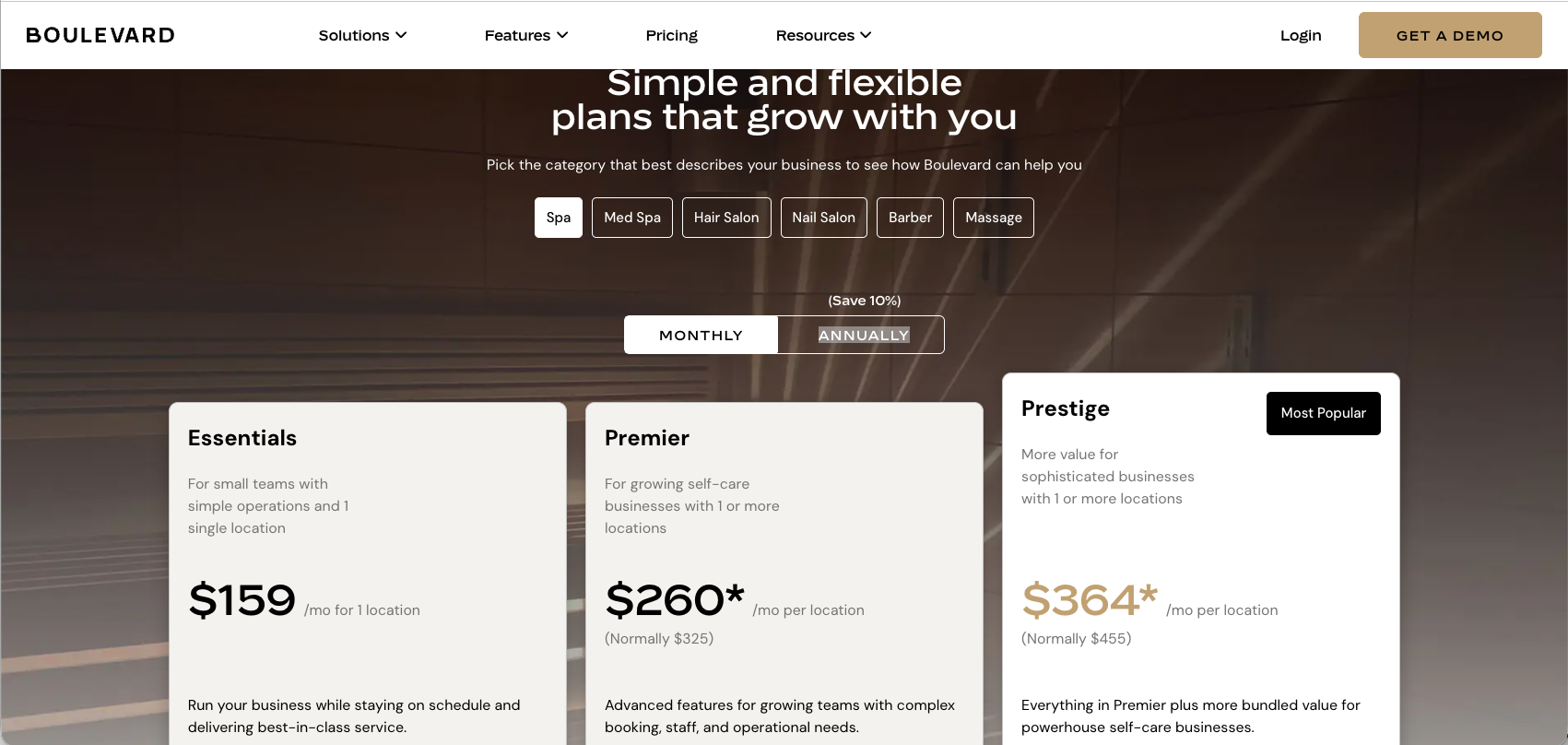
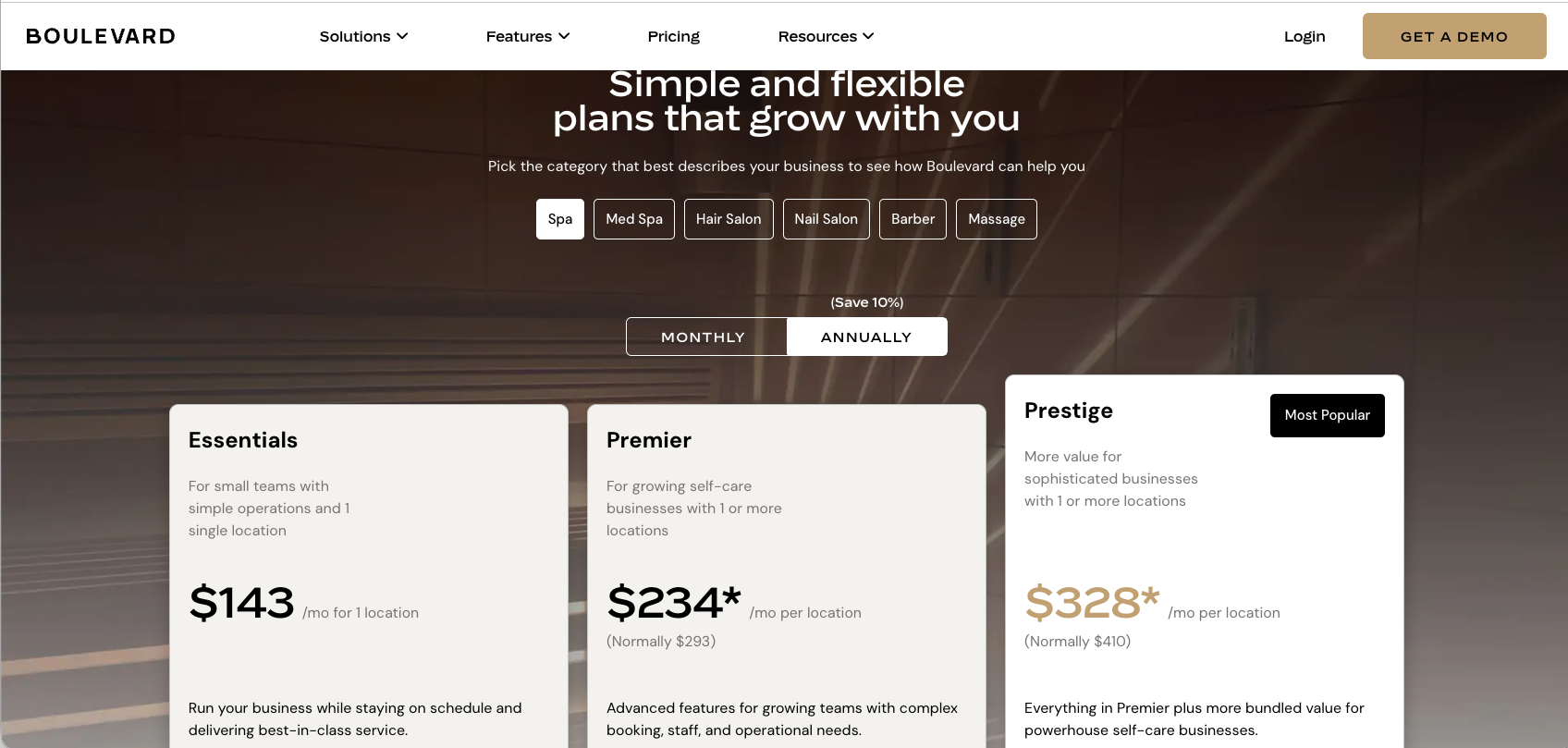
Boulevard publishes three tiers and a fourth you have to ask about. Billed month to month, Essentials is $159 a month for one location and up to five providers. Premier is $260 per location with unlimited professionals, shown beside a normally $325. Prestige, badged most popular, is $364 per location beside a normally $455, and it folds in the Forms add-on and ten times the free texts. The two struck prices carry an asterisk: limited-time offer, fall pricing, new customers only, terms apply. A Monthly/Annually toggle promises save 10%, and on the Annually side the same three tiers read $143, $234 and $328. Mangomint has no annual plan and no contract, so the month-to-month figures are the like-for-like ones, and they are the ones we use. Forms, which is where a salon’s intake questionnaire lives, is an add-on from $65 a month per location on the two lower tiers. Texts beyond the free allowance are billed by the number of texts sent and received each month, at a rate the page does not state.
What the page does not publish is a card processing rate. There is a section on payments, a mention of volume-based discounts, an invitation to bring your current processor’s statement, and a product called Boulevard Offset, under which your clients pay a 3% fee on credit card transactions, and you pay just 1%. The Offset support article, dated 4 October 2026, says businesses typically pay around 2.65%–3.65% in processing fees, which is a statement about the industry, not Boulevard’s rate card. The payouts article says your rate is based on your fee schedule, either Fixed Flat or Interchange Plus, and gives neither. To process payments at all you must buy Boulevard’s own terminal, the Duo. Same-day payouts cost 0.95% of the payout and instant payouts 1.75%, on top of processing. Boulevard is the second tool in this series, after Acuity, whose cost of taking a card cannot be read from its own pages, and the only one that requires you to take cards through it.
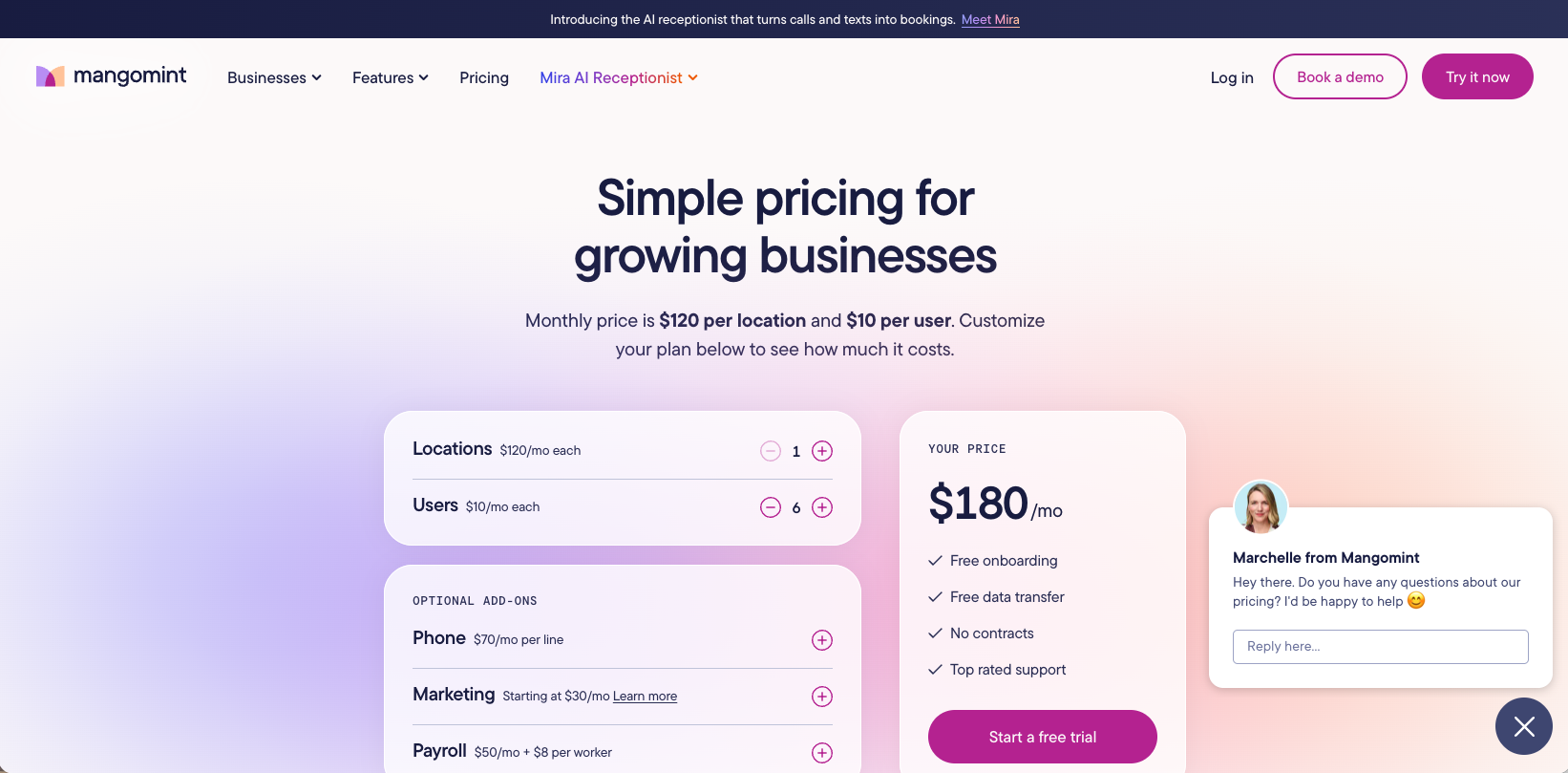
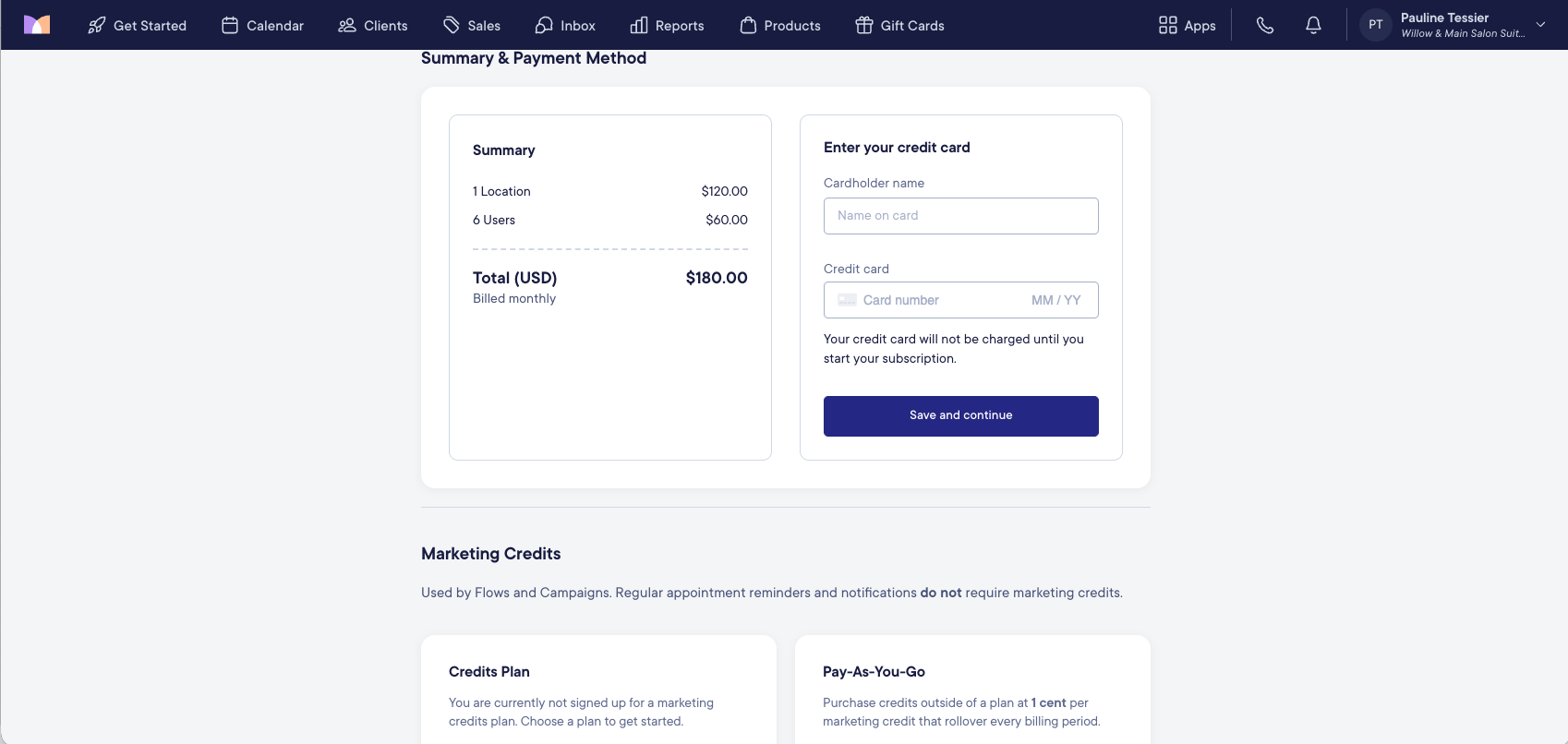
Mangomint’s page is one line: $120 a month per location plus $10 a month per user, where anyone with a profile in Mangomint counts as a user, providers and front desk alike. Processing is 2.45% plus 15¢ in person and 2.90% plus 30¢ online, with large businesses may qualify for custom rates beneath. Add-ons are a phone line at $70 a month, payroll at $50 plus $8 a worker, and marketing credits from $30. Automated texts such as appointment confirmations and reminders, are always included. No contracts, and no tier above or below. Our five providers plus the desk login made six users, and the subscription screen inside the account read $180.00 billed monthly, which is the arithmetic.
Here is what the two cost over a year for the three salon shapes our calculator uses, as far as the published numbers allow. Mangomint’s figure is subscription plus processing at its published rates, one user per provider. Boulevard’s figure is subscription only, because its processing rate is not published; the real annual cost is higher by an amount neither we nor you can read from its pages.
| Mangomint | Boulevard (subscription only) | |
|---|---|---|
| Solo booth renter · 85 appts at $65 | $3,518 ($130/mo + processing) | $1,908 (Essentials, $159; $1,716 if billed annually) + processing at an unpublished rate |
| Three-chair salon · 260 at $78 | $8,856 ($150/mo + processing) | $1,908 (Essentials, $159; $1,716 if billed annually) + processing at an unpublished rate |
| Six-chair salon + spa · 520 at $92 | $18,569 ($180/mo + processing) | $3,120 (Premier, $260; $2,808 if billed annually; six providers exceed Essentials) + processing at an unpublished rate |
Two things to read off that table. First, Mangomint is the most expensive subscription we have costed for a solo renter, $130 a month against GlossGenius at $24 and Square at $0, and processing at a typical volume is more than the subscription at every size. Second, Boulevard’s Essentials subscription lands within $10 of Mangomint’s for a three-chair salon, $159 month to month against $150, or $143 for a salon willing to commit to a year, before processing, and the before processing is the whole question. If Boulevard’s rate were at the bottom of its own typically range, 2.65%, the six-chair salon would pay about $15,200 a year in processing on top of $3,120; at the top, 3.65%, about $21,000. We are not putting either figure in the table, because neither is Boulevard’s rate. Add the Forms add-on, which our esthetician’s intake needs, and Essentials is at least $224 a month, $208 on annual billing, more than Mangomint’s $180 for the same roster either way.
The trial that is a sandbox
Mangomint’s trial has no time limit and asks for no card. A blog post dated August 2026 calls it free until you launch. Both claims are true, and neither is the point. Thirty minutes after signup, having cleared out the sample data, this is what the dashboard said.
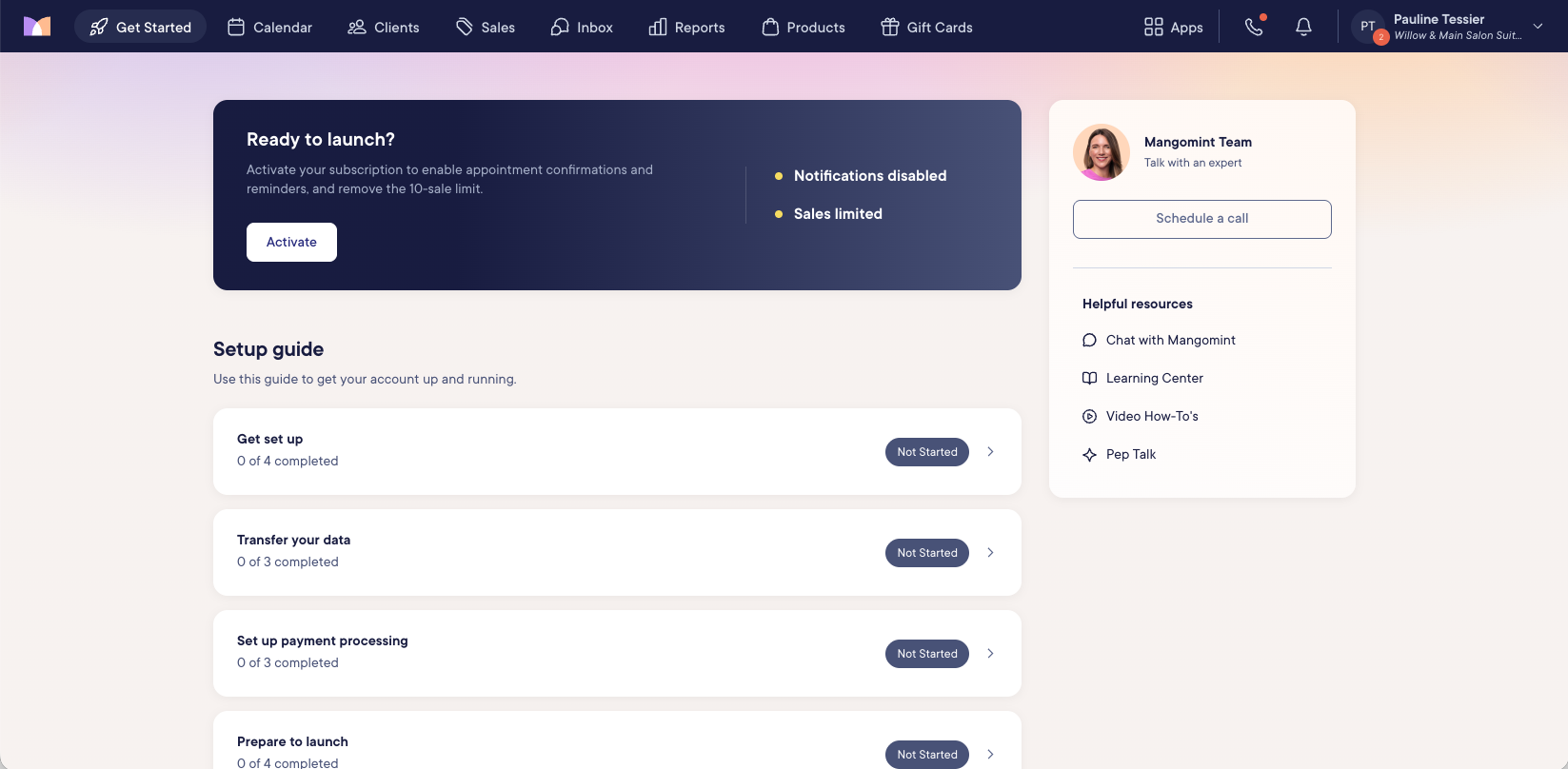
A Mangomint trial is a configuration sandbox. You can build the whole salon in it, and we did. You cannot run a week of it. Checkout stops at ten sales, which includes a $0 membership redemption and a deposit taken against an open sale (we asked, and the vendor confirmed both count). Reminders do not send. And two more walls stand behind that one.
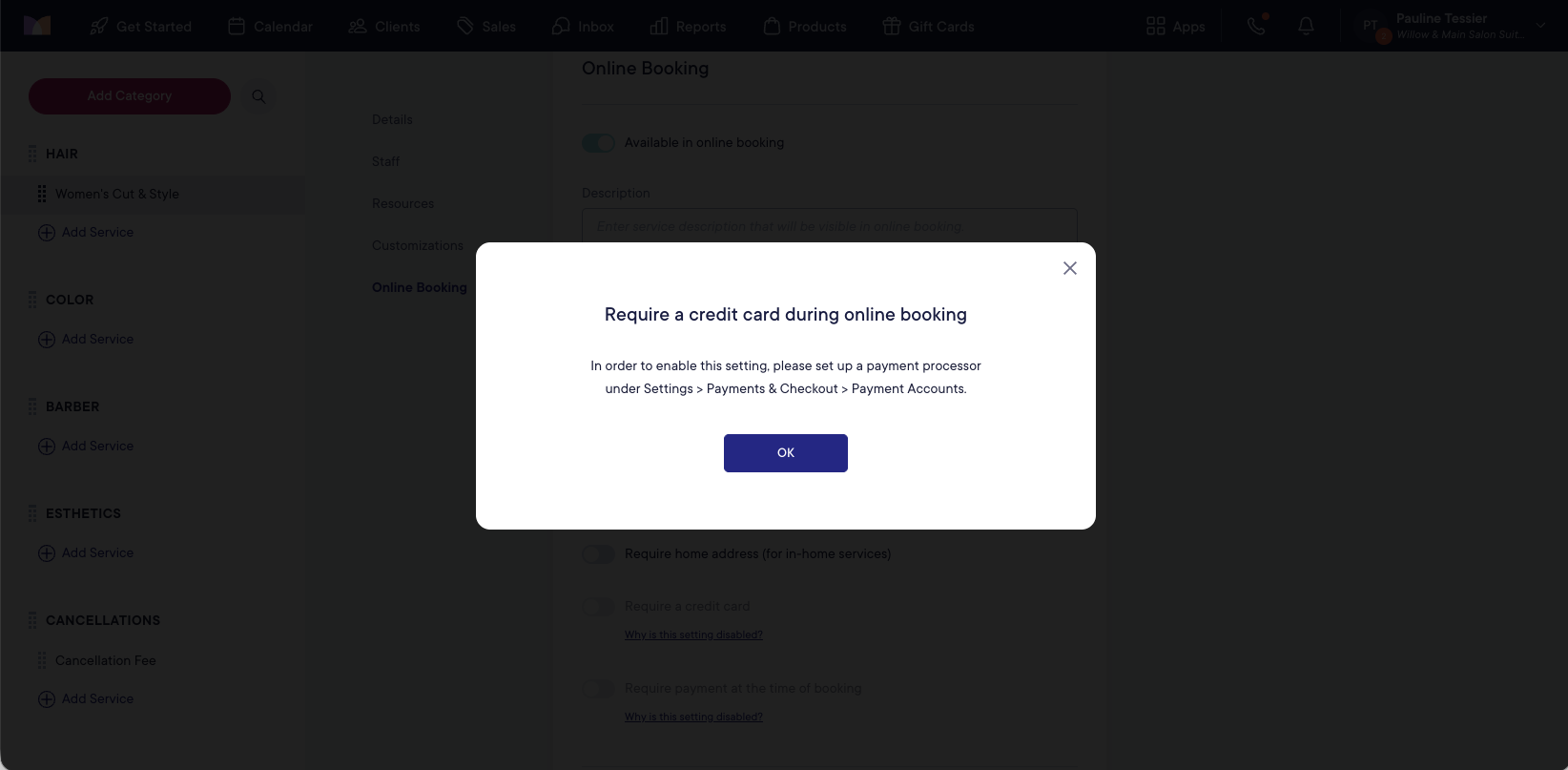
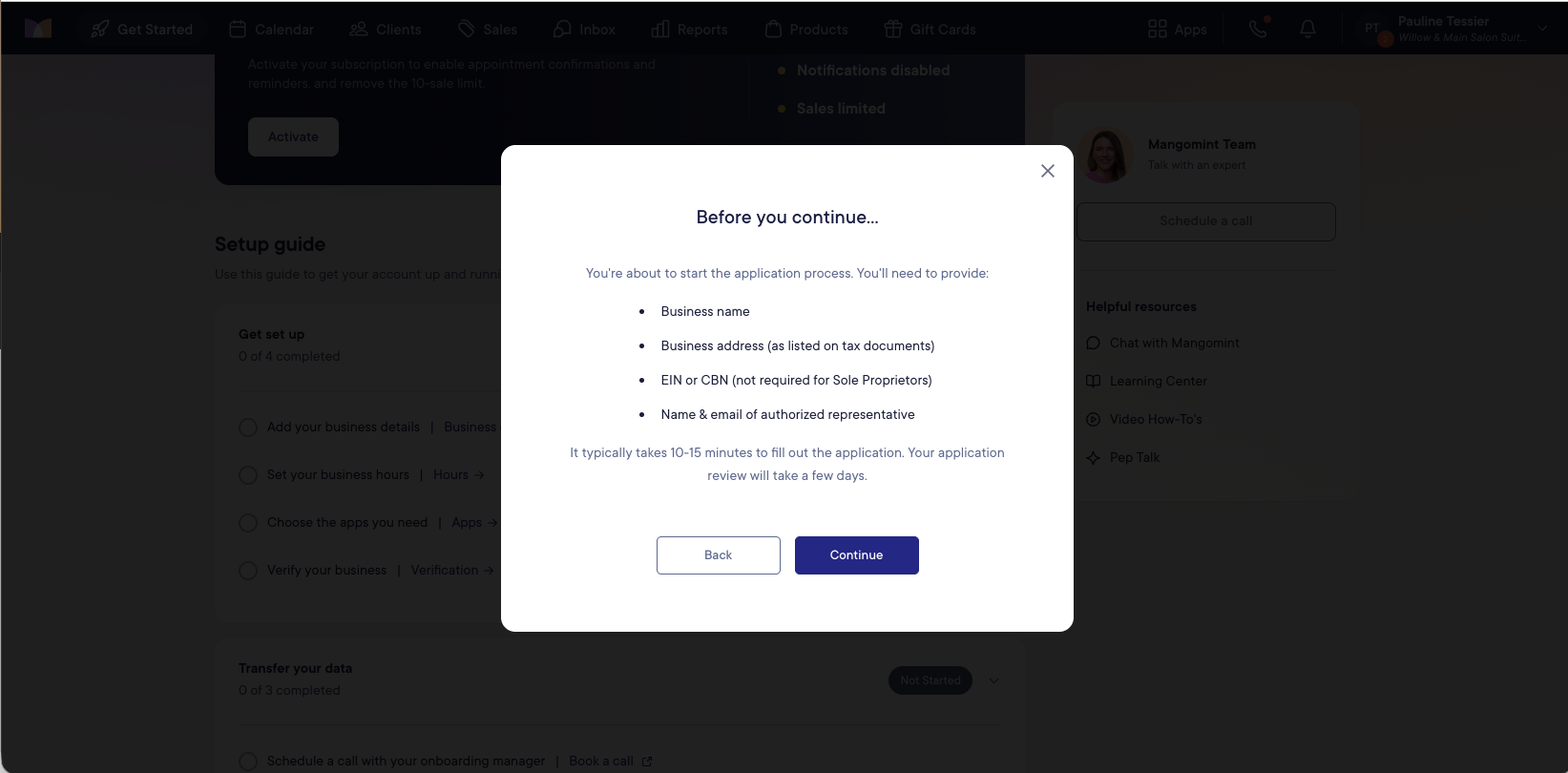
The first wall is the one every tool in this series has: deposits and cards on file need a payment processor, and a processor needs a merchant application. Mangomint’s is a page titled Verify your business that asks for a business address as listed on tax documents, an EIN, and an authorized representative, and says the review takes a few days. We stopped there, as we always do. What is different here is that the deposit cannot even be expressed. On the six tools before this one, you could at least fill the field in and watch it fail to collect. On Mangomint the per-service switches for Require a credit card and Require payment at the time of booking are greyed, with a dialog explaining why. The staff-level default for requiring a card is switched on and does nothing.
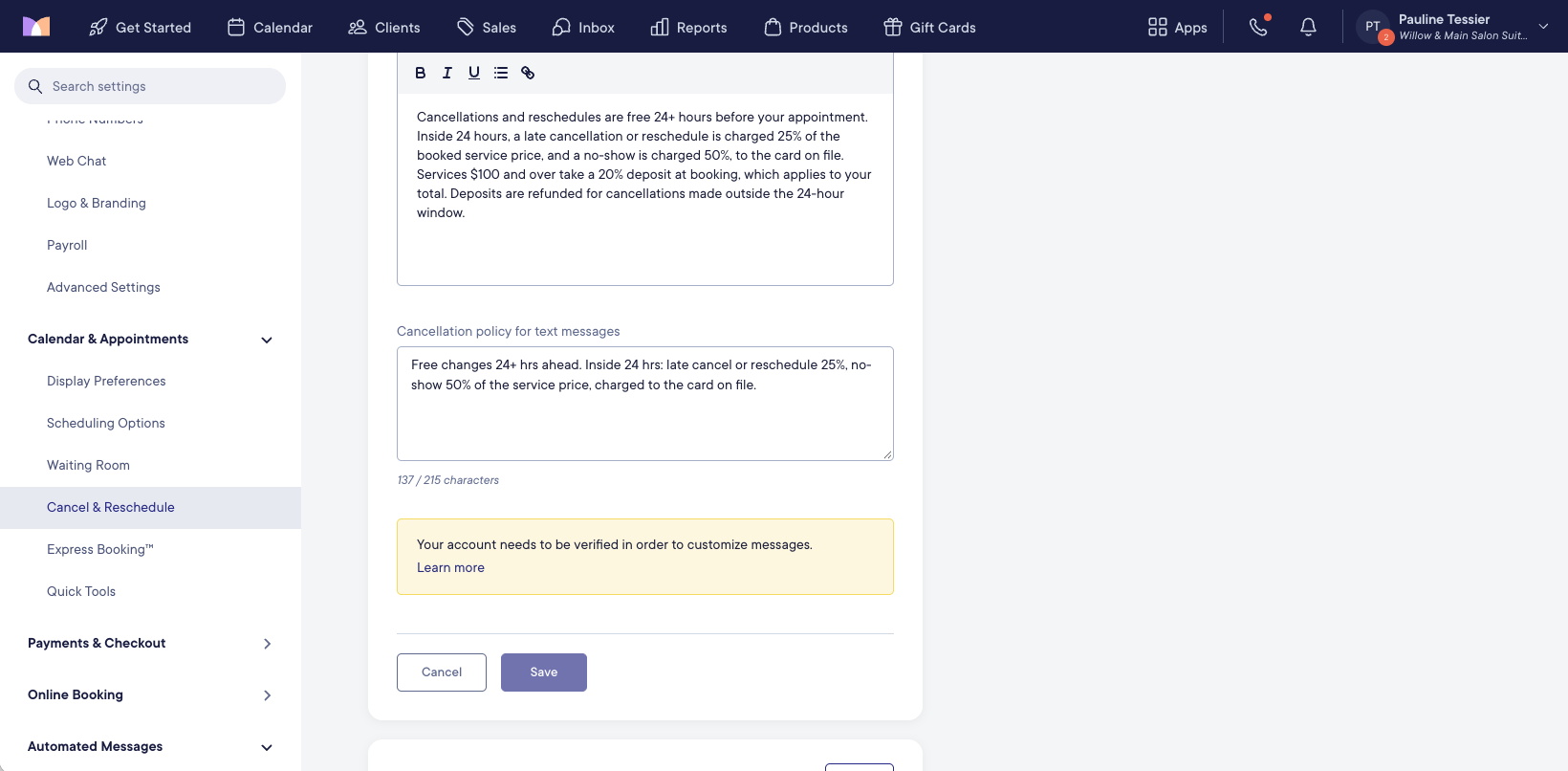
The second wall is one we had not seen before. The cancellation policy your clients read, in every email and on the booking page’s confirm step, cannot be changed on a trial. Mangomint ships a default: For appointments canceled or rescheduled within 24 hours we charge 50% of the service total. Ours says 25% for a late cancel and 50% for a no-show, with the deposit applied to either. Typing it in produced a banner, your account needs to be verified in order to customize messages, and a disabled Save. The Learn more link led to a second verification, separate from the payment application: request verification and our team will be in touch shortly. Support confirmed it in writing: every trial run uses the default 50% within 24 hours text until the account has been verified. So for the four days our trial ran as a trial, every client who booked online agreed to a cancellation policy Willow & Main never wrote. The vendor lifted this for us on 3 November; a salon on a standard trial would have to apply.
The cancellation windows, as opposed to the words, were settable from the start: self-reschedule up to 24 hours before, self-cancel changed from the default only within 15 minutes of booking to 24 hours before, and the desk’s late-cancellation threshold at 24 hours. That split, in which the rules save and the text does not, is why the late-reschedule trap below reads the way it does.
Boulevard, from its documentation, handles the same two things differently. Its policy is also generated rather than written: the cancellation policy verbiage in the notification text itself cannot be modified and pulls from the location’s cancellation policy settings, a window in hours and a fee as a percentage or dollar amount, with a default that permits up to 100% of the full appointment value inside 24 hours. If you want your own wording, you host your own policy on a business-owned webpage and paste its URL. And Boulevard requires a card for every online booking, on every plan, as a product rule: a valid card is required for every online appointment, validated and not charged unless a deposit applies. Whether a salon can switch that off is not published. Deposits are configured per individual service or staff member as a percentage of the service value, which is the shape our two-tier sheet needs and only Acuity’s fields have managed before. What Boulevard’s documentation does not say is whether the fee it charges can differ between a late cancel and a no-show. It describes one fee.
Booking, from the client’s phone
Mangomint’s booking page is the lightest we have used. From the salon’s link to the confirm form took eight taps and about a minute: pick a category, a service, an optional add-on with its price and extra minutes shown, a provider or anyone, a day, a slot. The form asks for a phone number first, then a name and email. There is no account, no login, no password, no code. Alexis Nguyen’s Saturday cut was booked by 08:13, four minutes after we started, screenshots included.
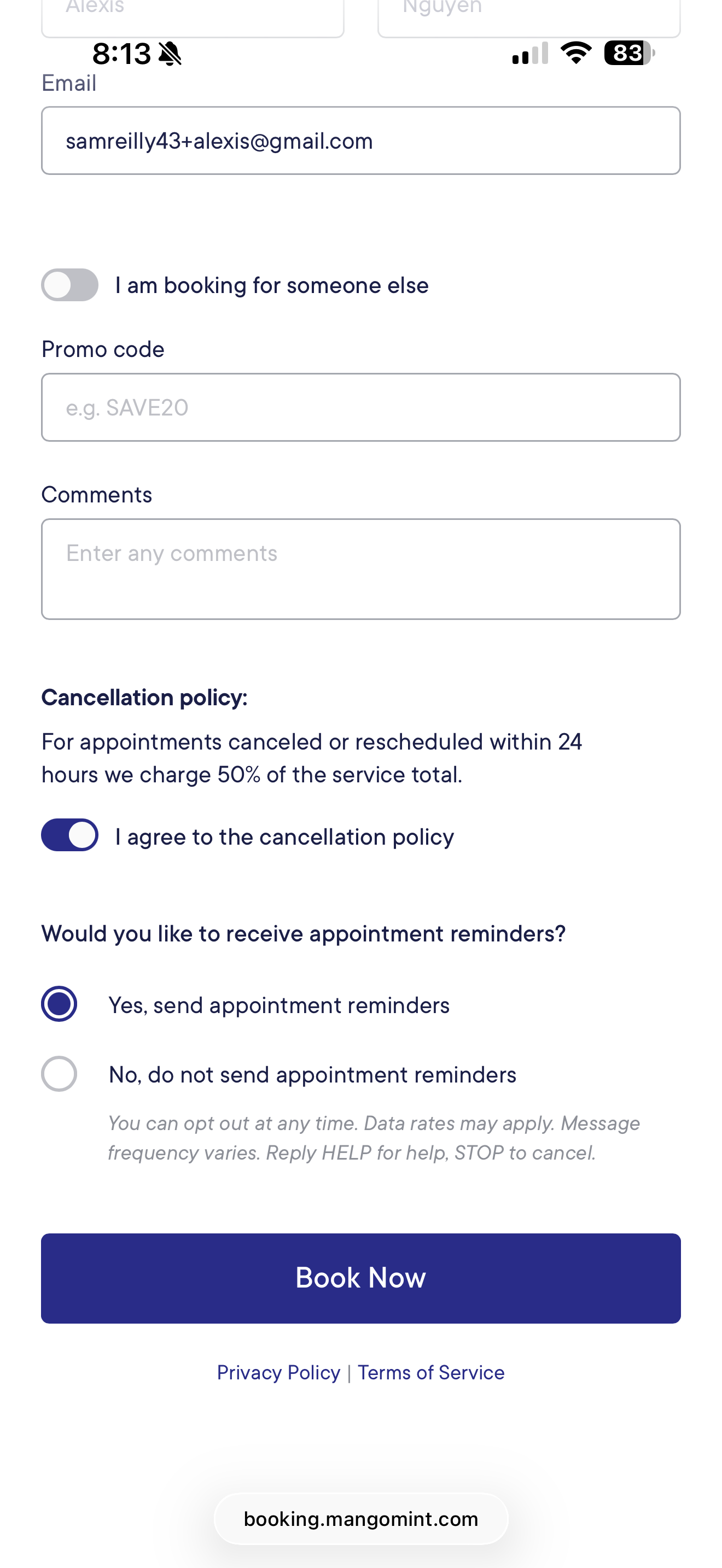
Two things on that form earn their place in the scorecard. The policy the client must agree to is the stock 50% text, for the reason above. And there is no card field and no deposit line, not for the $75 cut and not for Marcus Webb’s $220 balayage the same morning, because the trial cannot have one. A client booking a colour service on a Mangomint trial holds nothing in writing about a deposit and has given no card, while agreeing to be charged 50% if she cancels late. One hazard we logged three times: the phone field pre-filled the previous caller’s number on the same device, and had we not noticed, Marcus’s booking would have attached to Alexis’s record. A shared family phone or a front-desk tablet would do the same.
The confirmation arrived in the same minute, and it is why item 4 on our card is a one and not a two.
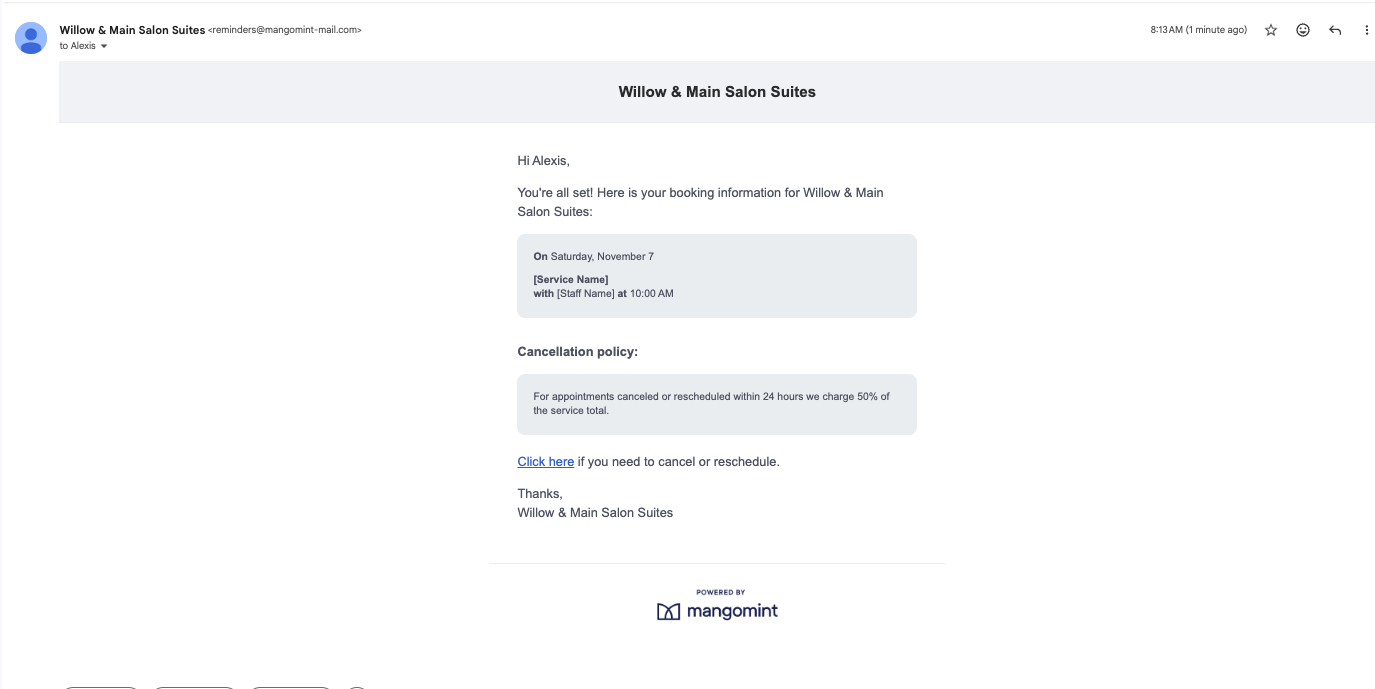
Every one of the six emails the standard trial sent to a client read [Service Name] with [Staff Name]. The dashboard had said notifications were disabled; the booking confirmation sends regardless, which is better than Acuity’s trial, which emails no client at all, and worse in a way Acuity’s was not, because a real client sees this. The emails carry no price and no deposit line. The click here if you need to cancel or reschedule link works and leads to a client portal we will come back to. After the vendor’s change on 3 November, the same template rendered the service name correctly, and the house policy, in the reschedule email we show below.
Boulevard’s client flow, from its own description, is heavier on purpose. New clients enter contact details and create an account at the end; returning clients enter an email or phone and we send a verification code. Every online appointment requires a card. The review screen shows any deposit due today in green plus the amount due after. Confirmation emails go out immediately, cannot be disabled, include the price by default, and carry a Manage Appointment button that works under your cancellation policy. Confirmation texts are opt-in and need a dedicated location phone number. None of that is a score. It is what the documentation describes, and it describes a flow that asks the client for more and tells her more.
The traps
Six traps were planted in Willow & Main’s scripted week, each written to the policy sheet, each with an expected outcome recorded before the trial began. Mangomint met all six on the vendor-modified account, 4 to 7 November. Boulevard met none, and its column below is the behaviour its support centre documents, which is a different kind of statement from a verdict.
T1 · The double booking
A walk-in booked into an occupied chair is blocked, or at least warned about.
Mangomint — Saved over the occupied slot in 37 seconds with no warning, badge or dialog. No overlap setting exists anywhere in Scheduling Options.
T2 · The no-show
A $220 no-show against a 50% policy, $44 deposit held: the tool computes $66 and attempts the card.
Mangomint — No Show is a cancellation subtype with no fee maths; the desk builds the fee by hand. But the $66 can be posted as a negative balance on the client’s ledger, the first tool of seven that can.
T3 · The cancelled deposit
Cancel outside the window: a $28 deposit visibly refunds or converts to credit.
Mangomint — Cancel dialog silent on the deposit; the $28 stays on an open sale. Recoverable in three manual steps; the client email never mentions it.
T4 · Discount plus gift card
$90 less 15% is $76.50; less a $50 gift card is $26.50 due; the card reads $0.
Mangomint — The code the client typed online applied itself at checkout, before the gift card, to the cent. Receipt itemised; card balance $0.
T5 · The late reschedule
A client moves a 9 AM appointment the evening before: enforceable as a 25% late cancel, or flagged for the desk.
Mangomint — Client portal walls both reschedule and cancel with a bare contact-us modal. The desk then moves it free, notify toggle off by default, no flag; the email recites the policy the product ignored.
T6 · The duplicate client
Two records for one client, same phone formatted two ways, are detected or findable, and merge without losing history.
Mangomint — Never flagged, but findable: search shows both with identical normalised phones. Merge keeps the appointment, timeline and archived record; the single email field drops the losing address silently.
The double booking. On the Saturday, a walk-in named Rob Feldman wants a men’s cut at 10:30 with Maya, whose 10:00 to 11:00 is taken by Alexis’s online booking. On GlossGenius this raised a named Double Book? warning; on Acuity, a conflict dialog that demanded a yes. On Mangomint the desk typed 10:30, picked Maya, and saved. Thirty-seven seconds including creating Rob as a client. Nothing happened.
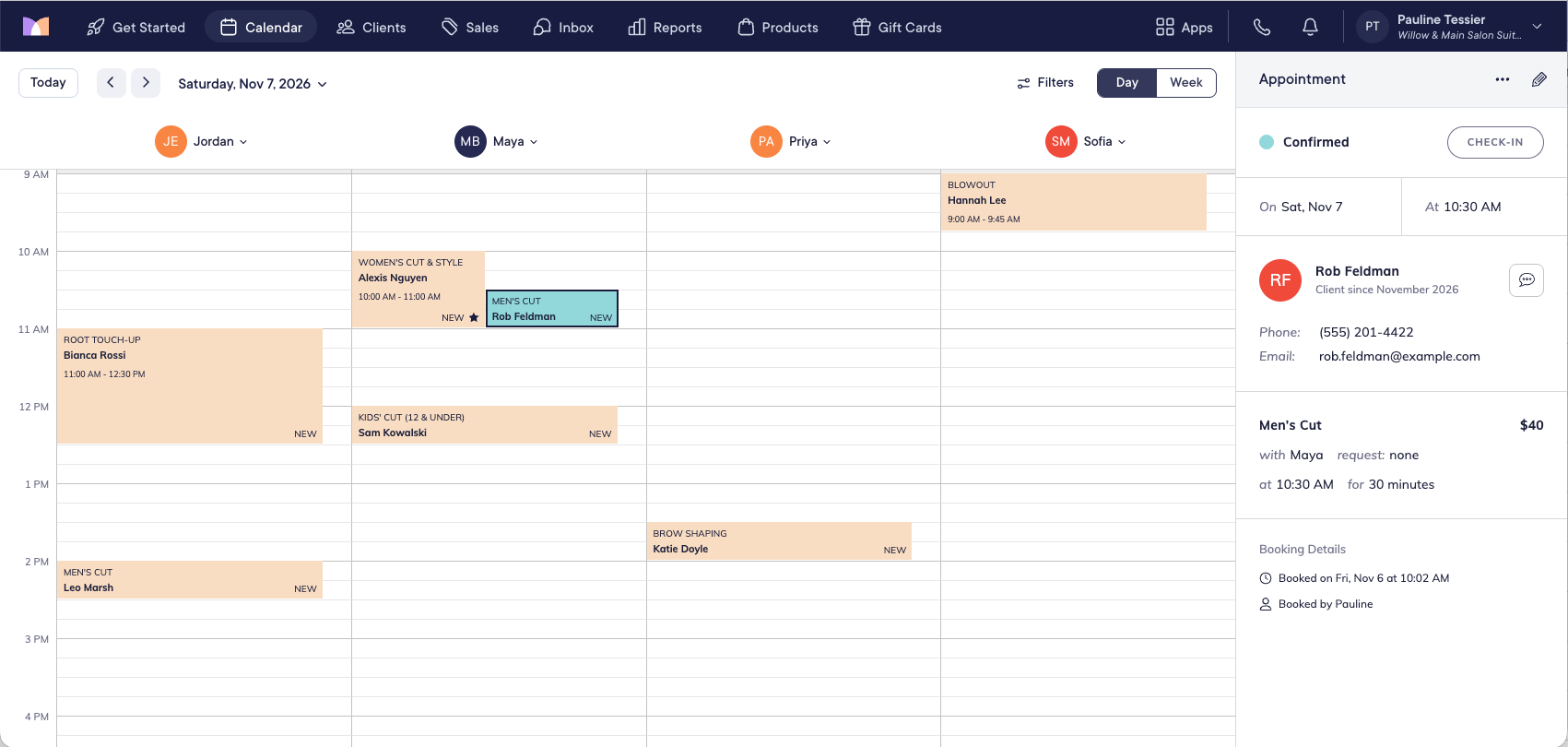
We went looking for the setting. Scheduling Options has increments, buffers, processing time and group appointments. It has no overlap control. Overlap is by design in Mangomint, so that a colourist can take a second client while the first processes, and the design applies equally to a men’s cut in the middle of a women’s cut. The only tool that failed this trap the same way is Vagaro. Boulevard’s documentation describes a Double Booking toggle per service that governs only processing time, defaults to permitting it, and a Schedule Detail Report for spotting overlaps after the fact because they aren’t flagged automatically. On paper, the same philosophy.
The no-show. Marcus Webb’s Thursday balayage: $220, a $44 deposit recorded in cash at the desk because the trial cannot take one online, and a policy that says a no-show is charged 50%, deposit applied. The expected outcome is $66 attempted against a card on file. There is no card on file, so the test is whether the tool knows what $66 is.
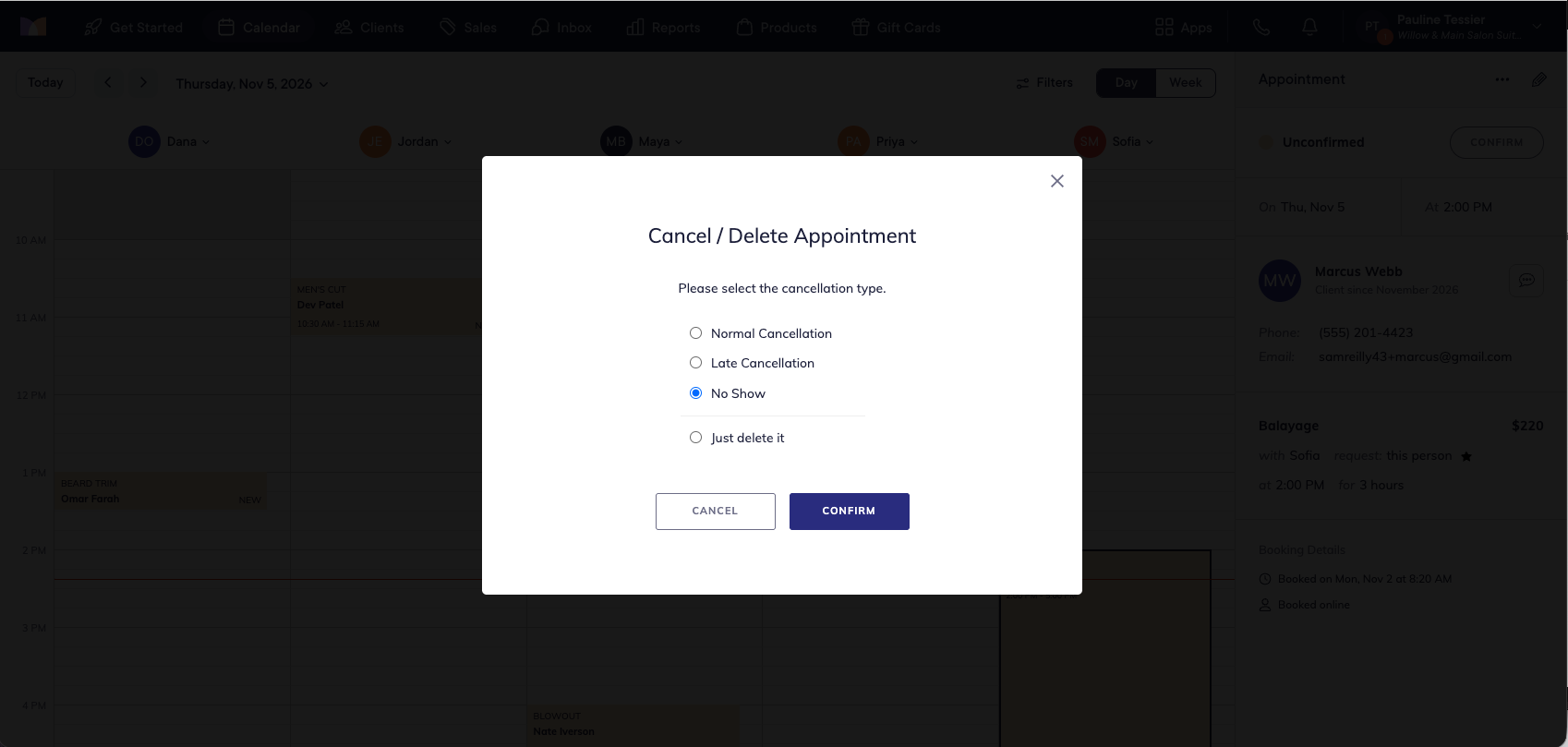
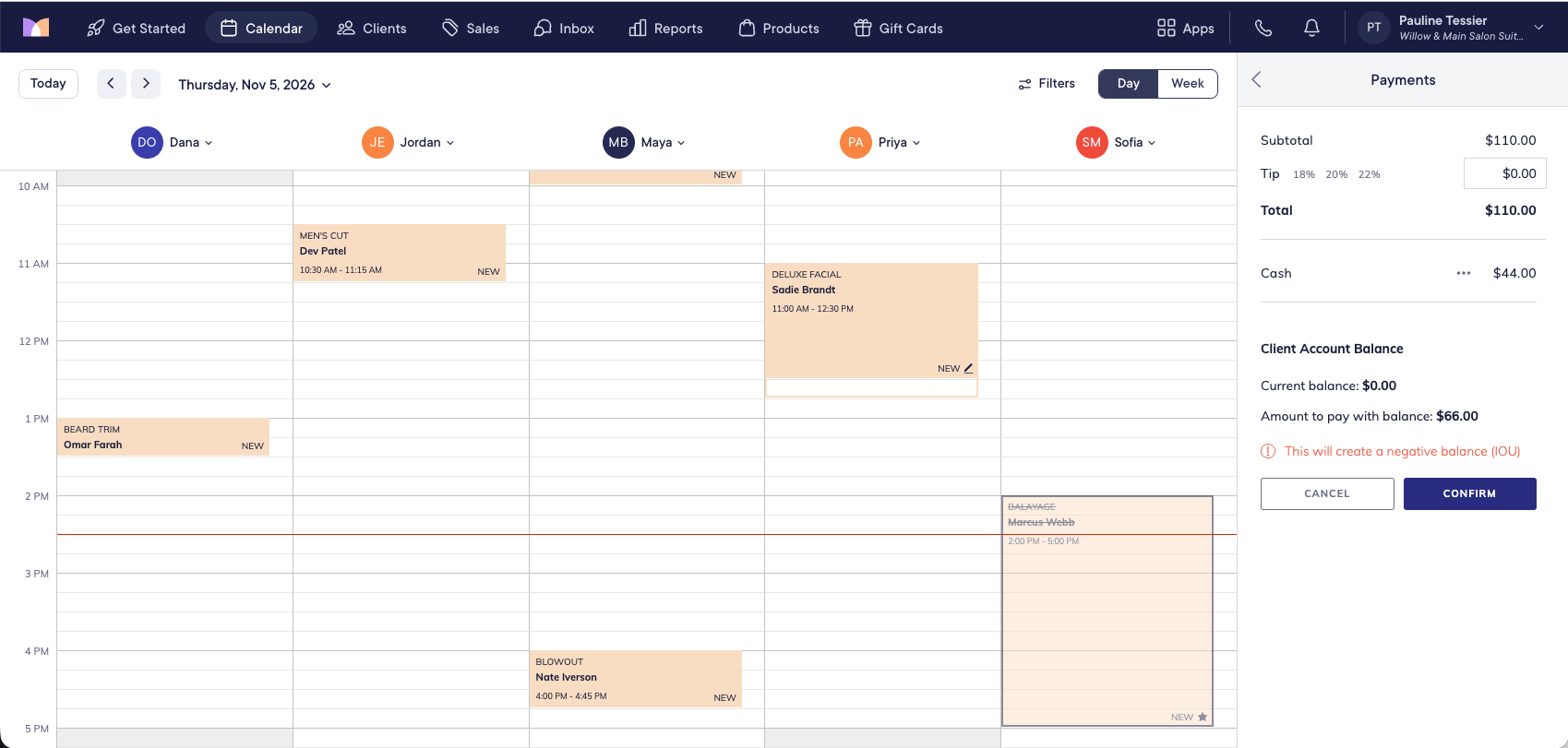
Mangomint does not compute the fee. No Show is a radio button in the cancel dialog, and confirming it struck the block through and opened a sale asking for the full $176 remaining, as if Marcus had come. The fee is built the way Mangomint’s help centre says to build it: a service called Cancellation Fee priced at $0, added to the sale, the price typed over to $110. The $44 deposit netted it to $66. Then the thing no other tool has offered: a tender called Account Balance, which with a warning, this will create a negative balance (IOU), closed the sale and posted $66 against Marcus.
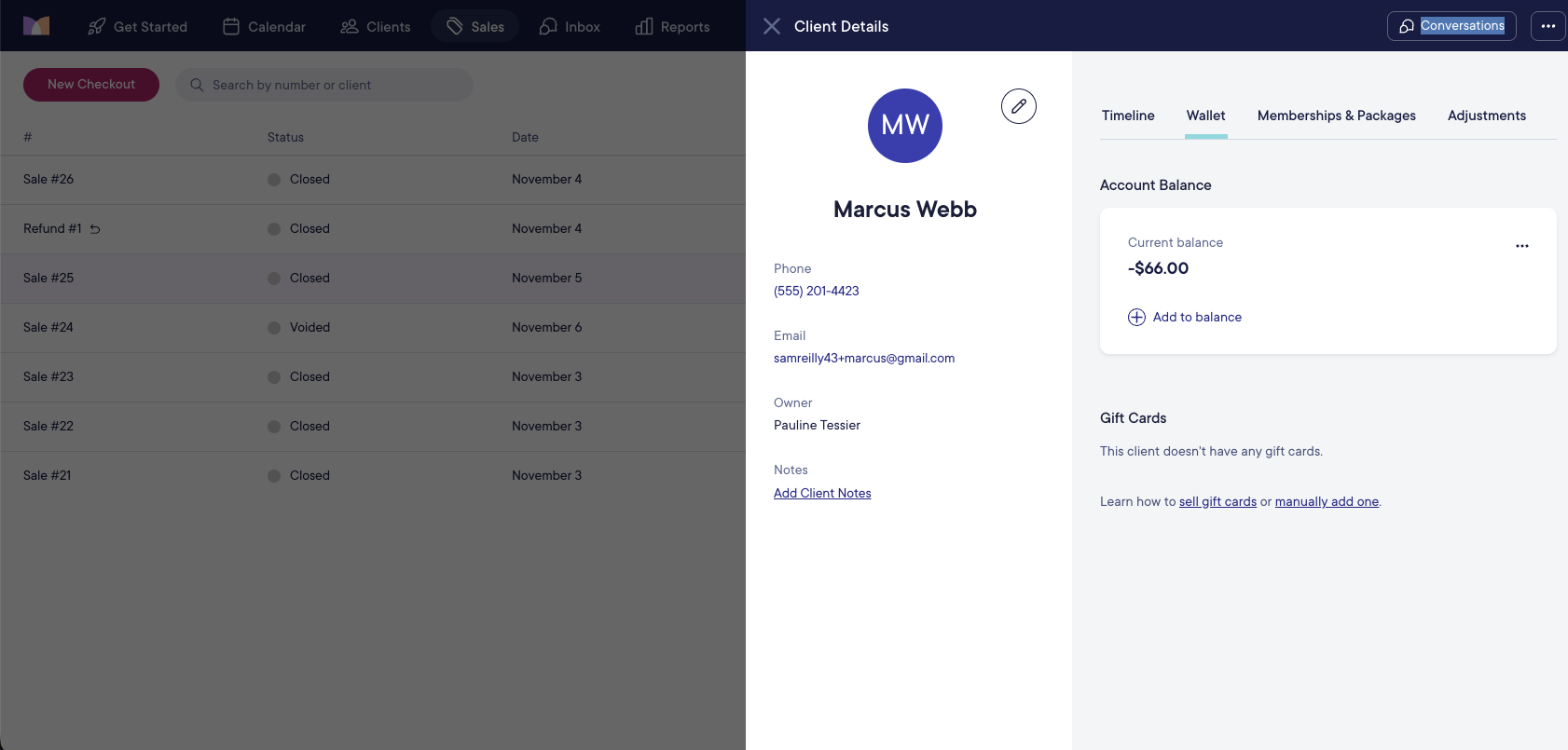
That is a one on our card, not a two, and the distinction is exact. The policy was not computed, it was typed. No client email went out at any step, so Marcus has nothing in writing about owing $66. The $110 landed in Sofia’s service sales on the staff report, which means a fee built as a service would feed her commission unless the salon notices. But the debt exists, the desk can see it on his next visit, and the report can total it. After seven tools, that is the furthest any of them has carried a no-show without a card.
Boulevard’s documentation on the same event, from its Canceling Appointments article dated 22 August 2025: five cancellation reasons, of which only Client late canceled and Client did not show up allow a fee; the fee is charged at checkout after the desk ticks a box, and a client is never charged a cancellation fee unless you specifically choose to charge them. The fee is the location’s configured percentage or amount, capped at the appointment price. Whether a held deposit is netted against it is not published. The commission behaviour is: by default, the assigned professional earns their regular commission percentage on the fee, and the article’s suggested workaround is a Cancellation Charge product sold with no seller. If a fee is charged the client gets a cancellation confirmation email and a separate receipt email. On paper that is a card-backed version of the manual flow Mangomint has; whether it is a one or a two on our card is exactly what a trial would tell us.
The cancelled deposit. Elena Petrov’s Friday colour, $140, $28 deposit, cancelled Wednesday with two days’ notice. Policy says the deposit is refunded. On Mangomint the deposit had been taken at the desk, in cash, through checkout, which leaves a sale open with a partial payment until the service is done. Cancelling the appointment did not touch the sale.
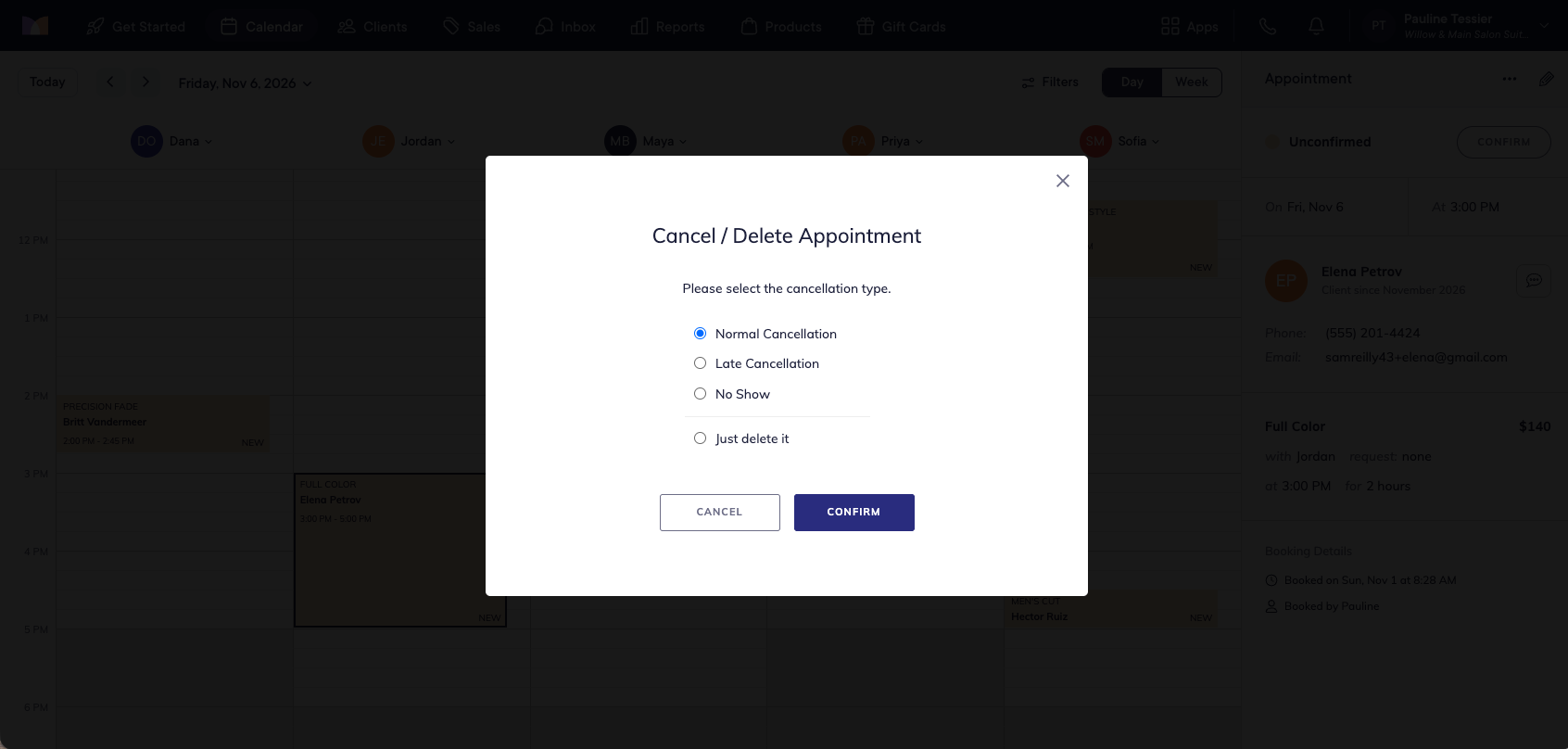
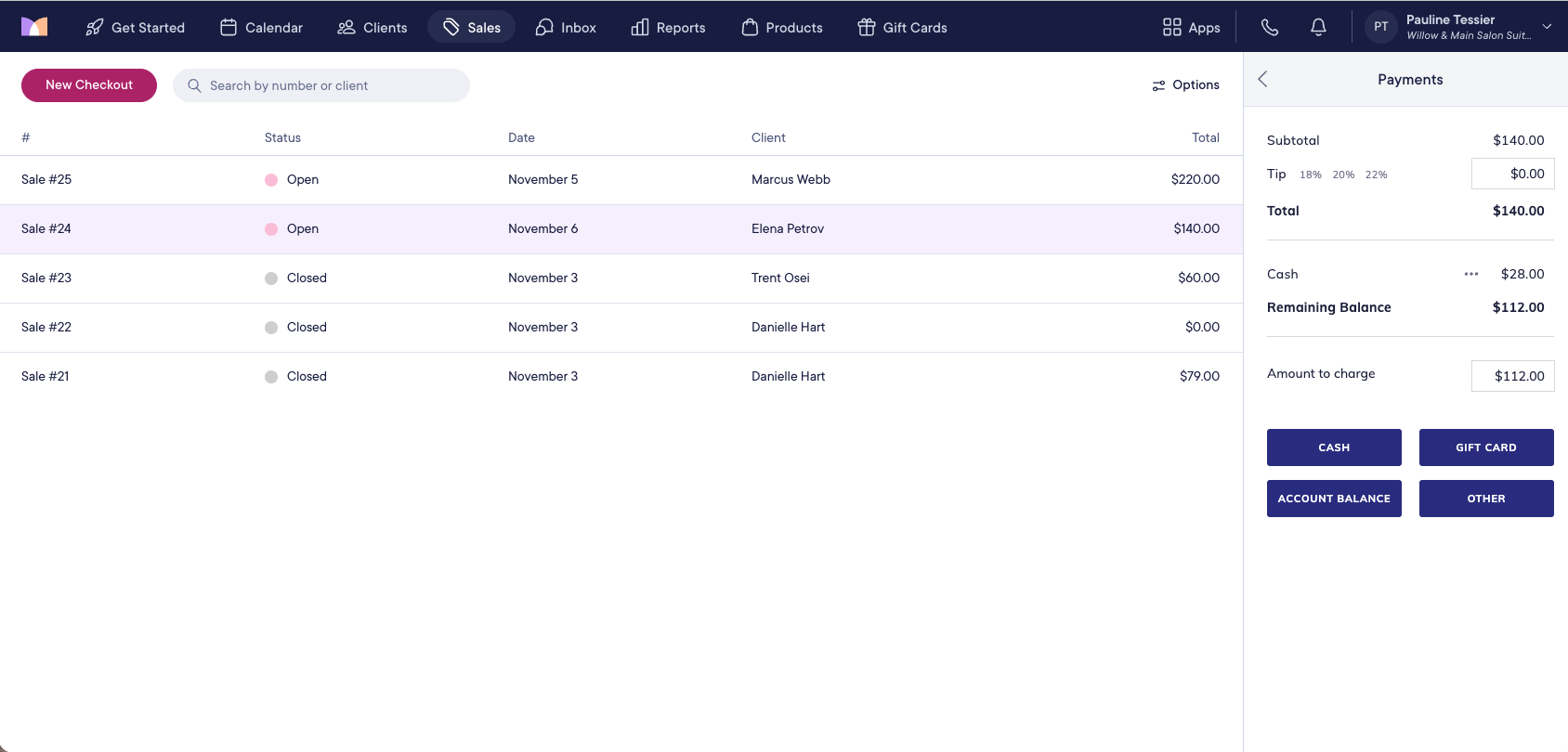
The $28 is recoverable: open the sale, refund the cash line, then void the sale. Three steps the desk has to know to take, with no prompt. The cancellation email to Elena rendered our policy, including any deposit is refunded, and said nothing about her deposit. The refund then appeared in the Refund Details report and not in the Refund Summary, so an owner reading the summary at week’s end would see no refunds. Vagaro is still the only tool to interrupt a cancel with a pre-filled refund. Boulevard’s documentation is plain on the point: the deposit is not refunded automatically, the business must manually process the refund, and a rescheduled appointment keeps the deposit as account credit. Documented, that is the same one Mangomint earned.
The discount and the gift card. This is Mangomint’s clean win. Tessa Okada typed NEWGUEST15 into the promo field when she booked her facial online. The desk could not see it anywhere, not on the appointment, not on her record, not on the offer’s own page. We flagged that as a risk. At checkout it applied itself.
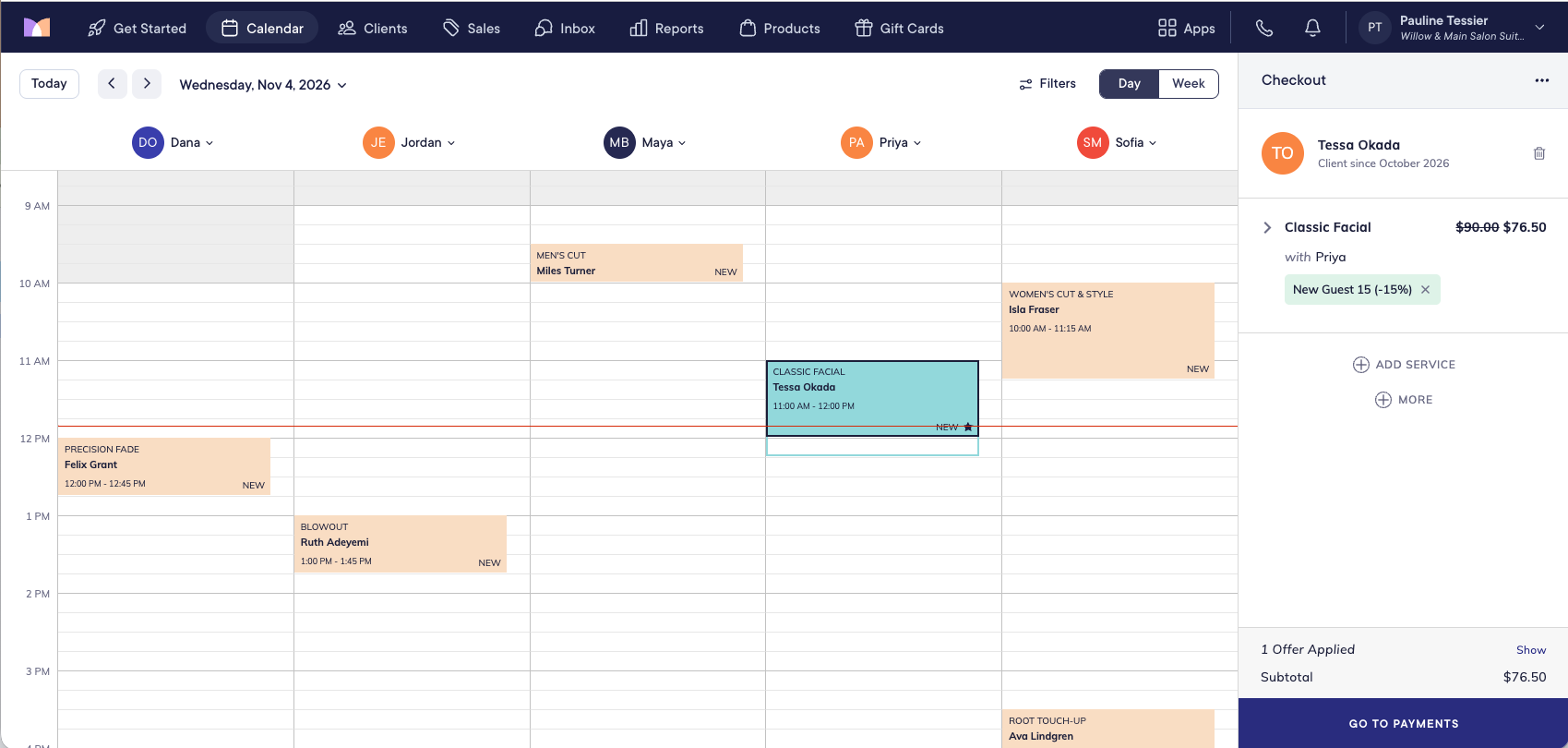
Right order, right figures, receipt itemised, gift card history showing the $50 draw, Offers Usage report showing the $13.50. Vagaro and Fresha got this right too. SimplyBook.me’s till and invoice disagreed with each other. Boulevard’s documentation says gift cards can’t be used in the overlay online and describes account credit at checkout; it does not describe promo-code ordering, so we have nothing to set beside this.
The late reschedule. Bianca Rossi has a 9 AM root touch-up on Friday. On Thursday afternoon she wants to move it to Saturday. Policy says a reschedule inside 24 hours is a late cancellation at 25%. We ran this on the vendor-modified account, with the house policy text saved, so the email below renders it. The outcome would have been identical on the standard trial except that the email would have recited the stock 50%.
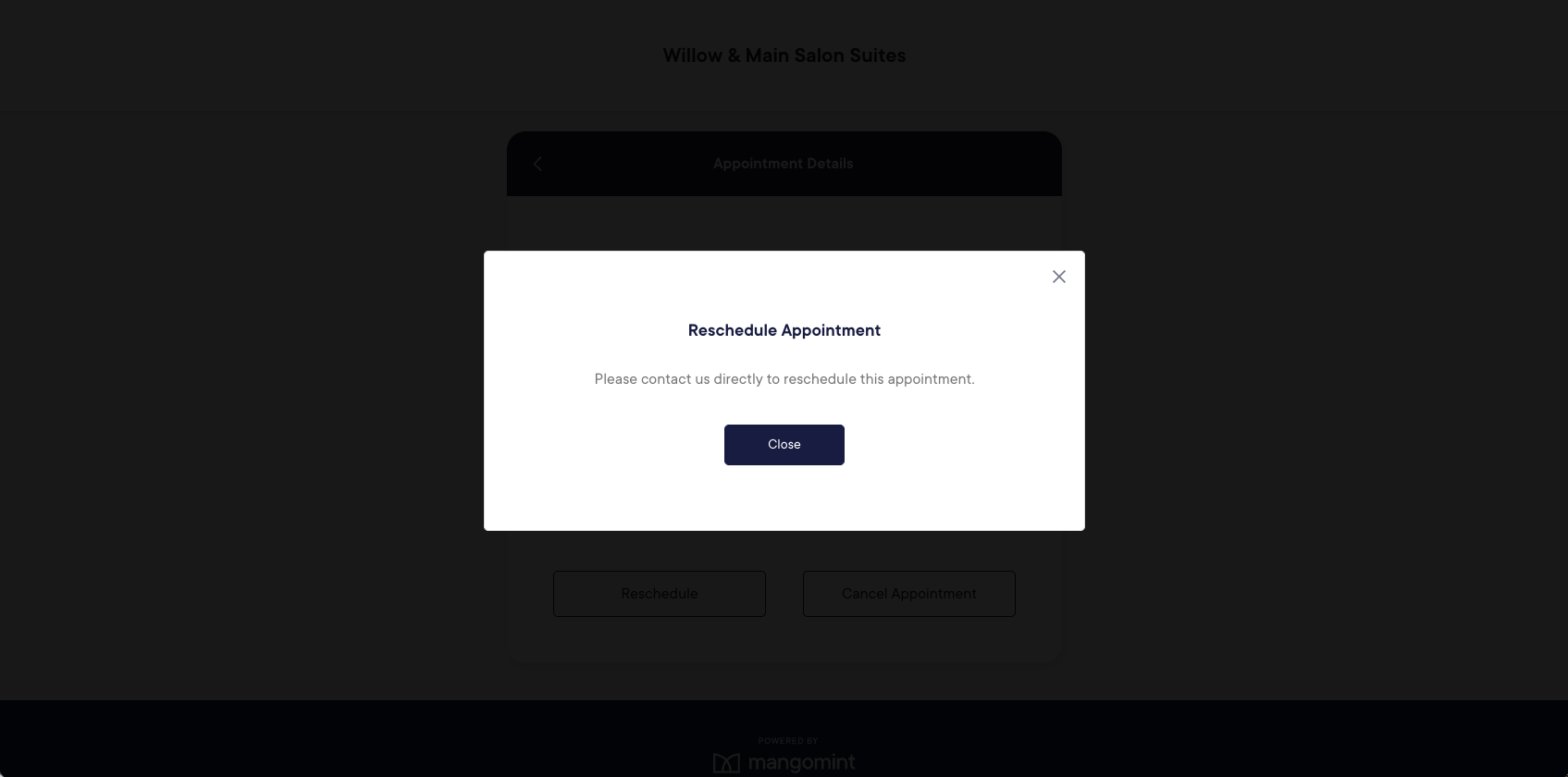
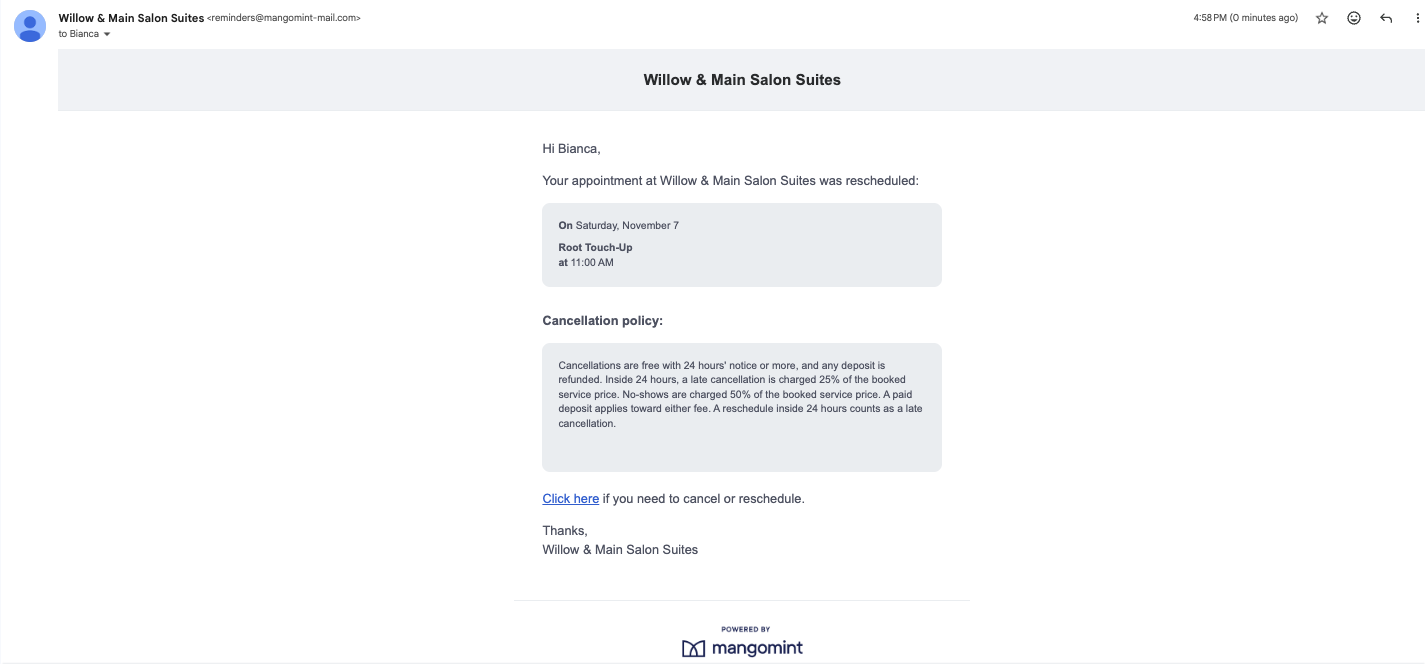
The client side is a wall, which is the shape GlossGenius, Fresha and Acuity all had: she cannot move it and cannot cancel it, and the modal tells her to contact us directly without saying why, what it would cost, or how. The windows we set are doing that. Then she calls, and the desk moves her.
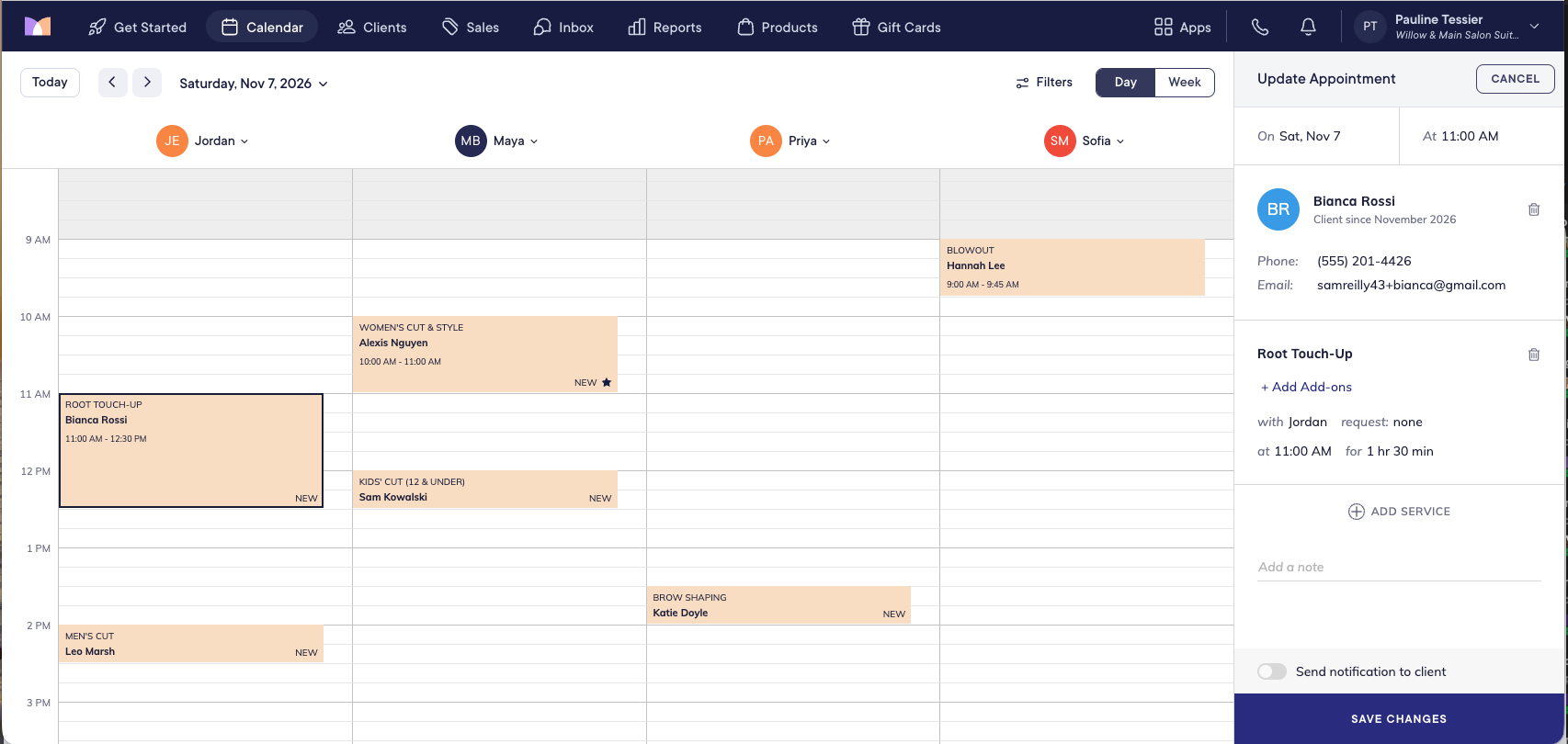
Nothing on the desk’s side knows this is late. The Late Cancellation type that exists for cancels has no counterpart for moves. The audit line says Updated. The client timeline afterwards shows only the Saturday appointment, with no record that a Friday one ever existed. The $23.75 our policy would charge appears nowhere. And the email Mangomint then sent, with the toggle we turned on, told Bianca in the salon’s own words that what had just happened to her counted as a late cancellation. The product recited the rule and did not apply it. One point, as the three tools with the same wall got, and we have noted the argument for zero in the score file.
Boulevard’s portal documentation says clients can reschedule or cancel only outside your business’ cancellation deadline, and inside it they are prompted to call and speak to staff, so you can assess whether to charge cancellation fees. That last clause is the one piece of this behaviour that no tool we have tested has written down: the desk is meant to decide, and the documented fee flow exists for it to decide with. What Boulevard’s desk sees when it moves the appointment itself is not published.
The duplicate. Katherine Doyle was created as a client in October and booked a brow shaping; Katie Doyle was created inline at the desk on the Saturday with the same phone number typed with hyphens instead of brackets. Mangomint normalised both to the same format and raised nothing. Searching doyle listed both rows with identical numbers, which a human can spot. Merge is a menu item on the record you keep.
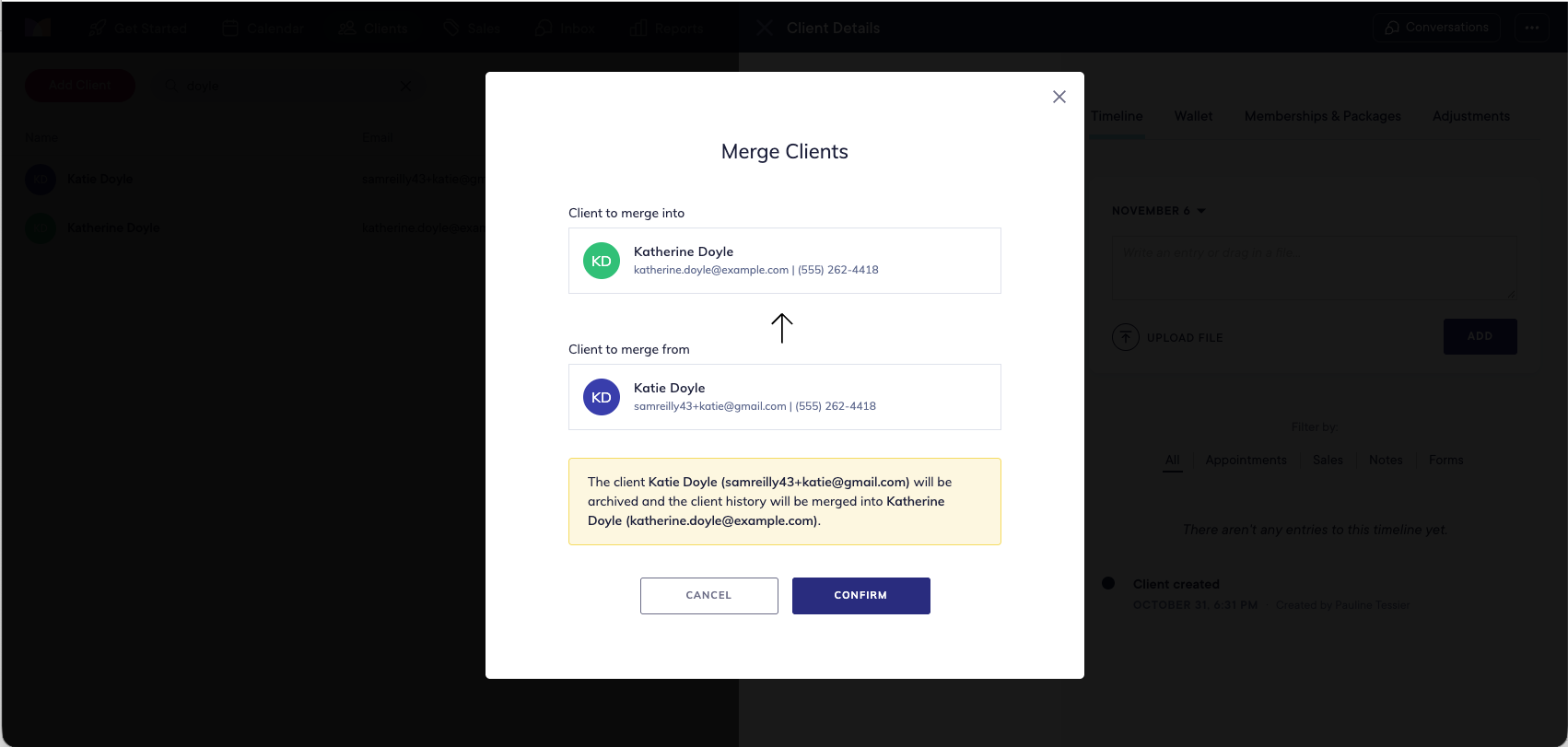
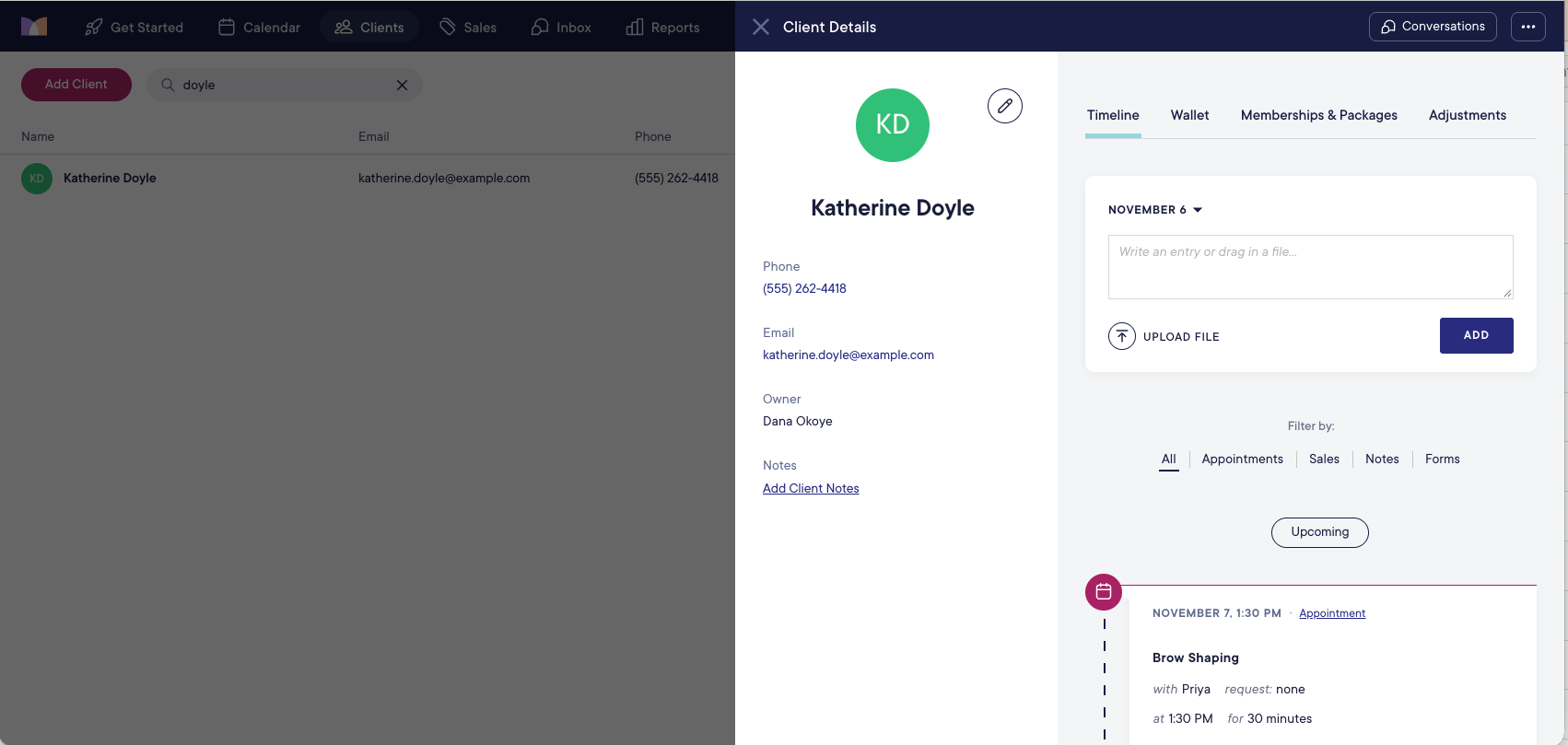
The appointment moved to the kept record and showed on the Saturday book under Katherine’s name. The archived record is invisible to search, which is tidy and also means a desk cannot find it to check. The loss is small and silent: Mangomint has one email field per client, the kept record’s address wins, and Katie’s address is gone without a word. We scored it a two, because the trap’s named test is the history, and the history survived; the argument for one is in the score file. Boulevard’s documentation describes a Merge Clients action in which staff decide which field values to keep, which would answer that exact loss, and a Client Records Report for finding duplicates by sorting. It also says merging is permanent. So does Mangomint’s.
The desk
This is the section that puts Mangomint top of the ranking, and it is the one Boulevard’s documentation has the least to say about, because speed and legibility are things you measure.
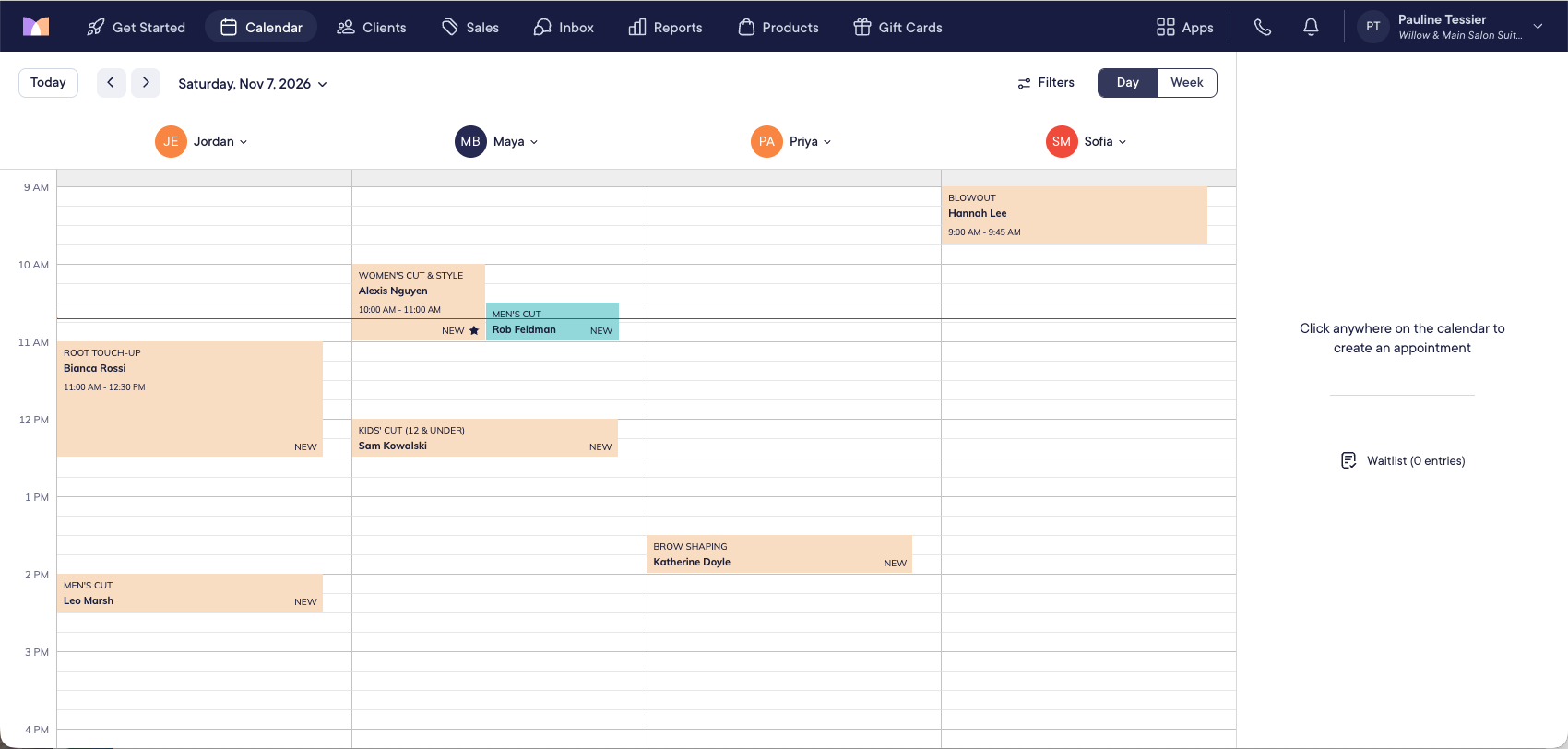
The day view is one named column per working provider, every block carrying service, client and time, with a star for a requested provider, a pencil for an unfinished intake form, and the cleanup buffer after a facial drawn as a hollow outline. The week view is one provider at a time, which is a real gap for a five-chair desk. Walk-in entry for a new client, created inline in the same panel, took fifteen seconds; only Fresha has been faster at ten. Rob’s double booking took thirty-seven with a full client record.
Setup fidelity is the first two we have given since Vagaro and Acuity, and the first to cover every line of the sheet. Add-ons are option groups with their own duration and price, reusable across services and offered to the client with both shown. Turnover is native, as processing time and as separate before and after buffers. The intake form is scoped in one place to the two facials, asked once per client, with sixteen field types including signature and upload, and it reached Tessa on the booking success page and in her email independently of the disabled reminders. Her answers landed on the appointment card as a completed tile and on her timeline, timestamped, with the submitting IP. The caveats are a fifteen-minute duration grid that rounds a twenty-minute brow shaping to thirty, work hours that do not inherit business hours, and a Saturday shift two hours past closing that saved without comment.
The booth renter is where Mangomint separates from the field. Dana’s login is six toggles from the default: she cannot see or change other providers’ appointments, can run her own checkout and see her own sales, and nothing else. Then a setting in Advanced Settings called Enable client ownership, which the product describes as being for booth renter business structures, assigns clients to a provider and hides other providers’ clients from her. And under Payments & Checkout there is this.
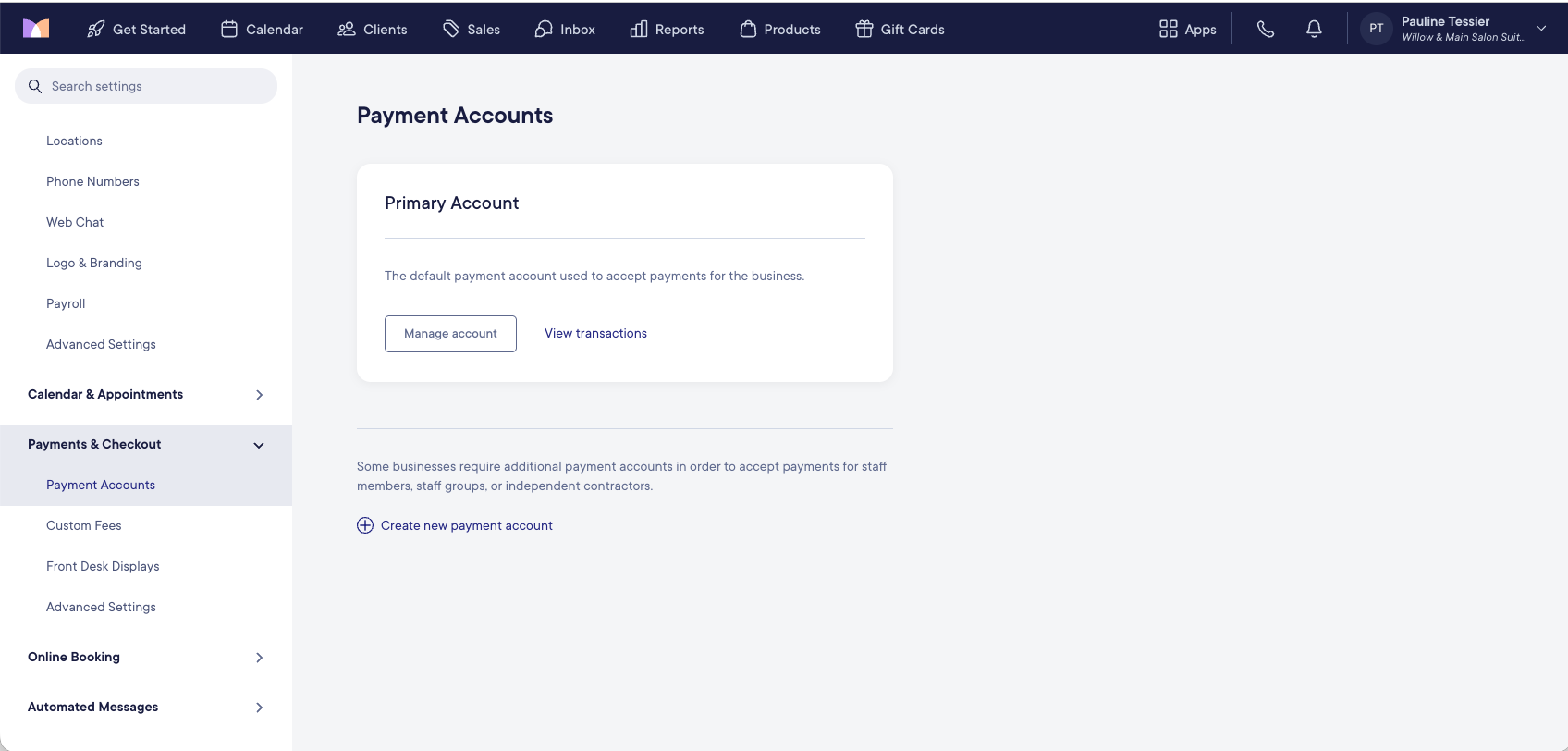
A renter who runs her own checkout can, on paper, have her own payout. We did not create one, because it is a merchant application. Boulevard documents multi-merchant accounts too, and a permissions system whose Service Provider default and granular toggles can restrict a staff member to only their own appointments on the Calendar; whether the client list can be scoped the same way is not clear from the article, dated 6 October 2026.
The membership closed its loop. The Blowout Club, two blowouts a month for $79, built with no wall and sold to Danielle Hart at the desk on manual terms, since automatic card billing needs the processor. At her checkout the product prompted to apply the membership and priced the blowout at $39.50 with a matching negative line, counter from two to one, next billing date set. Rollover is a field, services expire: never, which we set and could not watch across a month. And the staff report is honest about what a member visit is worth.
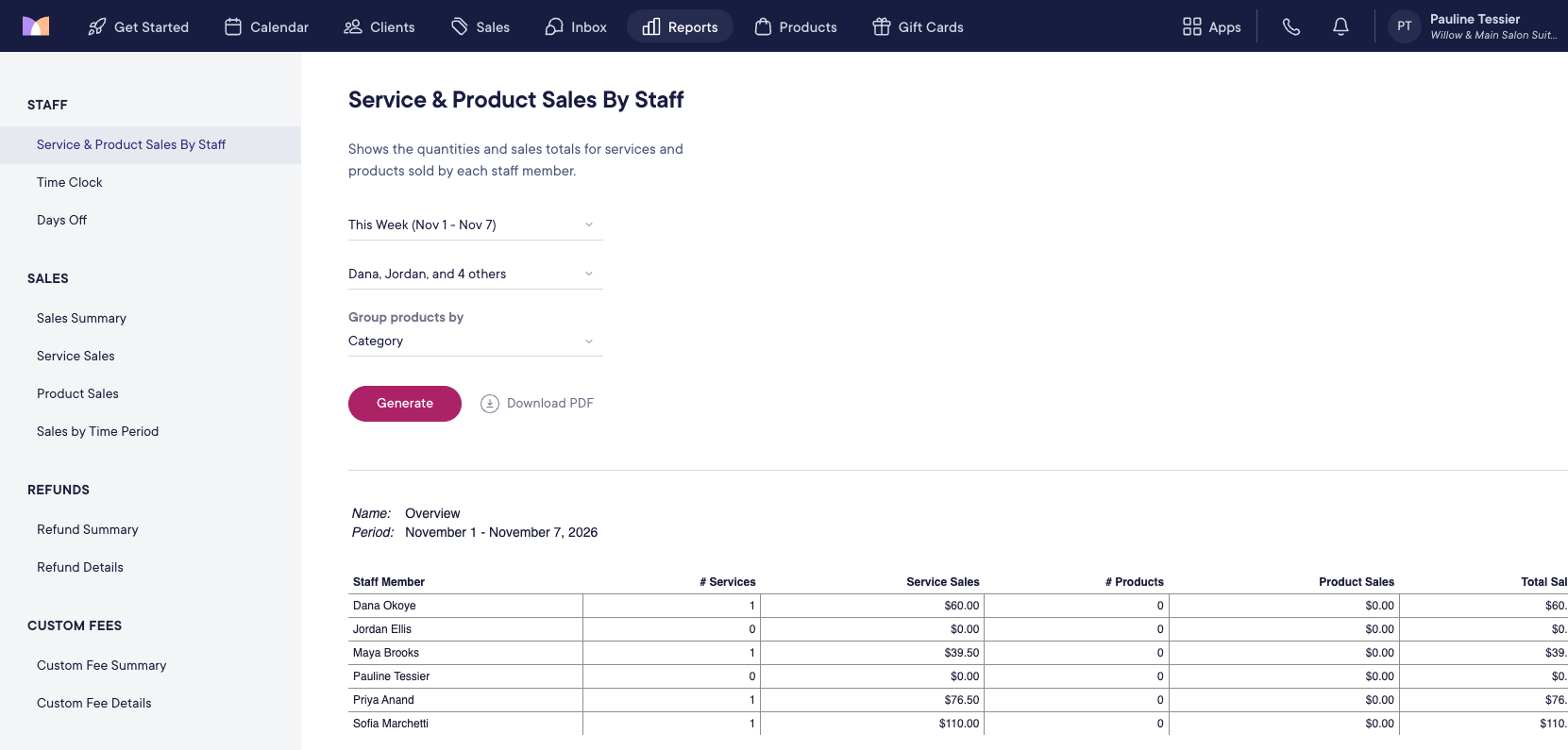
Three things on that report are article-worthy for a commission salon. A member visit credits the stylist at the membership-derived value. A client’s discount comes out of the stylist’s number. And a no-show fee built as a service is the provider’s revenue. The plan editor can express the sheet’s 10% off add-ons for members, as a percentage on additional services; we left it at zero, which is our gap, not the product’s. Boulevard’s membership documentation describes perks as vouchers and account credit added each billing cycle, renewal from two weeks to annual, a minimum commitment and notice period per plan, and client-side cancellation in the portal if enabled. It does not describe rollover.
Reminders, and who gets told
No reminder was sent to any client during this trial. Not on the standard trial, where the dashboard said so, and not on the vendor-modified account, where the vendor said so in writing on 4 November: reminders, the please confirm request, and marketing sends all lift on the first successful subscription payment. The default schedule, left as delivered, is the richest we have seen on paper: an email two days before asking the client to confirm, a text the day before, and an email plus a text on the day. Appointments booked more than two days out sit Unconfirmed in peach until the client answers a request that never goes, so on a trial, Wednesday to Saturday stay peach all week unless the desk presses Confirm on each one. Booking confirmations send, with the tags above. Cancellation and reschedule emails send. A one-click Resend Notifications exists on every appointment and sends the update template. Texts are included in the subscription price, which is the only tool in this series to say so, and we could not receive one.
We scored this a one, the way we scored Square’s trial, whose reminders were frozen by an account review: on what was sent, as it was sent, with the limitation stated. The argument for zero is that every email a real client received from this trial had broken fields in it. The argument for two is the schedule. Neither is what happened.
Boulevard’s confirmation documentation, dated 28 July 2026, describes an immediate email that cannot be disabled, with price by default and a manage button; opt-in confirmation texts from a dedicated number, with the policy as an optional 153 characters; and a same-day reminder toggle. The default text wording cannot be modified. Texts beyond the plan’s allowance are billed by segment at rates not published on the pricing page.
Leaving
Mangomint’s terms say a customer may cancel or delete the account at any time, and the pricing page says if you decide to leave, you can take all of your data with you. The client list exported in one click to a CSV with twenty-six columns, no login wall and no plan gate, which is better than SimplyBook.me’s trial managed. Sales, payments, gift cards and cancellations exported to Excel. The payments export carries a Processing Cost column per transaction, so on a live account the true cost of taking cards is auditable to the cent. The export also showed us something the screen hid: after we deleted the $220 balayage line from Marcus’s no-show sale to build the fee, the $44 deposit row was relabelled Cancellation Fee, and nothing in the data now says it was taken against a colour service.
We have not yet deleted the account. We will, after this review is published, and report here how long it took, what the product said about retention, and whether the public booking link dies. Of the six tools before this one, Fresha is the only one that let us leave completely.
Boulevard’s exit terms are not on its pricing page. Its FAQ on switching in says only that depending on your previous solution, only certain data types may be available. The contract length behind its normally prices, and what it takes to leave, are not published, and we did not have an account to ask from.
The full scorecards
Scores are 0 to 2 per item: fails, works with friction, works well. Mangomint’s column is tested. Boulevard’s column is what its documentation says about the same item, with not published where it says nothing, and it is not a score. The full item-by-item evidence behind Mangomint’s numbers, every screenshot, timing and settings screen, lives in our published score file, and the dataset is downloadable.
| Mangomint (tested) | Boulevard (documented, unscored) | |
|---|---|---|
| Mobile booking flow | 2 — 8 taps, ~1 min to the form; no account; sticky phone field | Account created at the end; verification code for returning clients; card required for every booking |
| Booking page truth | 1 — prices, durations, add-ons accurate; stock 50% policy the client must accept | Prices shown; policy generated from window and fee settings; own wording only via a hosted URL |
| Card + deposit at booking | 0 — nothing collected, and the switches are greyed without a processor | Card required on every online booking; deposit a percentage per service or staff member |
| Confirmations + reminders | 1 — same-minute confirmations with raw merge tags; no reminder ever sent | Immediate email, cannot be disabled, price by default; texts opt-in from a dedicated number |
| TOTAL | 4 | — |
| Mangomint (tested) | Boulevard (documented, unscored) | |
|---|---|---|
| T1 double booking | 0 — silent, 37 s; no overlap setting exists | Per-service Double Booking toggle governs processing time only; overlaps not flagged automatically |
| T2 no-show fee | 1 — hand-built fee; $66 posted as a negative balance on the ledger | Fee charged at checkout only if the desk ticks the box; location-wide % or $, capped at the price; commission applies by default |
| T3 canceled deposit | 1 — stranded on the open sale; three manual steps; client email silent | Not refunded automatically; business must manually process the refund |
| T4 discount + gift card | 2 — code applied unprompted before the gift card, exact | Gift cards not usable in the online overlay; credit applied at checkout; ordering not published |
| T5 late reschedule | 1 — client walled without a reason; desk moves free, notify off by default | Client prompted to call inside the deadline so staff can assess whether to charge; desk behaviour not published |
| T6 duplicate merge | 2 — findable, not flagged; history kept; losing email dropped silently | Merge Clients with a choice of which field values to keep; permanent; duplicates found by report |
| TOTAL | 7 | — |
| Mangomint (tested) | Boulevard (documented, unscored) | |
|---|---|---|
| Day view + entry speed | 2 — 15 s walk-in with inline client; readable day view; week view single-provider | Not published |
| Setup fidelity | 2 — add-ons, turnover, scoped intake, six-toggle renter plus client ownership; 15-min grid | Add-on services, resources and processing time documented; Forms is a $65 add-on below Prestige |
| Membership lifecycle | 2 — sold on manual terms, redeemed at checkout 2 → 1, rollover a field | Perks as vouchers and credit per cycle; commitment and notice periods; portal cancellation optional |
| Client records | 2 — intake on the card and the timeline with IP; notes; wallet; change history | Notes, orders, appointments, stored cards and forms on the profile; portal shows forms and memberships |
| TOTAL | 8 | — |
| Mangomint (tested) | Boulevard (documented, unscored) | |
|---|---|---|
| Pricing honesty | 1 — $180 in-app matches the page; trial limits and verification gates not on the page | Three tiers with struck "normally" prices on a limited-time offer; demo only; terminal purchase required |
| Rates + fine print documented | 2 — 2.45% + 15¢ and 2.90% + 30¢ on the page; texts included | No processing rate published; Offset 3% client / 1% business; same-day payout 0.95%, instant 1.75% |
| TOTAL | 3 | — |
Boulevard or Mangomint: which should you buy?
If you run a salon with a front desk and several chairs, want the whole policy sheet expressible in one product, and are willing to pay $120 a month plus $10 a seat for it, Mangomint, with three conditions. Submit the payment application before you build anything, because until it clears you cannot set a deposit, require a card, or state your own cancellation policy, and your clients will be agreeing to Mangomint’s instead. Do not run the trial on a real week: nothing reminds anyone, checkout stops at ten, and every confirmation your clients get will have the service name missing. And know that it will double-book a chair without telling you, and move a late reschedule without charging for it, because on the evidence of seven tools that is what salon software does.
If you are weighing Boulevard, we can tell you what its own pages say and nothing more. Its documentation describes the card-on-file and deposit model our policy sheet wants, a desk that decides whether to charge a fee, and a merge that lets you choose what to keep. It does not publish the rate you will pay to take a card, the length of the contract behind its fall prices, or what happens when you leave, and it requires its own terminal. Those are the questions to take into the demo, and the only way in is the demo. We asked, twice, to test it as a publication, and we will update this review the day that changes.
Seven tools, seven trials, and the policy sheet is still unenforced. The best score on the twelve points that measure it is seven, and five tools now share it. What Mangomint added is not enforcement; it is memory. The no-show that nobody charged is at least a number on a ledger, which after six tools that forgot is the most progress we have to report.
Changes to this review
- 16 Nov 2026: First published. Mangomint trial ran 30 October to 7 November 2026; account deletion to follow and be reported here. Boulevard documented from its pricing page and support centre as read on 9 November 2026; sandbox request sent 5 October, followed up 12 October, unanswered.
Willow & Main Salon Suites is a fictional business we operate for testing. We paid nothing for the Mangomint trial, which asks for no card; Mangomint modified our trial account on 3 November 2026 so that message templates and the cancellation policy text could be edited, at our request and on the condition, which we would have met anyway, that we disclose the standard trial does not allow it. No vendor saw this review before publication. We hold no employer or vendor relationships, and every price above was read from the vendor’s own pages on the dates stated. The dataset is yours to reuse.
Filed under: mangomint · boulevard · salon software · comparison · pricing