GlossGenius vs Vagaro: we ran the same salon through both
We configured the same five-chair salon in GlossGenius and Vagaro, booked the same 34-appointment week, and planted six traps. What each tool caught, missed, and actually costs.
Some links below are affiliate links — if you subscribe through one, we earn a commission at no extra cost to you. It never changes a verdict; every tool runs the same test salon. Full disclosure
Search glossgenius vs vagaro and here is what Google hands you: the top organic result is Vagaro comparing itself to GlossGenius. The third is GlossGenius comparing itself to Vagaro. Above both sits an ad — bought by Vagaro. The rest of the page is competitor blogs, feature roundups assembled from spec sheets, and Reddit threads where practitioners compare memories. As of the day we checked, nobody ranking for this comparison shows any sign of having run both tools.
So we ran both tools.
We built a fictional salon-suite business — Willow & Main, five providers including a booth renter and an esthetician, twelve services, a membership, forty clients — and configured it identically in GlossGenius and Vagaro, down to the same cancellation policy and the same intake form. Then we booked the same 34-appointment week into each, from both sides of the desk: a second identity booked online, rescheduled, no-showed, and paid everything short of a live card charge. Six of those appointments were traps, planted in the dataset before either trial started, each with its expected outcome written down in advance. The full dataset and policy sheet are downloadable — you can check our work.
The final score was 20 to 19 out of 32, and that one-point margin is the least useful fact we collected. The useful one: each tool is excellent at the half of the job the other ignores, and neither can enforce the policy both of them cheerfully email to your clients.
The verdict, up front
Buy Vagaro if your business lives at the front desk. It went eight for eight on desk operations — the only perfect section either tool posted — and it got every money-math trap exactly right: the deposit refund, the discount-then-gift-card stack, the no-show fee it recorded as a debt it couldn’t charge. The catch is that you cannot work out what Vagaro will cost you from anything Vagaro publishes, and your clients pay a toll in friction that GlossGenius clients never see.
Buy GlossGenius if you need to know what you’ll pay and want your clients’ path to be effortless. It scored a perfect four on true cost — one flat subscription that genuinely covered our five providers, one flat processing rate, published where a buyer can find them — and its client-facing side is the cleanest we tested. The cost is a desk that works two clicks deeper everywhere, and five core tasks that cannot be done on the web dashboard at all.
Do not buy either one expecting it to run your no-show policy for you. That’s the headline finding of the six traps, and it gets its own section below.
Client-side booking
out of 8
Policy enforcement — the six traps
out of 12
Front-desk operations
out of 8
True cost
out of 4
TOTAL
out of 32
How we tested (and what we couldn’t)
Willow & Main Salon Suites does not exist. That’s the point: because it’s fictional, we could configure it identically in both tools — same five providers, same service menu with add-ons, same deposit and cancellation policy, same planted landmines — and nobody’s real business was at stake when we no-showed a $220 balayage on purpose. Both trials ran through the tools’ own signup flows in August 2026, GlossGenius on its (forced) Gold tier, Vagaro on its six-calendar plan, and every claim in this review traces to a screenshot taken during those trials or to a vendor page read on a stated date. The dataset, policy sheet, and appointment script are published; the traps’ expected outcomes were written down before either trial began.
One honest limitation, up front, because it shaped several verdicts: we never processed a live payment. Completing merchant onboarding means feeding a real identity and bank account into a fictional business, so we declined it in both tools — GlossGenius’s Stripe identity check and Vagaro’s merchant application both got a polite “do this later,” permanently. Everything money-shaped is therefore scored up to the payment rail: what each tool computes, claims, and records — not whether money moves. Where that boundary bit a verdict, we say so at the spot.
GlossGenius vs Vagaro pricing: what it really costs
The advertised prices first, beside what Willow & Main — five providers plus a bookable owner — would pay per month:
| GlossGenius | Vagaro | |
|---|---|---|
| Advertised entry price | $28/mo | $23.99/mo |
| Our salon, actual subscription | $56/mo (Gold) | $73.99/mo (6 calendars) |
| Modules needed for policy basics | $0 — included | +$20/mo (Shopping Cart + Forms) |
| TOTAL, before processing | $56/mo | ≈$94/mo |
| Computable from the public pricing page? | Yes | No |
GlossGenius pricing is flat, and published where you’d look for it. One Gold subscription at $56 a month ($48 billed annually) carried all five of our providers plus the owner — we verified in-app that no per-provider charge exists — and processing is a flat 2.6% with no per-transaction fee, stated on the pricing page itself. The wrinkle is the trial: it forces the Gold tier with no choice offered, so you build your setup on Gold features and only discover later that the $28 Standard tier lacks the intake forms and gift cards you’ve been using.
Vagaro’s $23.99 is real — for a single calendar. Every bookable provider occupies a calendar, the owner counts, and the plan cannot be set below your active staff count, so our salon is six calendars at $73.99. The scaling ladder between one and six calendars is published nowhere: we read it off the in-app plan picker, which you reach after handing over a card. Then the policy sheet’s basics — online deposits, intake forms — each turn out to live in a $10-a-month module. And the processing rates aren’t on the pricing page either; they’re in a support article, two-tiered on a $4,000-a-month volume threshold, where the better swipe rate arrives bundled with a $10-a-month merchant subscription and two card-network fees. None of this is hidden exactly. It’s just distributed across places a buyer comparison-shopping from the pricing page will never see.
Update, Sep 28, 2026: Vagaro’s pricing page now shows every plan price as an “exclusive rate for the first 6 months.” The $23.99 above is struck through from $30, and our six-calendar salon’s $73.99 from $80: $6.01 a month more at every step once the introductory period ends. The page also now publishes the full calendar ladder, which in August we could read only inside the app. The trial figures above are what we were quoted in August; our true-cost calculator now uses the ongoing prices.
Two details from the fine print that belong in your math. First, the rate that applies when a salon charges a stored card — a no-show fee, say — is the keyed rate: on a $110 fee, Vagaro’s 3.5% + 19¢ costs you $4.04 against GlossGenius’s flat $2.86. Vagaro is the tool that records that fee properly — and the one that charges more to collect it. Second, re-sending a client their appointment confirmation is a free menu item in GlossGenius and, per Vagaro’s own documentation, requires an Email Marketing plan, a Text Marketing plan, or Connect by Vagaro. Feature lists won’t show you either of those; a month of running a desk will.
To turn all of this into a number for your salon — your ticket size, your appointment volume, your card mix — we built a true-cost calculator that reads from the same verified data file as this article and re-ranks the tools per scenario. Across our worked examples the pattern is consistent: for a solo booth renter the two land within ten dollars a year of each other — a wash — and for everything larger GlossGenius is cheaper, with the gap widening as volume grows, because Vagaro’s higher card-on-file rate and per-transaction fees scale with every appointment while GlossGenius’s flat rate doesn’t. Our three-chair example: about $7,000 a year against $8,300.
Booking speed is a design philosophy
We timed the same walk-in entry — same service, same provider, an existing client — at the desk in both tools. Vagaro: 32 seconds. GlossGenius: 44, a figure we measured twice on different days and got identical both times.
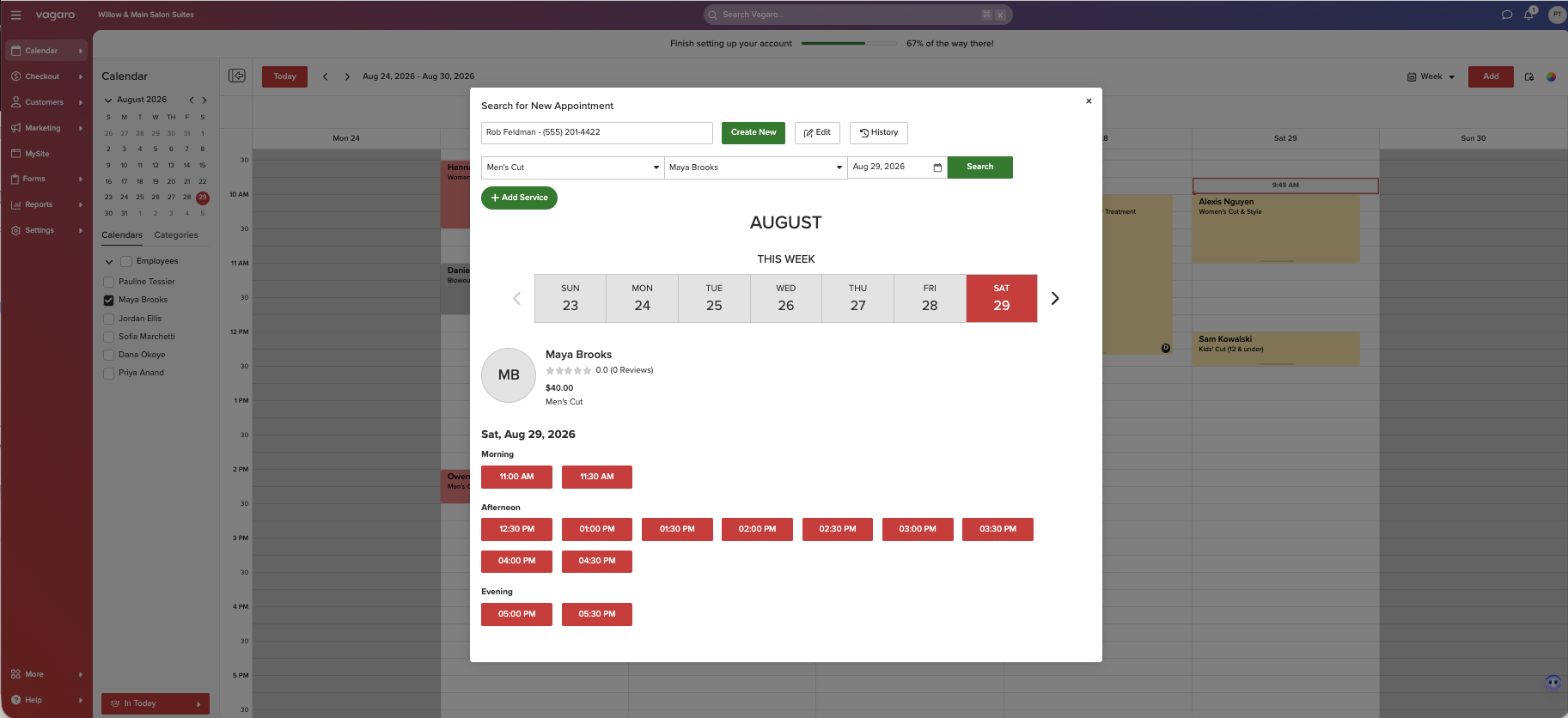
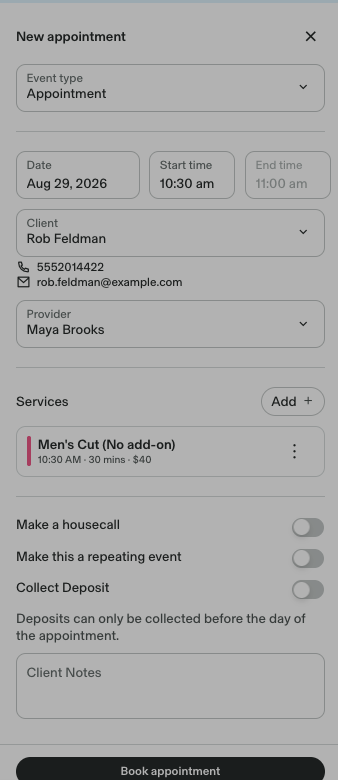
The twelve seconds aren’t polish; they’re philosophy. Vagaro is availability-first: pick the client, service, and provider, hit Search, and it proposes open slots — click one and the booking modal opens fully prefilled, one button from done. It answers the question a desk actually has, which is when can I fit this person in? GlossGenius is form-first: a date, then a time from a dropdown, a client from a dropdown, a provider from a dropdown, a service from a dropdown. It assumes you already know the slot and are merely recording the decision.
Hold that thought, because the same engine that makes Vagaro faster is about to fail the first trap.
Six traps, two tools
Six of the thirty-four appointments were landmines, planted in the dataset before either trial opened, each with its expected outcome written down in the published manifest: a deliberate double-booking, a no-show against a fee policy, a cancellation with a deposit on it, a discount stacked with a gift card, a reschedule inside the cancellation window, and one client entered twice with her phone number formatted two ways. Every salon’s ordinary disasters — scripted, so both tools met exactly the same ones.
T1 · The double booking
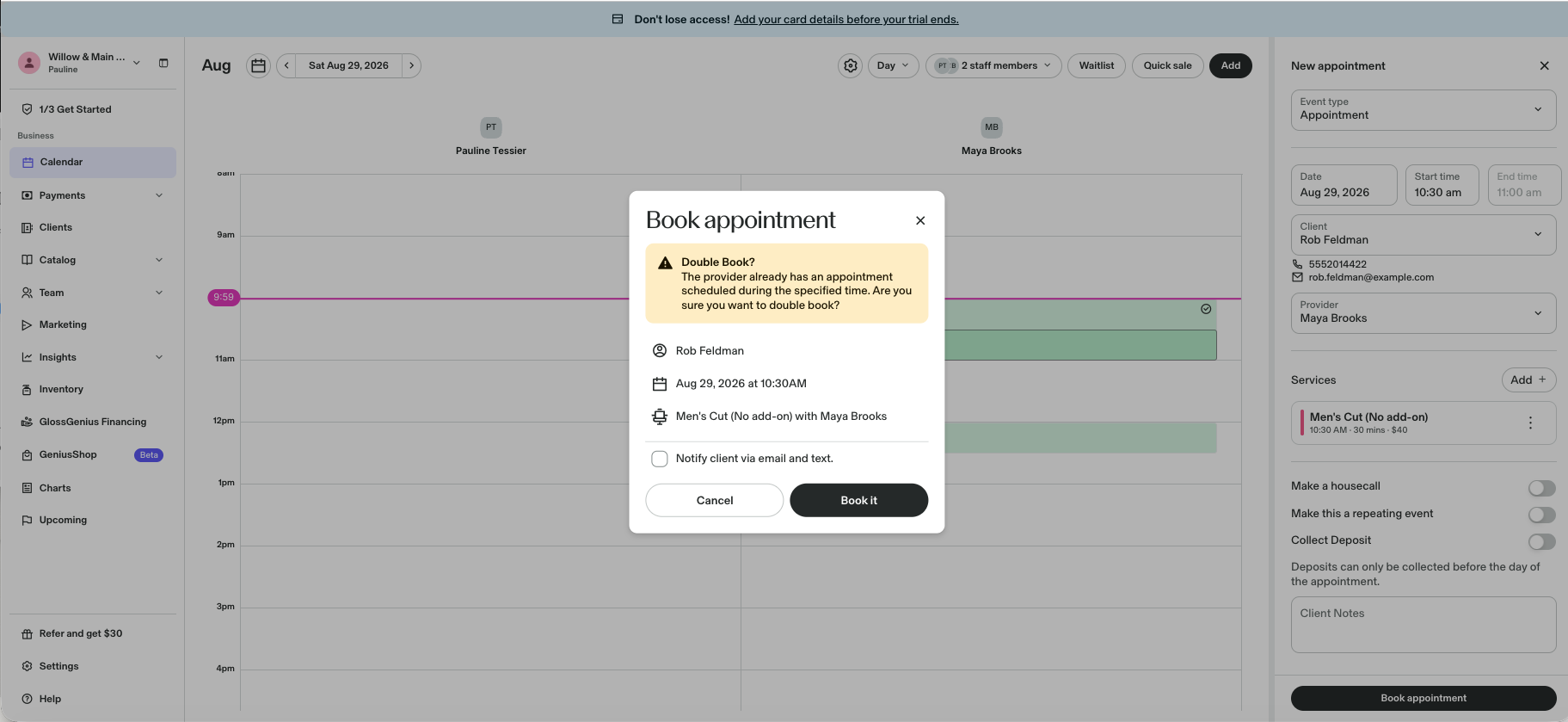
A walk-in booked into an occupied chair gets blocked — or at least a warning the desk must override.
GlossGenius — Named "Double Book?" warning, the overlap previewed on the calendar before committing, explicit override.
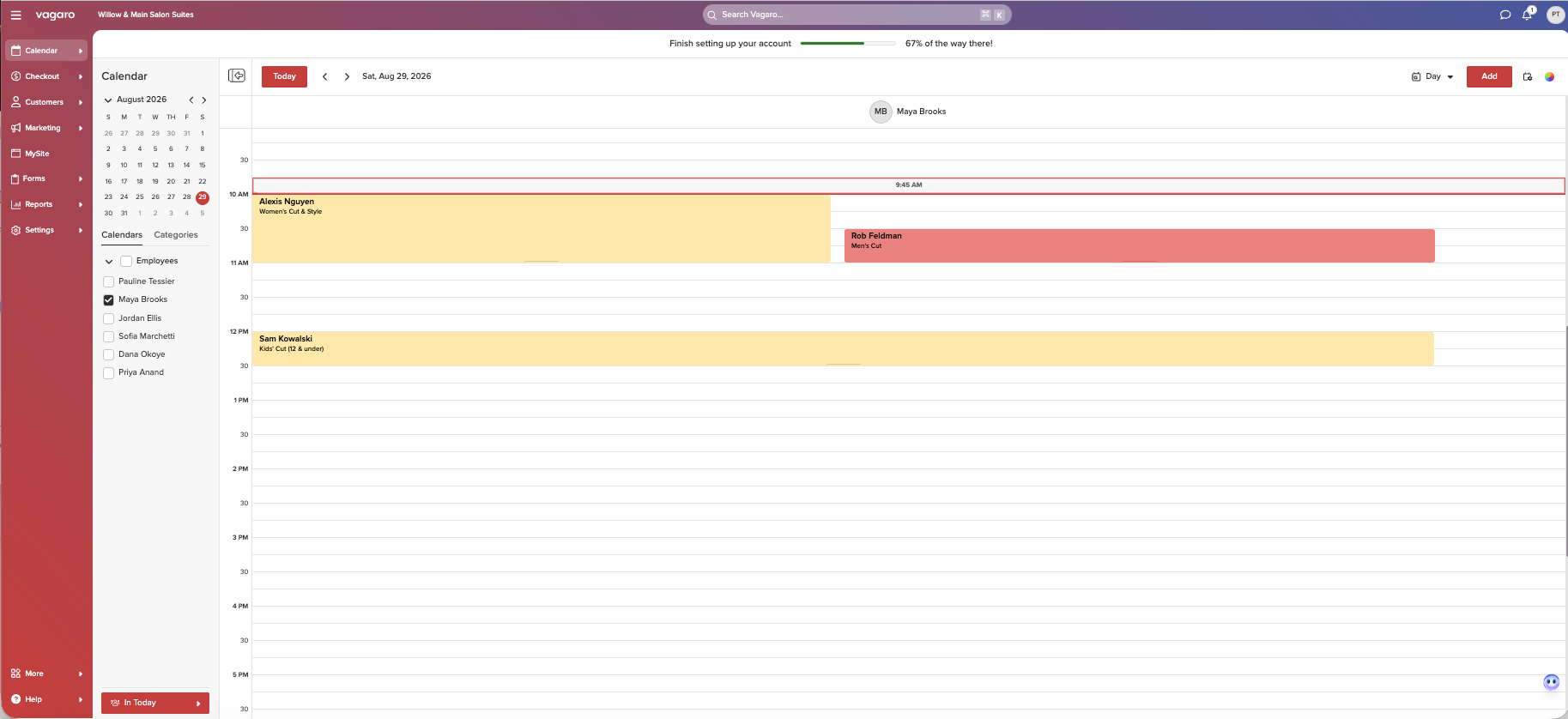
Vagaro — Its suggestions correctly hide the occupied slot — but typing the time into the booking modal books straight through, silently.
T2 · The no-show
A $220 no-show against a 50% policy: the tool computes $110 and attempts the card on file.
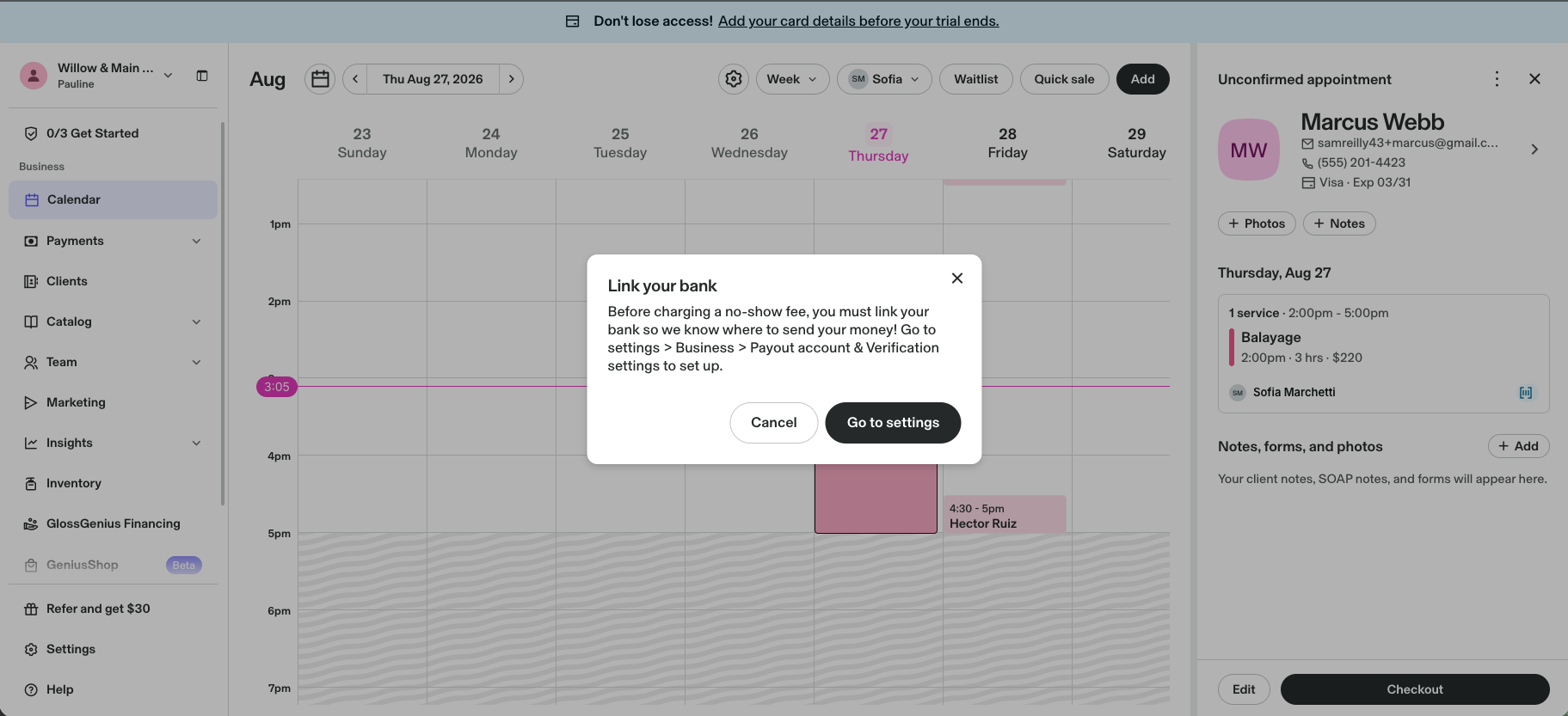
GlossGenius — Two explicit no-show options — then "Link your bank" before any amount appears. Without a fee it books a $0 line: no obligation recorded, no client email.
Vagaro — Shows the desk the full policy — beside a fee field defaulting to $0.00. We typed the $110; it recorded it as an outstanding IOU with a header badge.
T3 · The canceled deposit
Cancel outside the window with a deposit paid: it visibly refunds, or becomes a clearly stated credit.
GlossGenius — No deposit ever existed to refund (payments wall). The cancel flow itself is good: delete blocked, client notified by default, record kept.
Vagaro — Unprompted "refund the deposit?" interrupt, correct $28 pre-filled, refund-vs-credit choice — then no trace of the refund on the appointment.
T4 · Discount + gift card
$90 facial, 15% new-guest discount, then a $50 gift card: $26.50 due, card balance $0.00 — in that order.
GlossGenius — Discount math exact and beautifully labelled — after two attempts and a false calm. The gift-card leg dead-ends in "Something went wrong."
Vagaro — Every figure exact, the card balance shown before redemption, decremented to $0 on her record.
T5 · The late reschedule
A move inside the 24-hour window is treated as a late cancellation: 25% fee, or a block that routes it to a human.
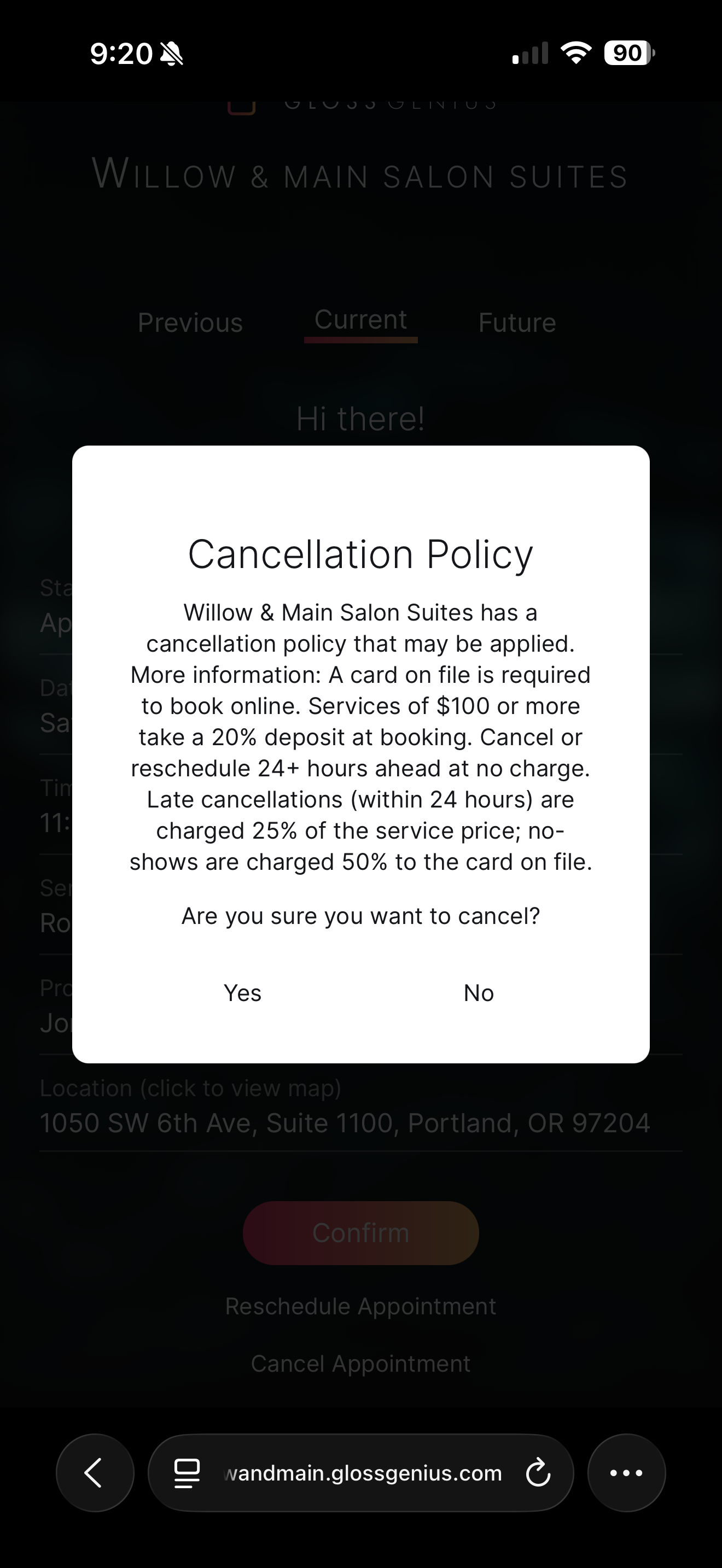
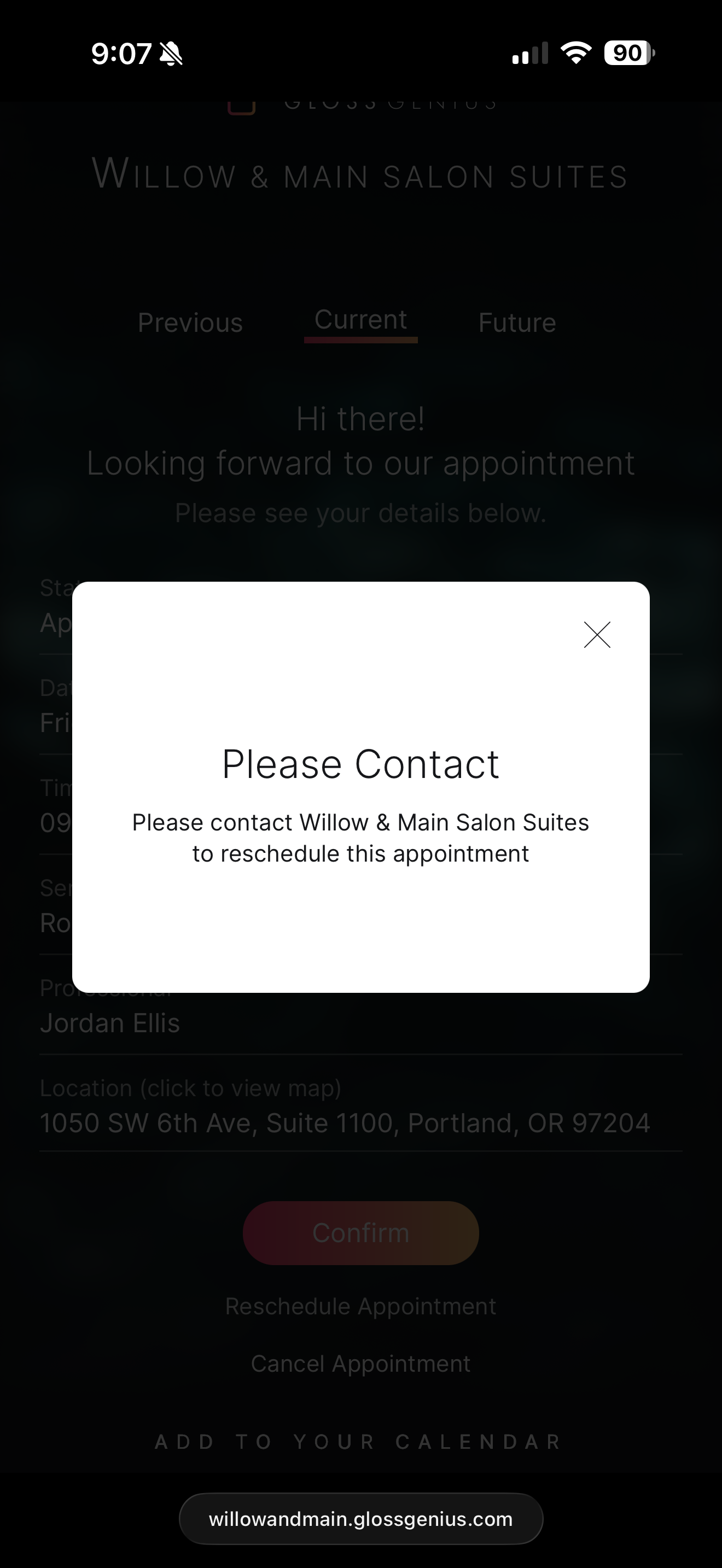
GlossGenius — The client is hard-blocked from moving or cancelling — told to contact the salon, given no reason and no phone number. The desk then moves it free, silently.
Vagaro — The client cannot reach the appointment at all (marketplace login wall). The desk moves it free — notify at least defaults on. $23.75 appears nowhere.
T6 · The duplicate client
Same client entered twice, same phone formatted differently: findable, and a merge that keeps both histories.
GlossGenius — Merge exists — in the mobile app only — and its confirmation names exactly what migrates. Notes and appointments survived. It never detected the duplicate itself.
Vagaro — Three detection surfaces and a field-by-field merge preview; notes, appointments, even an outstanding $110 IOU survived. Its report missed this exact pair.
A word on the two traps that swung hardest. The double-booking (T1) is Vagaro’s availability-first design meeting its own blind spot: its slot suggestions correctly hid the occupied 10:30 — a desk on the happy path can’t collide — but the booking modal’s time field accepts any time you type, and typing 10:30 booked a second client into an occupied chair with no warning of any kind. The conflict check lives in the suggestion layer, not the write path. GlossGenius, which has no suggestion layer and must validate on save, raised a named “Double Book?” warning, previewed the overlap on the calendar while the dialog was still open, and made us override it explicitly. The thing that makes Vagaro twelve seconds faster is also the only thing standing between its desk and a silent double-book.
And the duplicate client (T6) is the inverse story. Vagaro detects duplicates three separate ways — a report with match scores, a manual merge path, and an unprompted interrupt while you’re editing a profile — and its merge previews the resulting record field by field before you commit. GlossGenius detects nothing, ever; it saved our second Doyle without a murmur and its merge lives only in the mobile app. But both merges, once found, worked perfectly: appointments, notes, and in Vagaro’s case an outstanding $110 debt all survived. The asterisk on Vagaro’s detection: its report flagged the two accidental duplicates our own testing created and missed the pair we planted — same phone number, differently formatted, different name spelling — which is precisely what a real salon’s duplicate looks like. When we paired them manually, its own merge dialog scored them a 100% match.
T2, the one the whole comparison turns on
Marcus Webb booked a $220 balayage online. When he booked it, GlossGenius vaulted his card — enforcing its own card-on-file rule — and emailed him a confirmation carrying our cancellation policy in full, real percentages included: services of $100 or more take a 20% deposit at booking… no-shows are charged 50% of the service price to the card on file. A written promise, from the software to the client.
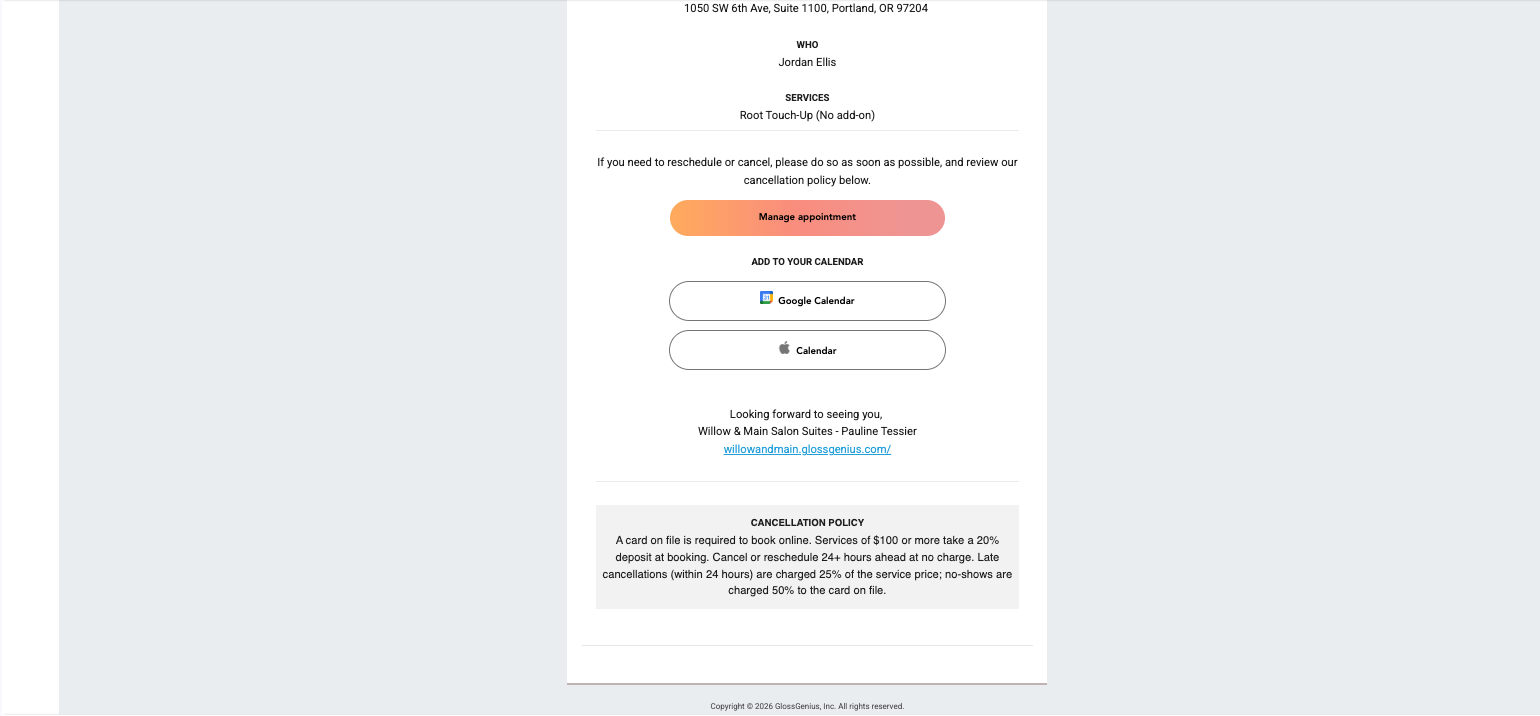
What was true instead: no deposit had been collected — not by GlossGenius, whose deposits sit behind a payments onboarding we’d declined, and not by Vagaro, whose online deposit collection lives in an unpurchased module. Neither tool had mentioned this to anyone. The policy said 20%; the tools said nothing; the client had it in writing.
Then Marcus didn’t show, and we marked him a no-show in both tools, fifteen minutes into his slot.
GlossGenius did the framing right: two explicit options, no-show and collect fee or no-show, don’t collect. We chose collect — and hit a wall: “Before charging a no-show fee, you must link your bank so we know where to send your money!” Refusing to charge without a payout account is correct, and the message even names the exact settings path. But trace the sequence: the tool accepted a 50% policy, vaulted the card, emailed the client the promise, and only at the moment of enforcement — client already gone — mentioned that none of it was connected to anything. Marked without a fee instead, it recorded a sale with a $0.00 “Cancellation Fee” line. No obligation. No trace that anyone owes anything. And no email to Marcus at all.
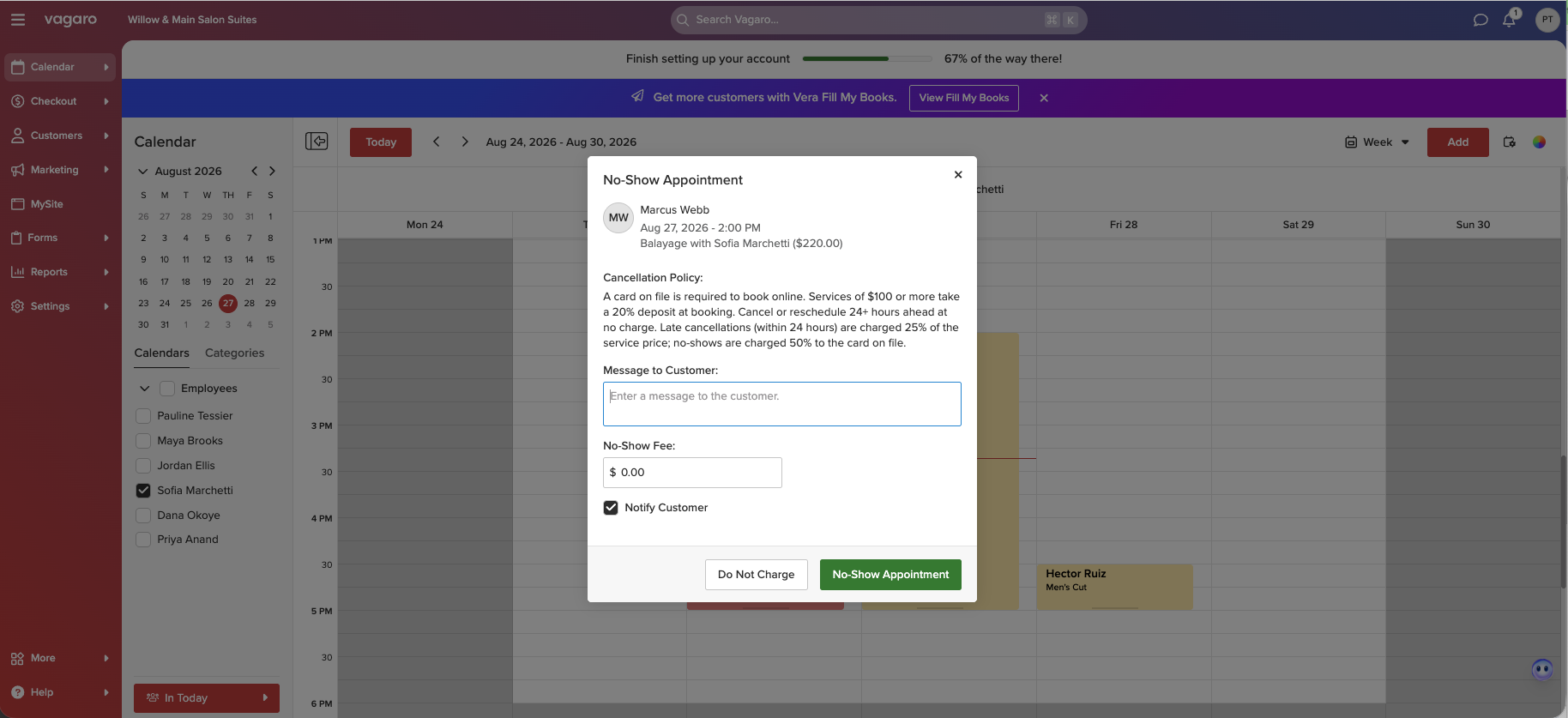
Vagaro’s no-show modal is, in one respect, the best screen either tool showed us: it puts the entire cancellation policy in front of the desk at the decision moment, with a fee field and a Notify Customer box checked by default. Then you look at the fee field: $0.00. The policy two inches above it says 50%; the appointment on the same screen says $220; the tool leaves the multiplication to whoever is standing at the desk. We typed $110 ourselves. To Vagaro’s credit, what happened next was the strong version: with no card to charge, it routed the fee to checkout, let us tender it as an IOU — the dialog defined the term, explained how collection works, and warned us unprompted that commissioned staff get paid on IOU sales — and pinned a $110.00 IOU badge on Marcus’s record, visible from every tab. The debt exists, attributed and dated. And the email it sent him, a warm “We Missed You,” mentioned money in exactly one place: the free-text box we’d typed the fee explanation into. Left blank — and a busy desk would leave it blank — the client gets a friendly note while a $110 balance quietly attaches to his name.
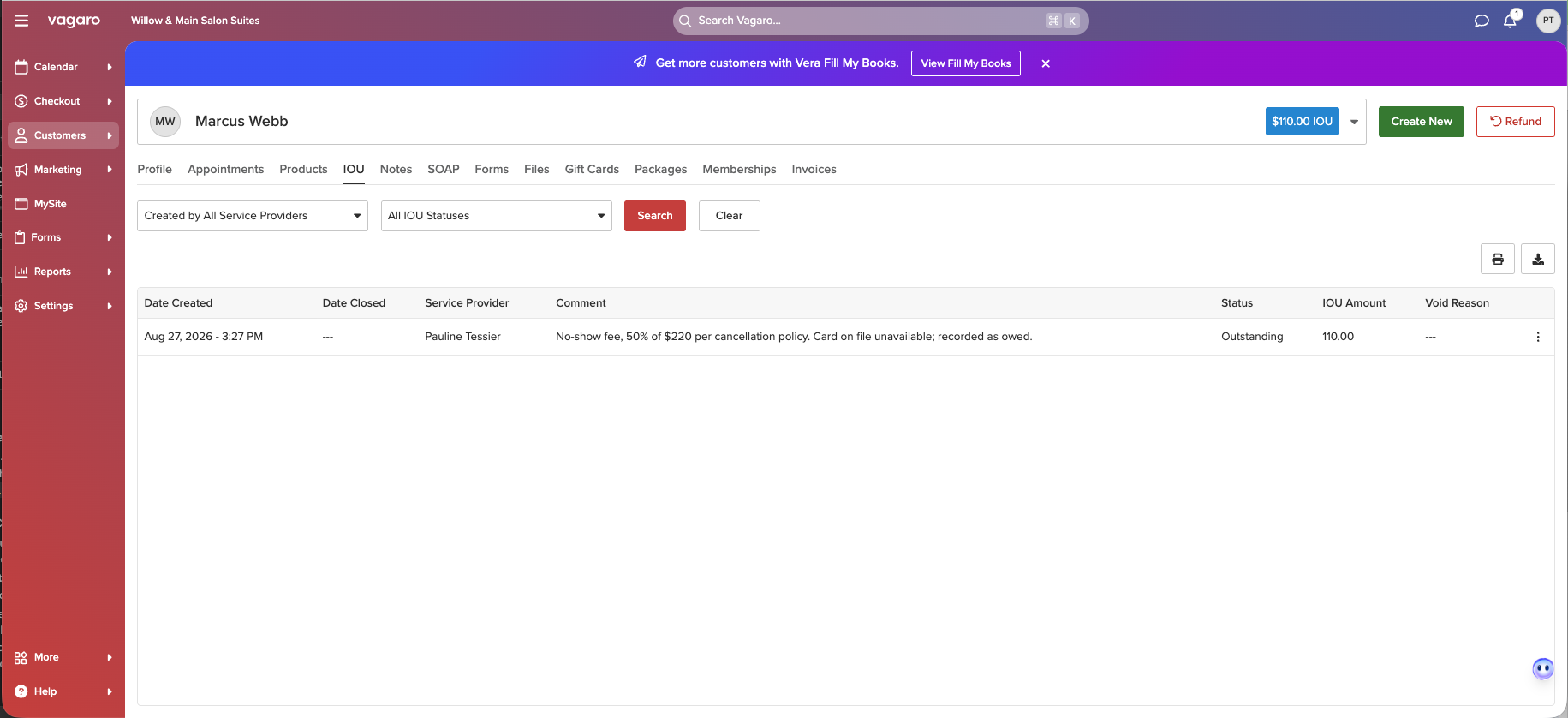
So: neither tool ever displayed the number $110 of its own accord, and neither told the client he owed it. One promised and went silent; the other acted and said nothing it wasn’t handed. If you take a single sentence away from this review, that’s the one.
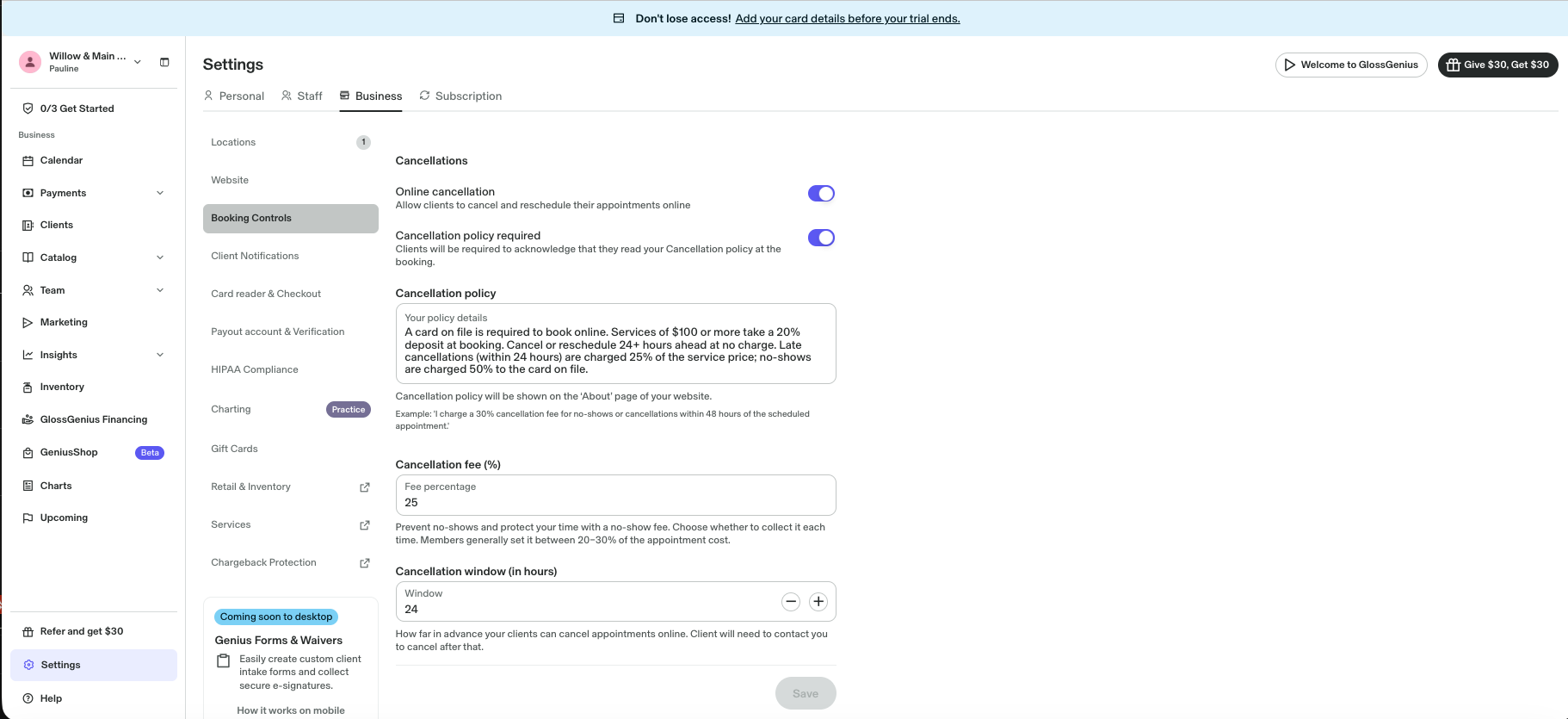
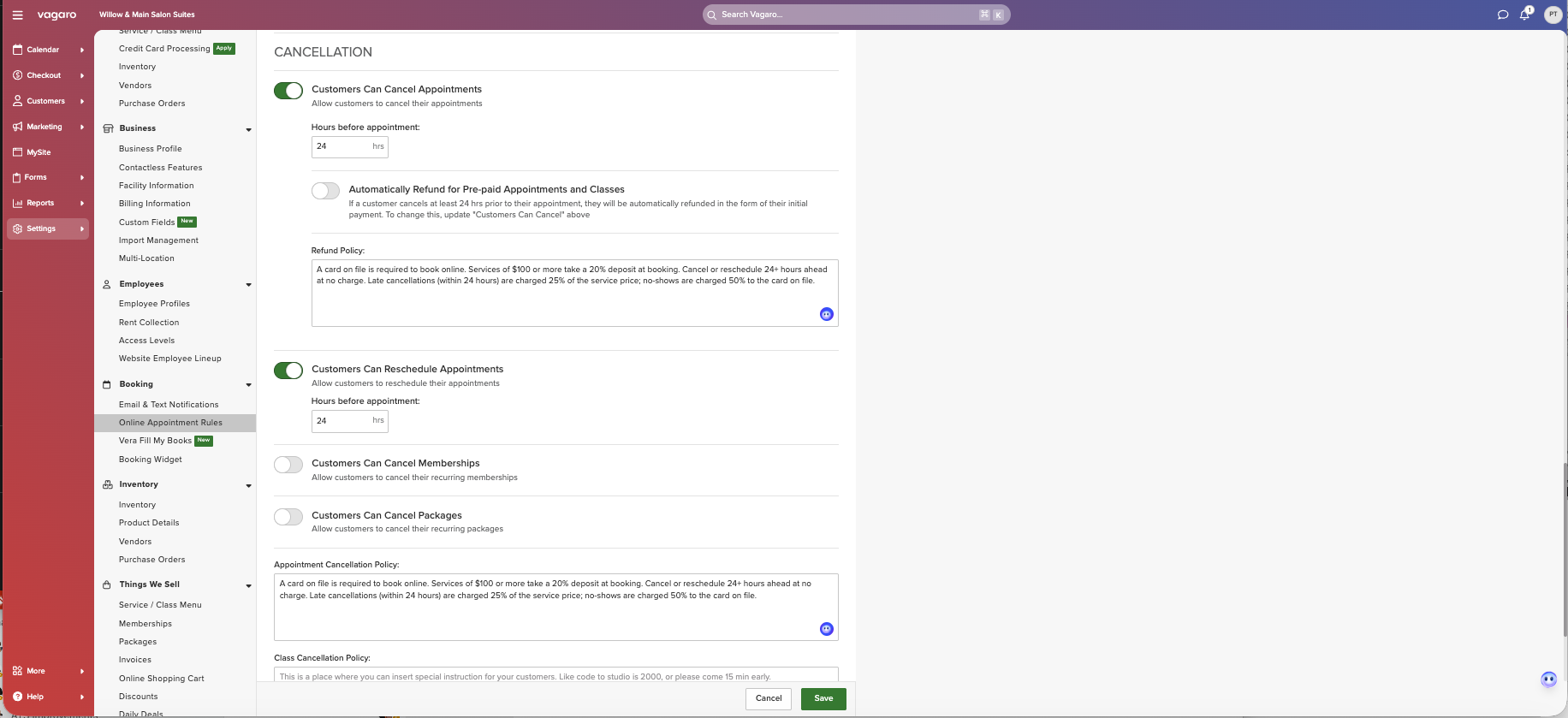
The cause is structural, and we found it in the settings. GlossGenius has exactly one percentage field — labelled Cancellation fee, described by its own helper text as a no-show fee, one number for both concepts. Set to our 25% late-cancel rate, it would charge a no-show $55, not the $110 its email promised; there is no way to express both tiers. Vagaro has no fee field at all — every fee is hand-typed at the moment of marking. The policy text in both tools is a free-text box: prose the software mails out but never reads. The policy box and the enforcement engine are not connected — in either product.
The client side: a tale of two front doors
Booking with GlossGenius as a first-time client took about ten minutes on a phone, most of it vaulting a card — no account, no verification, guest-style. Booking with Vagaro required creating a Vagaro consumer account: signup form, email verification, then a mandatory SMS phone verification with no skip, no deliverability check, and no way to correct a mistyped number short of restarting the whole wizard. The friction is real but front-loaded — it happens once per lifetime, and returning clients book in a couple of minutes. Still, your newest client meets it on the day they’ve decided to try you.
What each shows that client differs just as sharply, and here Vagaro wins outright. Its booking pages carry prices everywhere — on the menu, on the provider card, in a running order summary — and the full two-tier cancellation policy with an agree-checkbox at every single checkout. GlossGenius showed our client no prices at all: not one dollar figure anywhere in the flow, and a card-vaulting step that never says what the card is for or that $0 is due today. Its policy acknowledgement quotes the 25% cancellation clause and omits the 50% no-show tier entirely.
Worse, GlossGenius’s forced-variant service model actively mispriced a booking — the plain $75 cut wasn’t bookable, only a “$100+” variant tile, a client-facing wrong price that was invisible from the desk until our client-side pass caught it.
After booking, the doors swap. GlossGenius’s confirmation email is the best client document either tool produces — the appointment, working add-to-calendar buttons, a Manage appointment button that opens the appointment directly with no login, and the full cancellation policy, percentages included. Vagaro’s equivalent link lands on vagaro.com’s login wall: the marketplace homepage, with a city search bar and a Daily Deals tab, one query away from every competing salon in town. Our client, who existed as a salon-created record, couldn’t get past it at all — “Send Login Info” turned out to send a Vagaro account signup invitation.
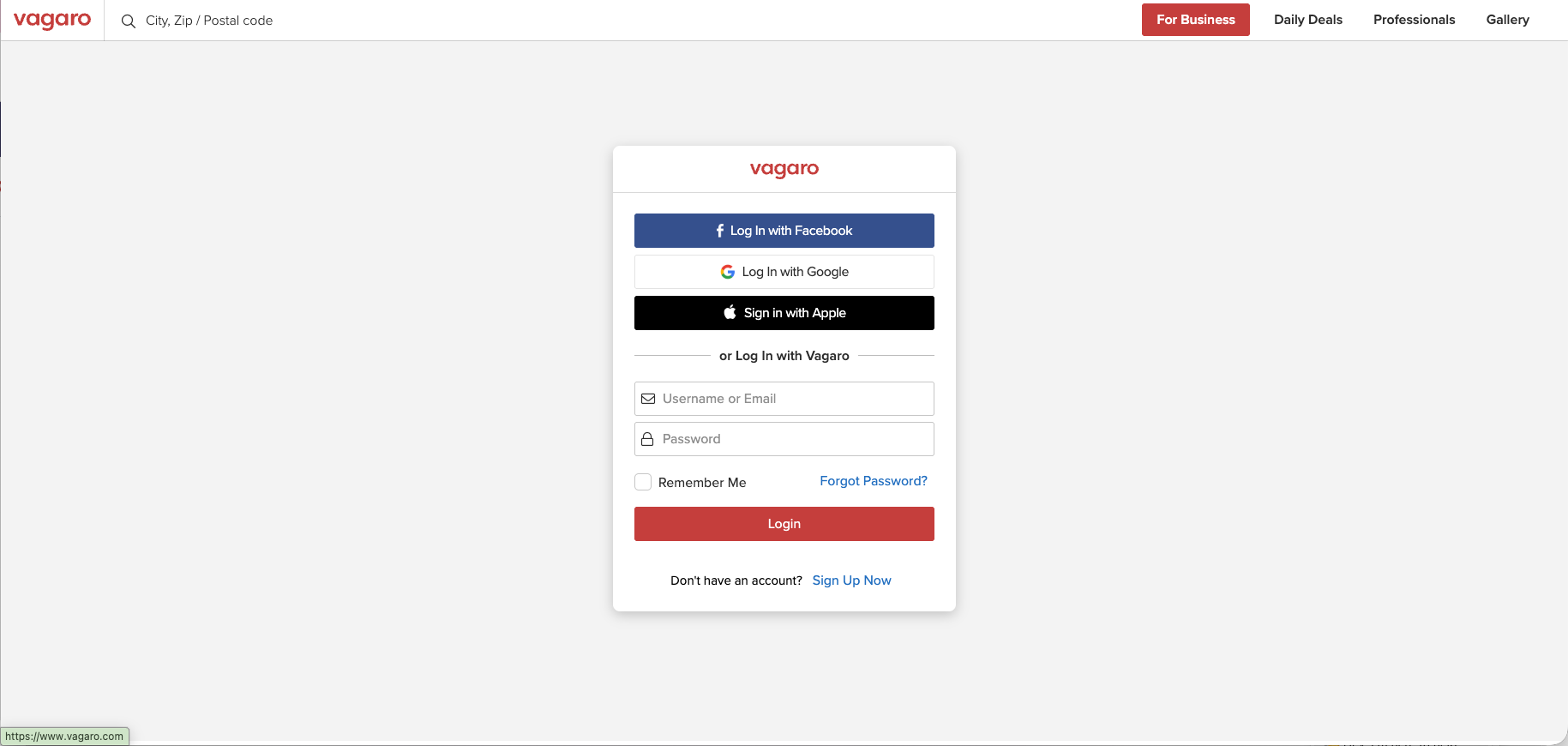
One caveat cuts against GlossGenius’s convenience: those no-login links are bearer URLs. The receipt page — which leads with a review star-rating and buries the actual amounts below it — is readable, and its review submittable, by anyone holding the link. Vagaro’s login wall is genuinely worse UX and genuinely better access control. Each tool picked an end of that trade and didn’t mention it to anyone.
The desk side: where Vagaro doesn’t miss
Vagaro’s perfect desk score wasn’t close. The one deposit our script actually consumed ran end to end without a hand touching it: flagged with a D badge on the calendar, held on the appointment, and auto-applied at checkout — $130 facial, $104 due, arithmetic correct and unprompted.
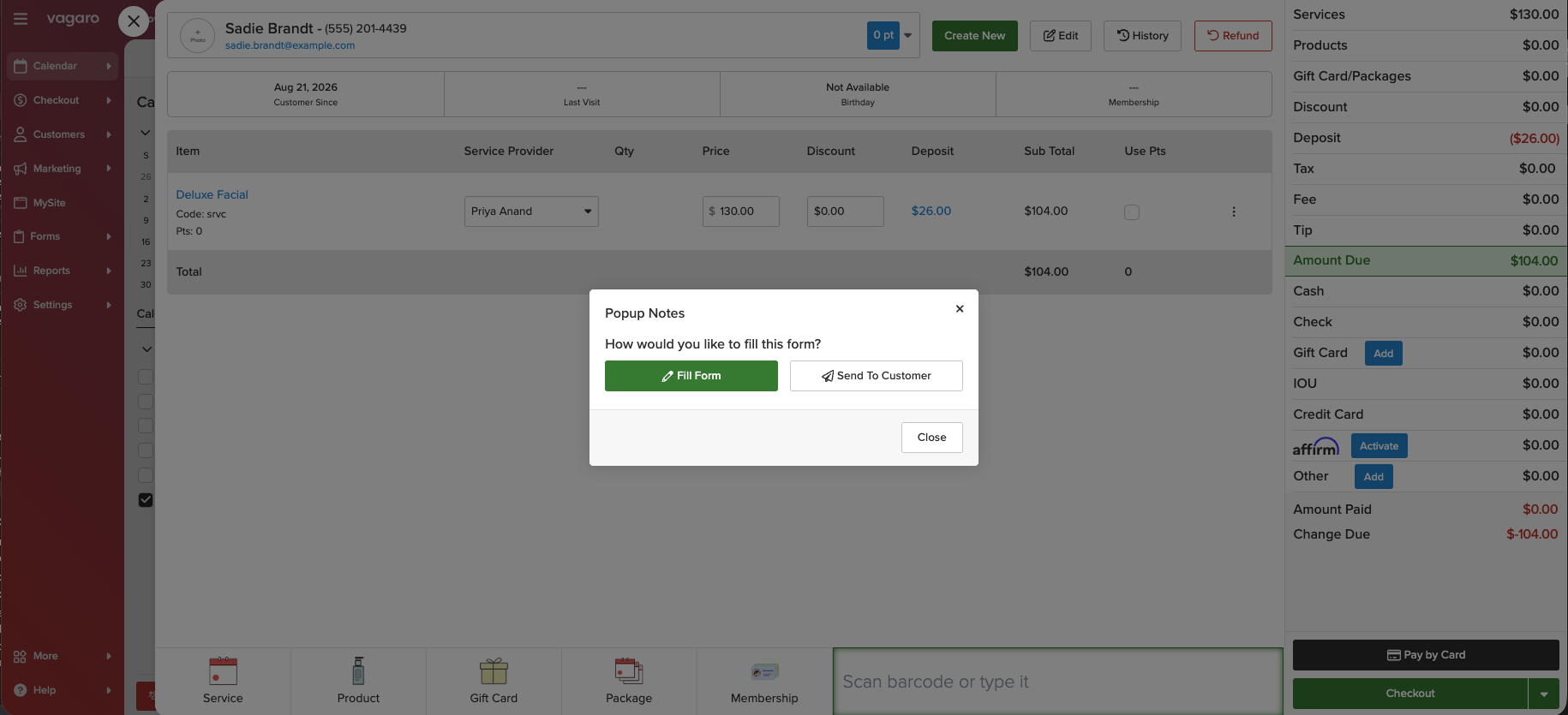
Vagaro’s desk has real warts — payment tender fields with no visible affordance (type on the invisible Cash line and it works), an Amount Due that never decrements so the remaining balance reads as negative change, and appointment records that under-report money (a cancelled appointment still says “Paid $28.00” after the refund; the no-show row never mentions its $110 fee — the header badge is what rescues it). But those are irritations inside workflows that fundamentally work.
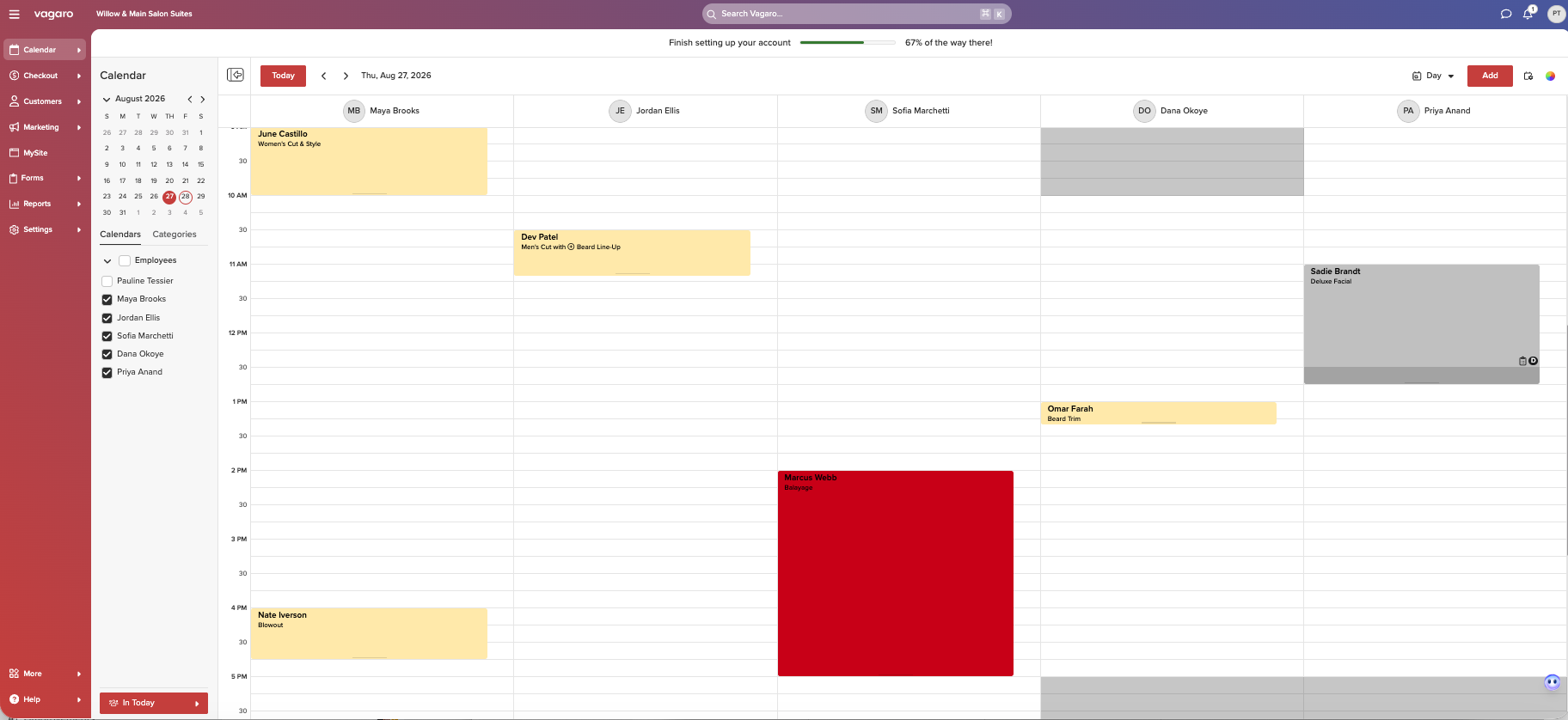
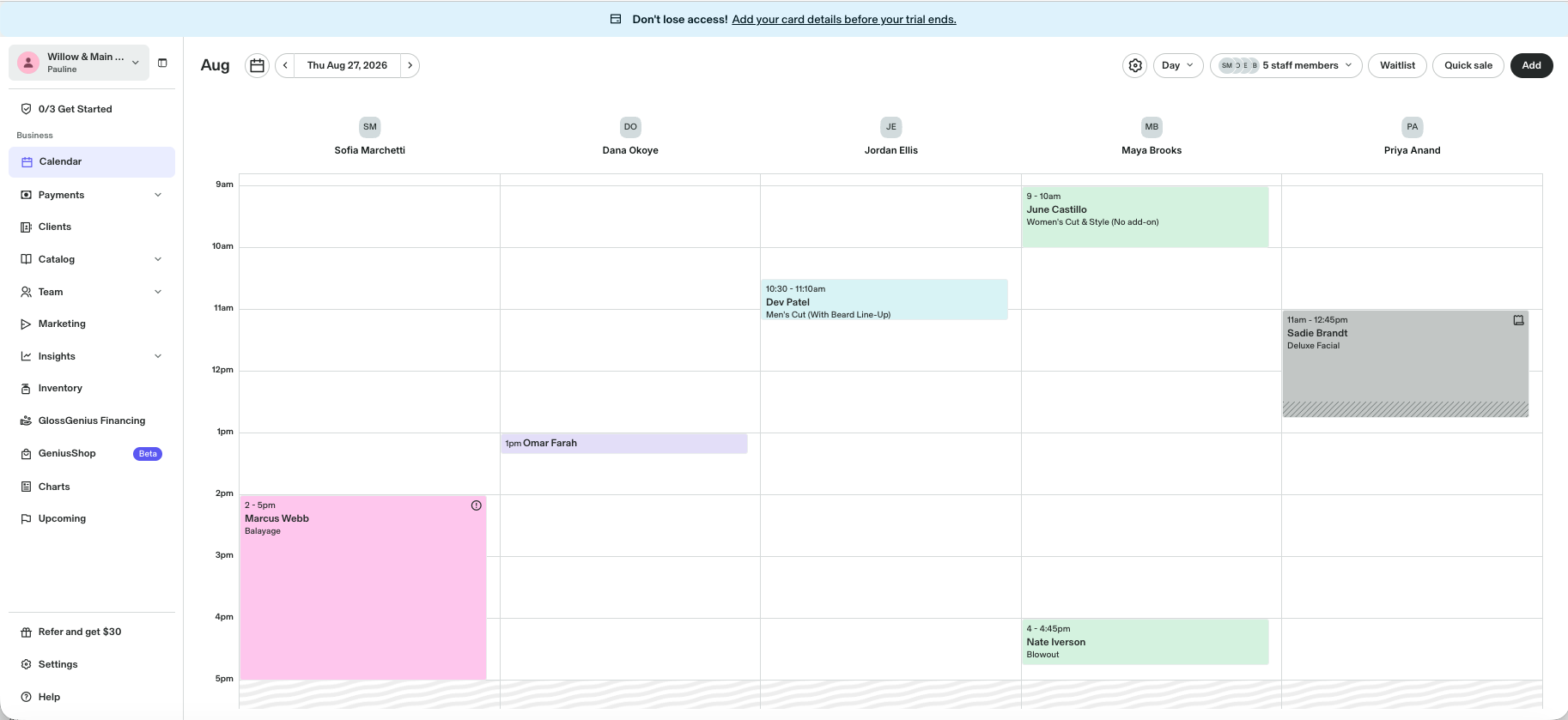
GlossGenius’s desk problem is more basic: five core tasks cannot be done on the web dashboard at all. Onboarding payments, taking deposits, issuing gift cards, authoring intake forms, and merging duplicate clients are all mobile-app-only. This is work a front desk does at a desk, on the machine with the big screen, and the answer is “pick up your phone” five separate times.
What neither tool will do
Step back from the individual traps and one shape repeats. GlossGenius vaulted a card it couldn’t charge, transmitted a policy it couldn’t compute, and warned nobody. Vagaro published “a card on file is required to book online” in its policy text while collecting no card, moved a rescheduled appointment inside the fee window without a word about the fee, and left the multiplication on its own no-show screen to the desk. Neither tool, anywhere, at any point in ten days, put a policy-derived dollar figure on screen unprompted. Neither told a client they owed one.
Both are good software. That’s what makes the finding worth publishing: this isn’t a bug in one vendor, it’s how the category currently works. The policy is prose in a settings box; the money is an engine in a different room; and the person at the desk is the only wire between them.
The full scorecards
Scores are 0–2 per item: fails, works with friction, works well. The full item-by-item evidence — every screenshot, timing, and settings screen behind these numbers — lives in our published score files, and the dataset both tools were tested against is downloadable.
| GlossGenius | Vagaro | |
|---|---|---|
| Mobile booking flow | 2 — guest-style, ~10 min | 1 — account + SMS gauntlet, once |
| Booking page truth | 0 — no prices shown; a variant mispriced | 2 — prices + full policy everywhere |
| Card + deposit at booking | 1 — card enforced, amountless; no deposit | 0 — claims card required, collects nothing |
| Confirmations + reminders | 2 — policy in email, no-login manage link | 1 — instrumented, but marketplace wall |
| TOTAL | 5 | 4 |
| GlossGenius | Vagaro | |
|---|---|---|
| T1 double booking | 2 — warned, previewed, overridable | 0 — silent via typed time |
| T2 no-show fee | 0 — bank wall; $0 line; no obligation | 1 — manual $110, recorded as IOU |
| T3 canceled deposit | 1 — no deposit existed; good flow | 2 — interrupt, pre-filled refund |
| T4 discount + gift card | 1 — exact but flaky; gift card dead-ends | 2 — exact, balance tracked to $0 |
| T5 late reschedule | 1 — client blocked; desk moves free | 0 — client locked out; desk moves free |
| T6 duplicate merge | 2 — works, app-only, zero detection | 2 — works, detected, missed our plant |
| TOTAL | 7 | 7 |
| GlossGenius | Vagaro | |
|---|---|---|
| Day view + entry speed | 1 — 44s; no-show nearly invisible | 2 — 32s; status-coloured calendar |
| Setup fidelity | 1 — add-ons inexpressible (variants) | 2 — everything native, one $0 default trap |
| Membership lifecycle | 1 — redemption opt-in; we missed it | 2 — auto-applies, balance tracked |
| Client records | 1 — clean, but paid appointments shed forms | 2 — twelve tabs, IOU badge, SOAP notes |
| TOTAL | 4 | 8 |
| GlossGenius | Vagaro | |
|---|---|---|
| Pricing honesty | 2 — as advertised; Gold-forced trial noted | 0 — $23.99 advertised, ≈$94 real |
| Rates + fine print documented | 2 — flat 2.6%, on the pricing page | 0 — rates in a support article, ladder unpublished |
| TOTAL | 4 | 0 |
GlossGenius or Vagaro: which should you buy?
If you run a busy multi-provider desk — walk-ins, deposits, memberships, the occasional IOU — Vagaro is the tool that will not drop the money math, and its desk is measurably faster. Budget from this review, not from its pricing page, and teach every front-desk hire two things on day one: the payment fields are invisible but typing works, and a hand-typed appointment time bypasses the conflict check.
If you’re a solo stylist, a booth renter, or a small team that lives on its clients’ goodwill — and you want a bill you can predict from the vendor’s own website — GlossGenius is friendlier to your clients at every step and to your accountant at every tier. Keep your phone at the desk, because five jobs need it; double-check that every discount really applied before you cash out; and read the next paragraph twice before you rely on the no-show policy it emails on your behalf.
And if a no-show policy is why you’re switching software: neither of these tools will run it for you. One can’t express it, the other won’t compute it, and both will happily put it in writing to your clients. Whichever you choose, the policy’s enforcement mechanism is the human at your desk — the software’s job, for now, is to hold the card and keep the record.
(Booth renters: your comparison is the solo column. At one calendar the two price within a rounding error of each other, so the deciding factors are your clients’ booking experience and how much of the job you’re willing to do from a phone. We’re testing the booth-renter field more widely in a coming piece.)
Willow & Main Salon Suites is a fictional business we operate for testing. We paid for our own trials, hold no employer or vendor relationships, and every price above was read from the vendor’s own pages on the dates stated. Both trials will be cancelled before their paid conversion dates; the dataset is yours to reuse.
Filed under: glossgenius · vagaro · salon software · comparison