Fresha vs GlossGenius: what "free " actually costs
Fresha has no free plan on its price list, and the part that is free took five gates, a 20% commission, and a card we could not remove. We ran the same salon through both tools and the two trials ended in opposite kinds of trouble.
Some links below are affiliate links — if you subscribe through one, we earn a commission at no extra cost to you. It never changes a verdict; every tool runs the same test salon. Full disclosure
Search is Fresha really free and the first page belongs to Fresha. Its pricing page, its help centre, its comparison of itself to GlossGenius. GlossGenius returns the favour two results down. In between sit the roundups, assembled from the same two pricing pages. The question people are actually typing — what does the free one cost me — is answered by nobody who has run a salon through it.
So we ran a salon through it. The same fictional one we ran through GlossGenius and Vagaro in August: Willow & Main, five providers including a booth renter and an esthetician, twelve services, one membership, forty clients, and a scripted 34-appointment week with six traps planted in advance. Fresha got the identical configuration, the identical week, and the identical second identity booking, rescheduling, no-showing and paying from the client’s side of the desk. The dataset and policy sheet are downloadable.
The scores were 18 for Fresha and 20 for GlossGenius out of 32, and as in August the margin is the least useful number. The useful one is this: on the twelve points that measure whether a tool can enforce the policy you show your clients, Fresha scored seven, GlossGenius scored seven, and Vagaro scored seven. Three tools, three price models, one answer. None of them can charge a no-show fee, hold a deposit, or price a late reschedule until you hand them your payment processing. Until then they are appointment books with a policy pasted on the front.
What differs is what the book costs, what you have to give up to get it, and what happens when you try to leave.
The verdict, up front
Buy GlossGenius if you want to know what you are paying and want the option of stopping. One subscription that genuinely covered our five providers, one flat processing rate, both on the pricing page. Your clients see no prices during booking, which cost it two points in August and still does, and it cannot express an add-on. But it is the honest bill of the two, and its client experience is the smoother one.
Buy Fresha if the marketplace is worth 20% of every new client it brings you and you are prepared to keep a card on file with Fresha indefinitely. It is the faster desk of the two by a wide margin, its checkout is the best we have tested, and its client records are the richest. It also cannot sell a membership, cannot hold a deposit, and took our venue offline on its own on day three, blaming us in the email.
Do not buy either one for the policy sheet. Read on for why.
How we tested (and what we couldn’t)
Same method as August, one tool this time. Fresha’s trial is seven days with no card required, so we opened it on a Saturday, built the salon over the weekend, ran the traps Tuesday to Friday, and exported everything Friday evening. Every screen described below has a screenshot in our published score file, dated and numbered.
Two limitations are ours to own. First, the payment-rail boundary: we never move real money through the fictional business, so every fee Fresha or GlossGenius would have charged is scored on what the tool computed and offered, not on whether a card was hit. Both tools made that boundary irrelevant by never computing a fee at all. Second, we did not capture what Fresha’s account looks like after the trial lapses, because on the last morning it locked us out. That story is at the end, and it is a finding in its own right, but it means we can describe Fresha’s expiry only up to the login screen.
Fresha vs GlossGenius pricing: where the free is
GlossGenius has a price: $28 a month on its Standard tier, $56 on the Gold tier the trial put us on, either of which covers all five providers, and 2.6% flat on every card. That is the whole model. There is nothing behind it to find.
Fresha’s pricing page also has prices, and to its credit it lists more of them than any page we have checked: $19.95 a month for a solo account, $14.95 per bookable team member above that, three processing rates, a text-message rate, a terminal price, and a buy-now-pay-later rate. Our five-provider salon came to $74.75 a month, which the page told us in advance and the account confirmed on the first day. There is no free plan on that page.
What Fresha means by free is on the same page, in the online-bookings grid, and it is worth reading slowly.
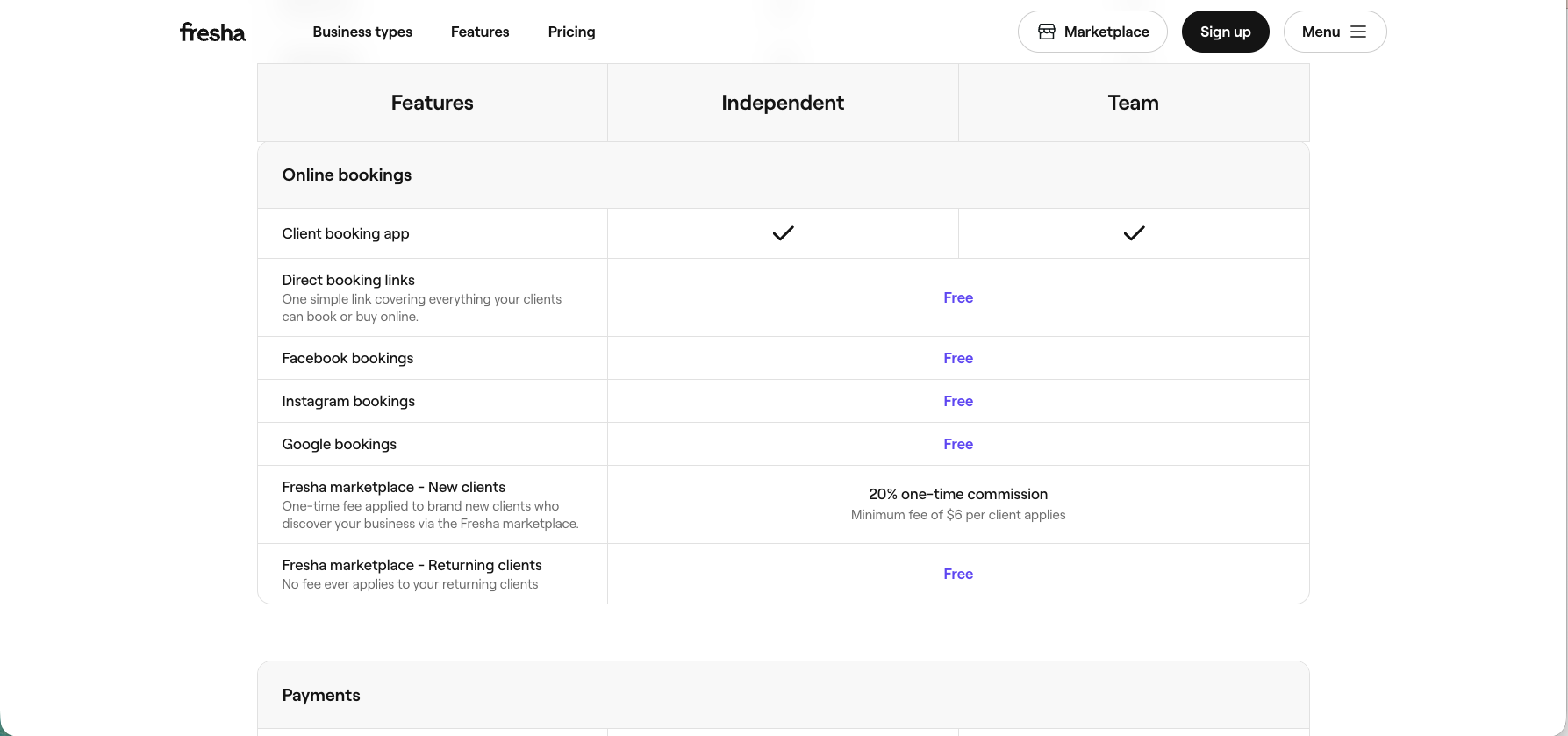
New clients who find you on the Fresha marketplace cost 20% of their first booking, minimum $6, one time. Returning clients are free. Clients who book through your own link, your Instagram, your Google listing are free. Clients you imported from your old system are exempt, which Fresha states plainly on the import banner: importing your list “prevents new client fees for existing clients.” The commission is the business model, and Fresha does not hide it. What it does not do, and what no pricing page could do, is tell a given salon how big that number will be. A shop that lives on walk-in discovery in a dense city will pay it constantly. A shop with a full book of regulars will barely see it. That is the honest answer to is Fresha free: it depends entirely on where your next client comes from, and Fresha’s own reporting, as we found later, defines “new client” in a way that follows the money.
The commission is not the only cost, though. Getting to the point where a client can book online at all is where the price of free is really paid.
Five gates and a card
Our policy sheet asks every tool for the same thing: clients book online, services over $100 take a 20% deposit, a card is required to book. In GlossGenius that took a settings screen and a booking link. In Fresha it took an afternoon, and we counted the gates as we passed them.
One: a published marketplace profile. Fresha issues no booking link, not even the commission-free direct one, to a venue that is not listed on its marketplace. The profile needs at least three photos and a description of at least two hundred characters, and the description passes through a content filter. Ours was rejected the first time for saying the venue was not accepting clients. We are a test lab; we do not want real strangers booking a salon that does not exist. The filter would not have it, and we rewrote the description to say the business was fictional and the data was test data, which it accepted.
Two: acceptance of the marketplace terms, the 20% and the $6, as a signed condition of the listing.
Three: a card.
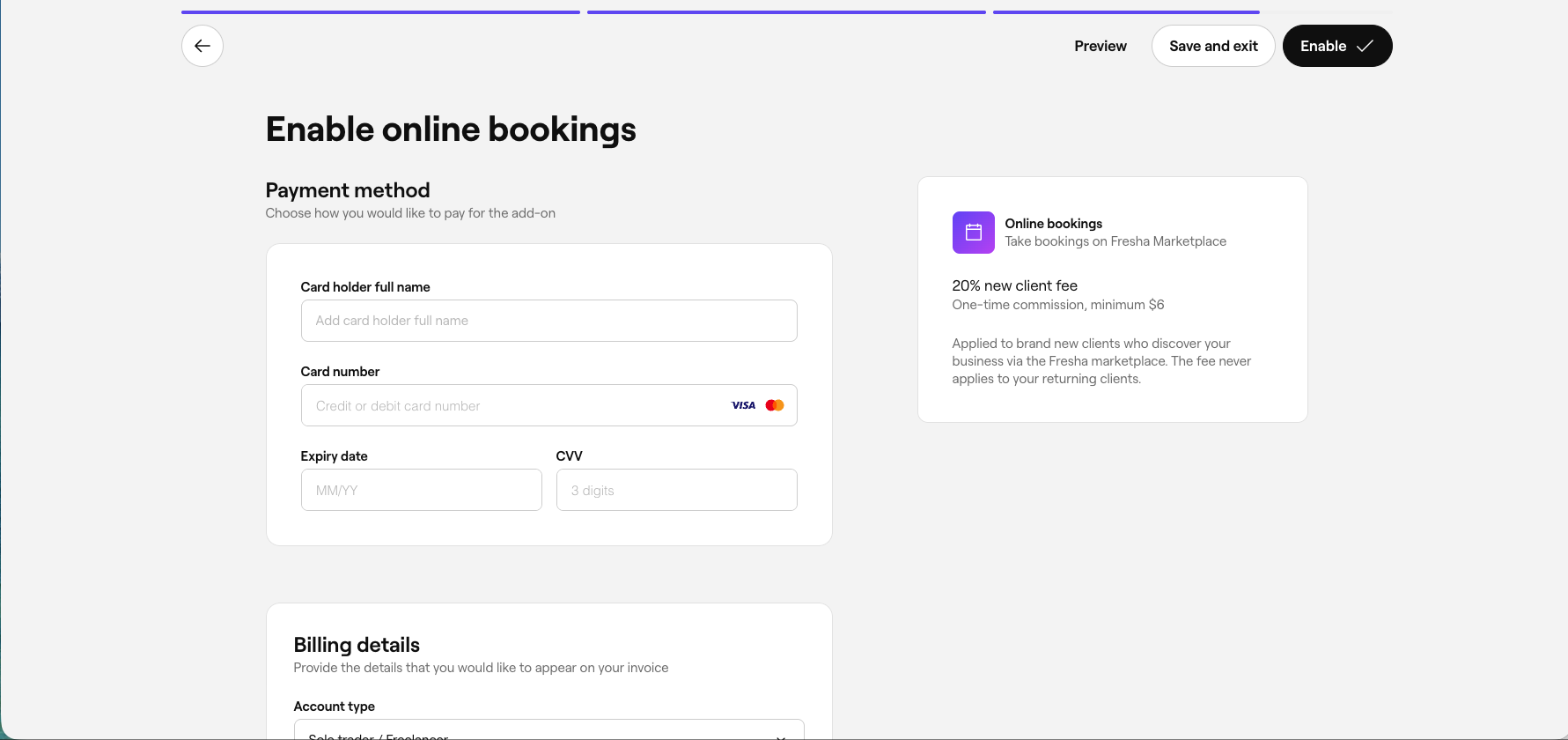
Four: a legal name and a tax ID for the billing party, on the same screen, below the card.
Five: a mobile number verified by text message, which the publish button refused to proceed without.
None of these is unreasonable on its own. A marketplace that charges commission needs a card to charge it to, and a way to invoice. But the trial is advertised without a card, and the feature a salon signs up for is online booking, and the two turn out to be different products. The card is entered on a screen called Enable online bookings, for a fee that only applies if the marketplace ever sends you anyone. We will come back to that card.
Two days after we published the profile, Fresha unpublished it.
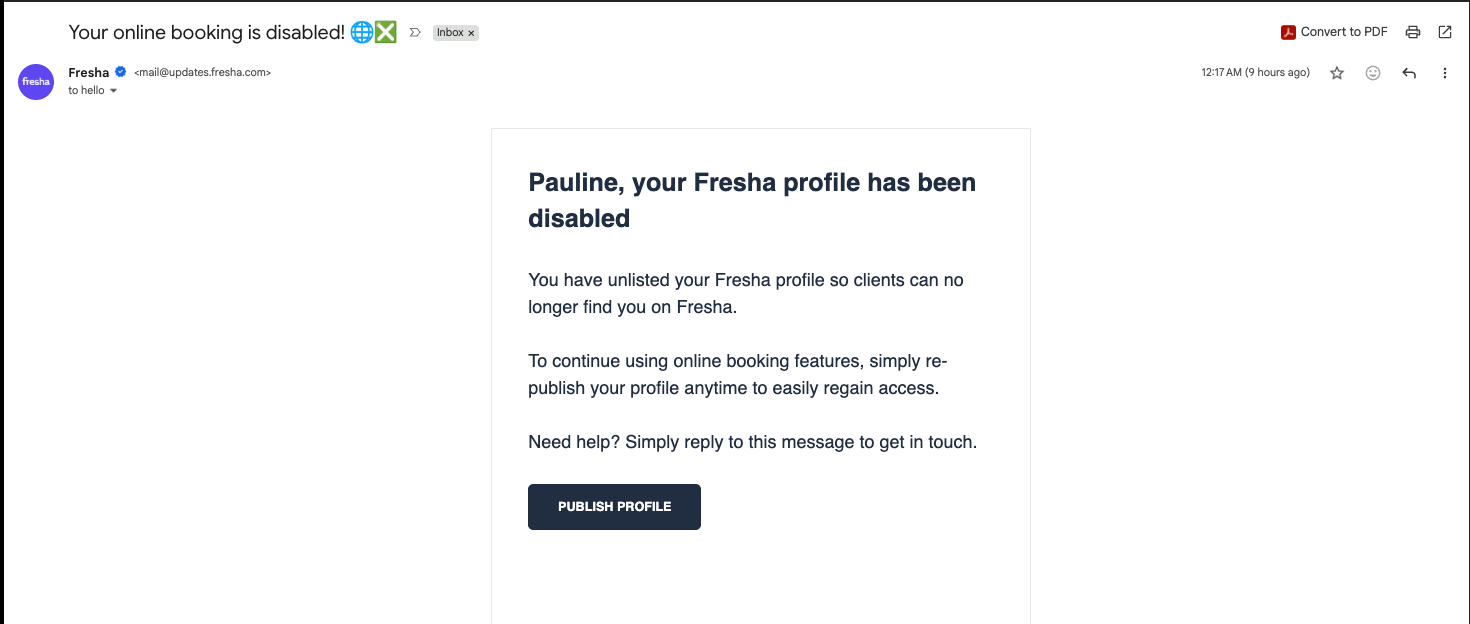
The email says we unlisted it. We did not. The desk offered no reason, no review status, no moderation notice; the profile simply read Unlisted with a date. We assume the marketplace moderation team took a second look at a listing describing itself as a fictional business, and we do not blame them for it. But the mechanism is the finding: a listed venue can be switched off overnight, and the only notice says the owner did it. And because Fresha issues booking links only to listed venues, unlisting killed the link too, including the direct one Fresha describes as commission-free.
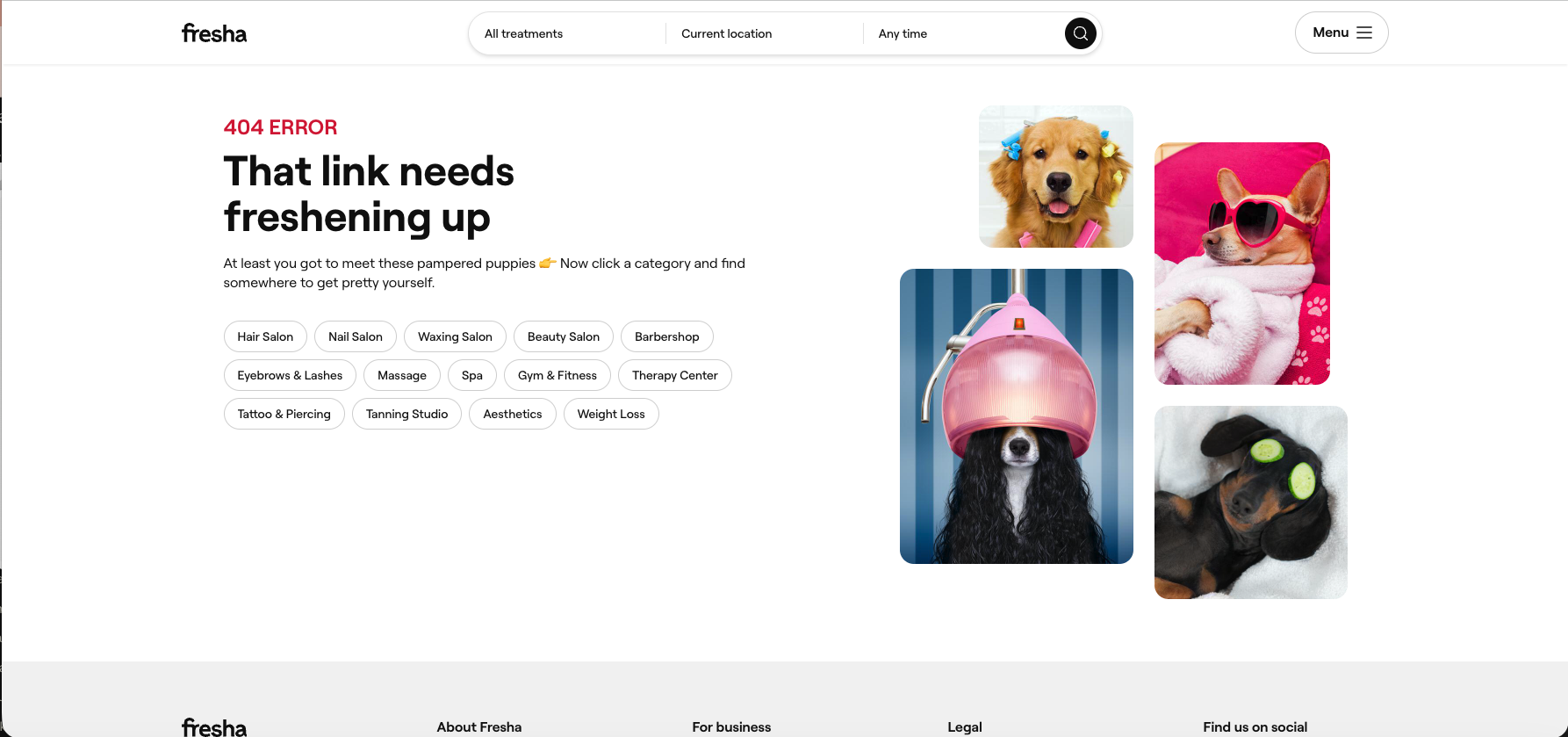
We chose not to re-list, partly because the same listing would likely have been pulled again, and partly because a fictional salon with a dead link harms nobody. A real salon in that position would have a choice between re-listing and hoping, or having no online booking. We finished the week without it, which the rest of the traps did not need. The three clients who had already booked through the link kept their appointments and their manage links. One of them tried to reschedule, and could not, and we will get to that too.
The policy sheet, shown and not enforced
Fresha does something GlossGenius does not: it shows your policy text to the client at the moment they confirm a booking, in full, including the percentages. Here is what one of our online bookings saw.
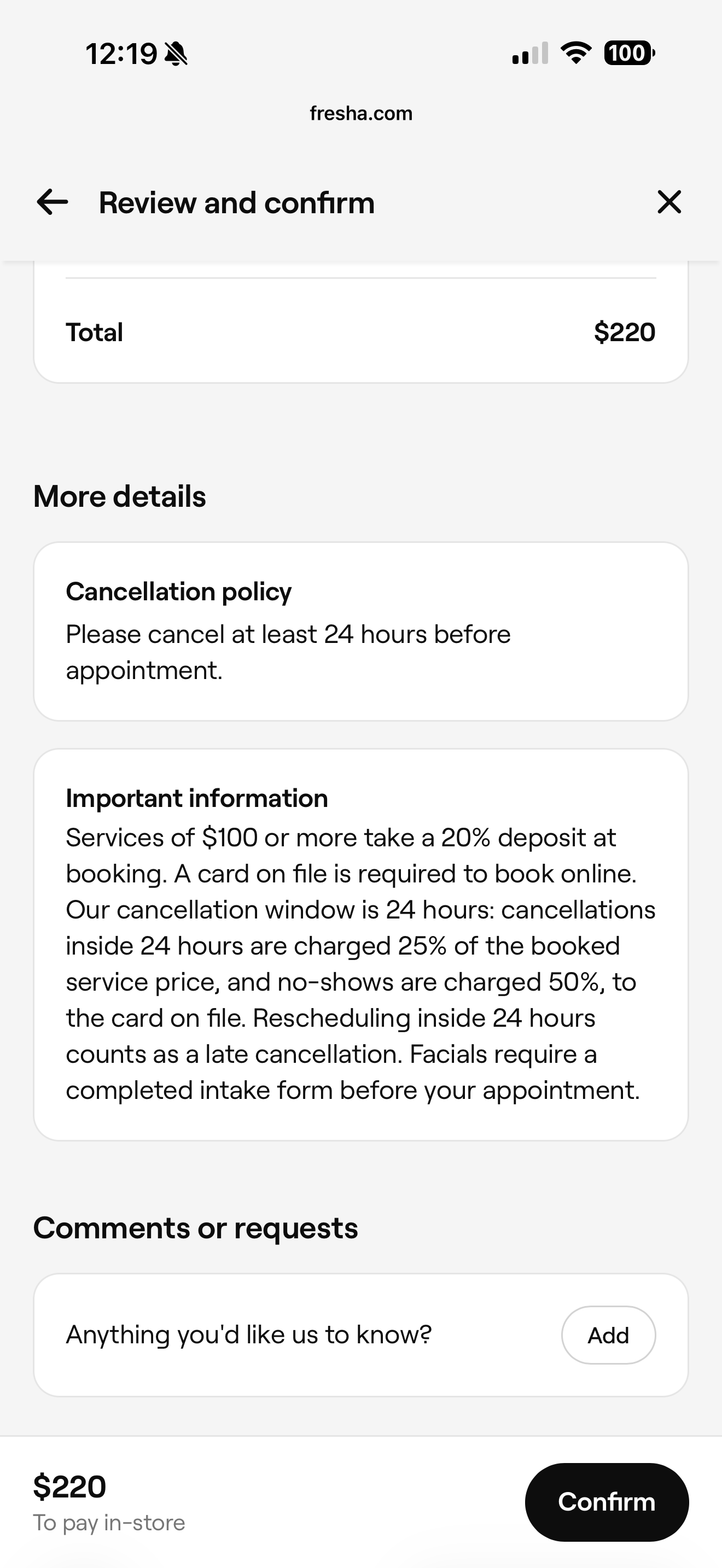
Nothing was collected. Not the 20% deposit the text describes, not a card, not a hold. Fresha has no deposit field on a service, no card capture at booking, and no fee engine of any kind until you complete Fresha Payments onboarding, which routes your processing through Fresha at the rates on the pricing page. Until then the policy is display text, and the checkout contradicts it in the same viewport.
GlossGenius, in August, did the reverse: it emailed the full policy to every client and made every new client vault a card at booking, then could not charge the card, and showed a fee it could not take. Same wall, different theatre.
Where the two differ in a way that matters is the no-show.
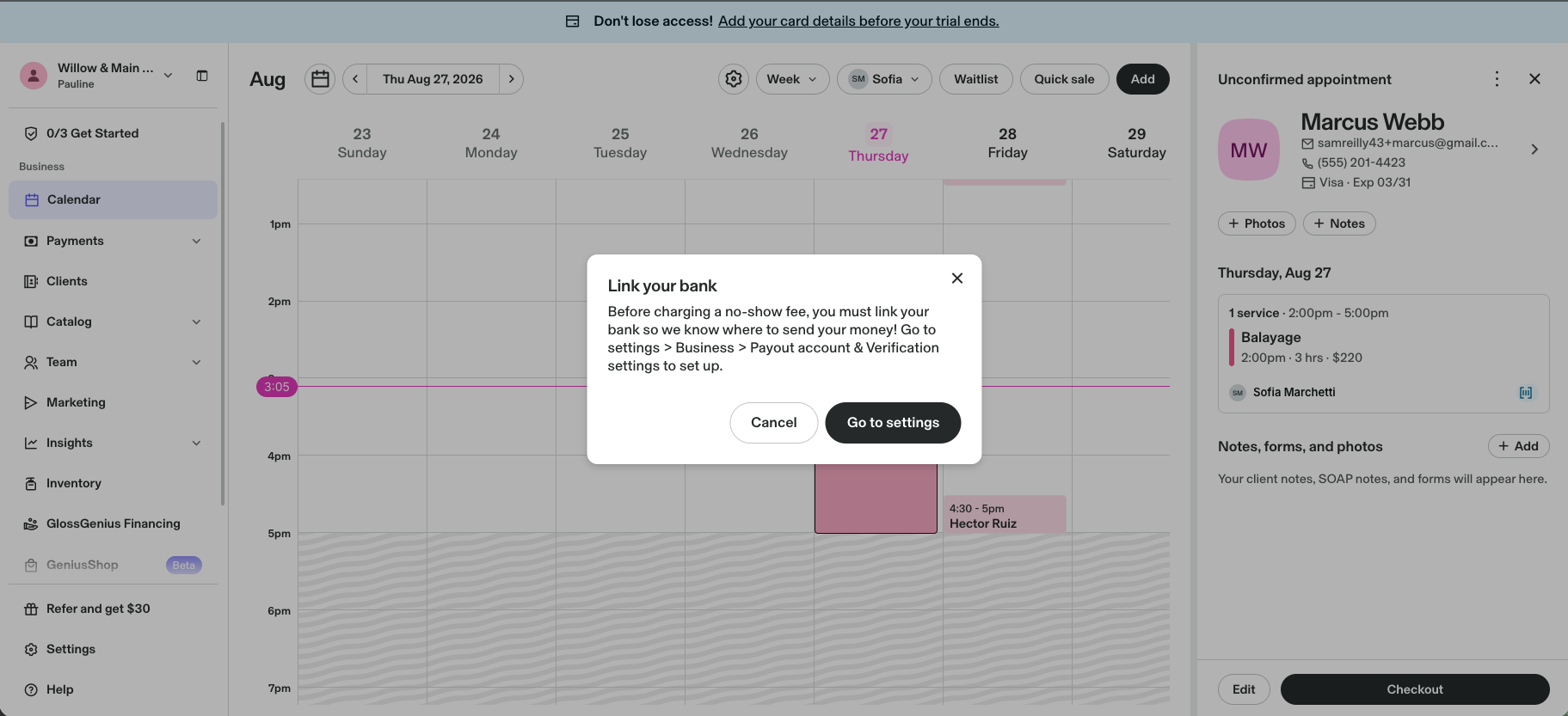
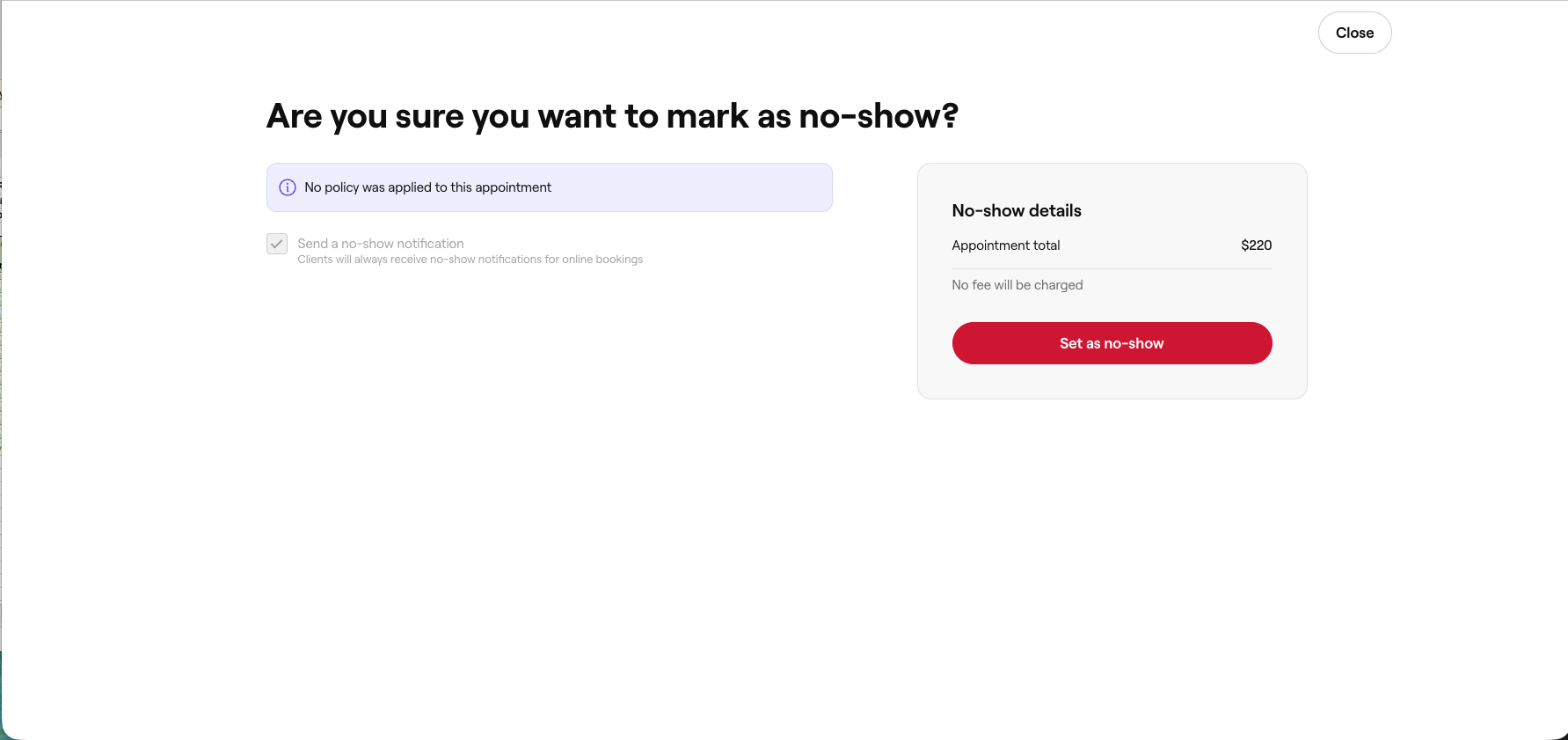
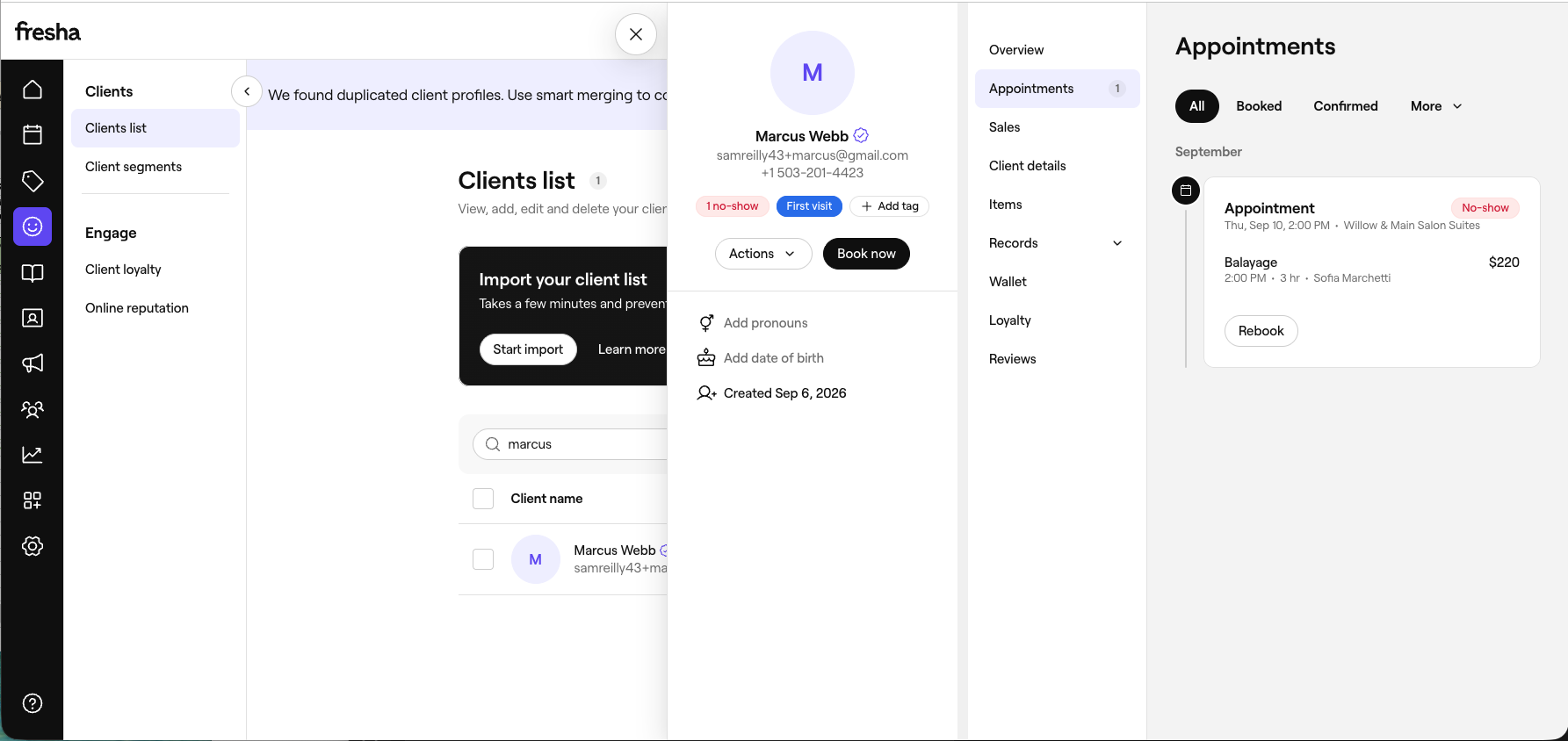
Both scored zero on that trap, because the policy says 50% and neither tool computed a dollar. But Fresha’s zero is the more honest one. It tells the desk, in the dialog, that no policy was applied and no fee will be charged. It does not offer a collect button that leads to a wall. And it does three things after the no-show that GlossGenius did not: it leaves the block on the calendar in red so the lost hours are visible on the day view, it stamps the client’s record with a 1 no-show tag that every future booking will show, and it emails the client that they missed the appointment. The email is locked on for online bookings. The desk cannot mark a no-show quietly.
The cancellation and the late reschedule went the same way. Cancelling a $140 colour two days out produced a dialog that said no policy applied and no fee would be charged, and a client email within the minute, and nothing about a deposit, because there was none to mention. Rescheduling inside the window was refused to the client without a reason and moved by the desk without a warning; the 25% our policy sheet asks for exists nowhere in Fresha. GlossGenius scored one point on each of those in August. So did Fresha. So did Vagaro. That is the tie at seven.
Where Fresha wins the desk
If the policy engine is a wash, the desk is not, and here Fresha is the best of the three tools we have tested.
Entering a walk-in took ten seconds from first click to save. GlossGenius took 44 in August, Vagaro 32. Fresha has a walk-in client option that skips the client record entirely, and a calendar that opens a booking with the provider and time already filled from where you clicked. The day view with five providers is clean and readable, greys out anyone not on the roster, and shows a double-booked pair side by side, which brings us to the one trap it half-passed: booking a walk-in into an occupied chair produced a yellow Team member is not available flag on the booking panel, and then saved anyway. A warning the desk can miss is worth a point, not two. GlossGenius blocked the same booking with a dialog that had to be overridden.
Checkout is where Fresha is simply better. The discount-then-gift-card trap, which GlossGenius fumbled in August and Vagaro got right, Fresha got right on the first attempt, and its receipt shows the arithmetic.
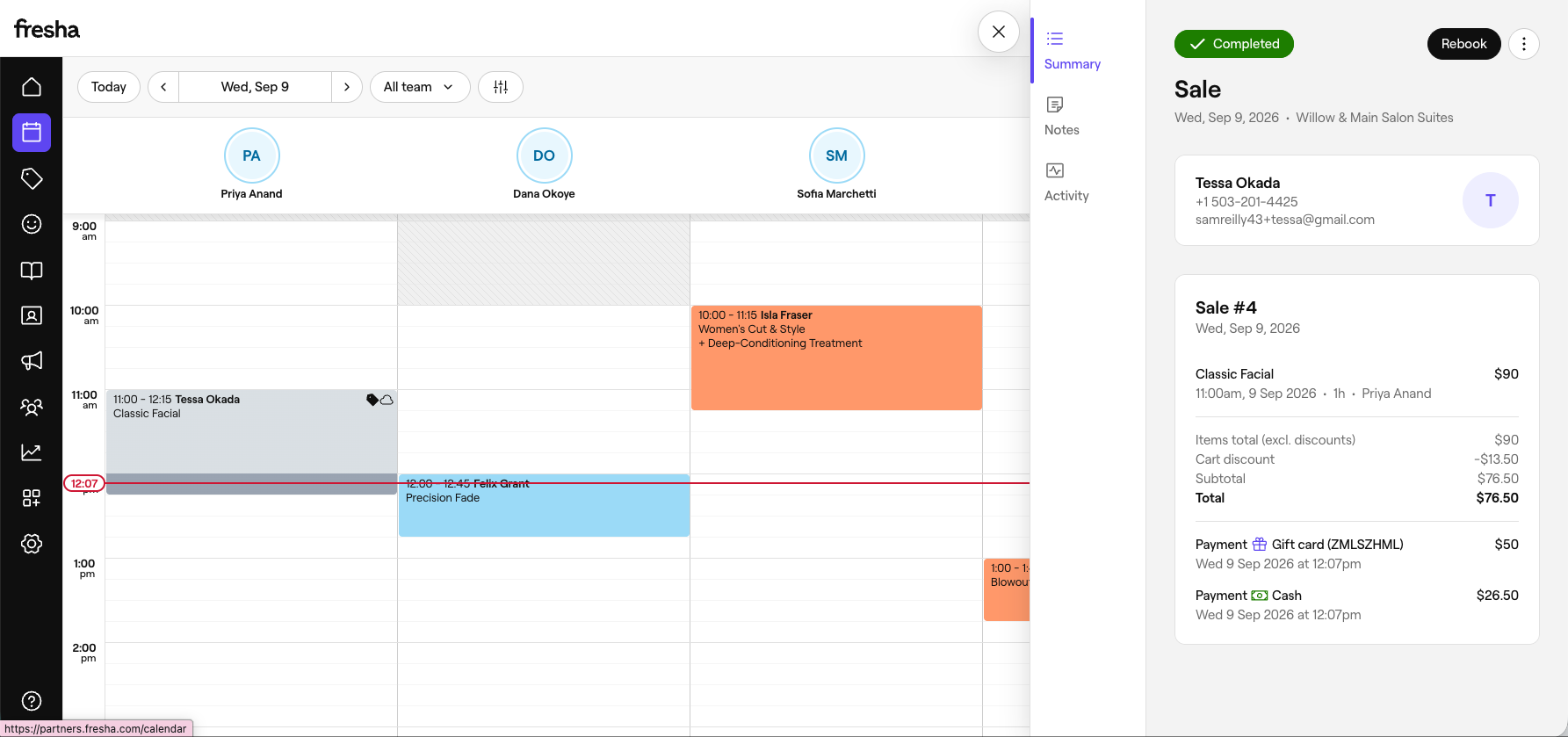
It found the gift card by the custom code we had printed on it, converted the sale to a split payment on its own, pre-filled the cash keypad with the exact remainder and offered change chips beside it. Five minutes, including our screenshots. Cash tender in general is what GlossGenius’s should have been: a keypad, an amount, a record of who took it.
Client records are the richest of the three as well. Imported staff alerts land on the client’s header and on the appointment panel. Intake form answers and the client’s typed signature sit on the appointment as a completed record before the visit, which is the exact thing our esthetician scenario asks for and which GlossGenius lost the moment the appointment was paid. Duplicate detection found our planted pair unprompted, on the day we created it, and refused the same pair at import; the merge leaves an audit note on the surviving record.
Then there is the daily email. Fresha is the only one of the three tools that sends the desk a takings summary every morning, unprompted: sales, appointments, occupancy, new clients, tomorrow’s book. It is a genuinely good idea, and it is where we found Fresha’s reporting problems, because we had the real numbers to check it against.
Fresha’s reporting counts what it should not
The morning after we cancelled the $140 colour, the email’s next seven days forecast still had it in the count. So did the one after that. We had also cancelled a wrong-week booking on day two, and the forecast carried that for a full week. The dashboard confirmed it in Fresha’s own words.
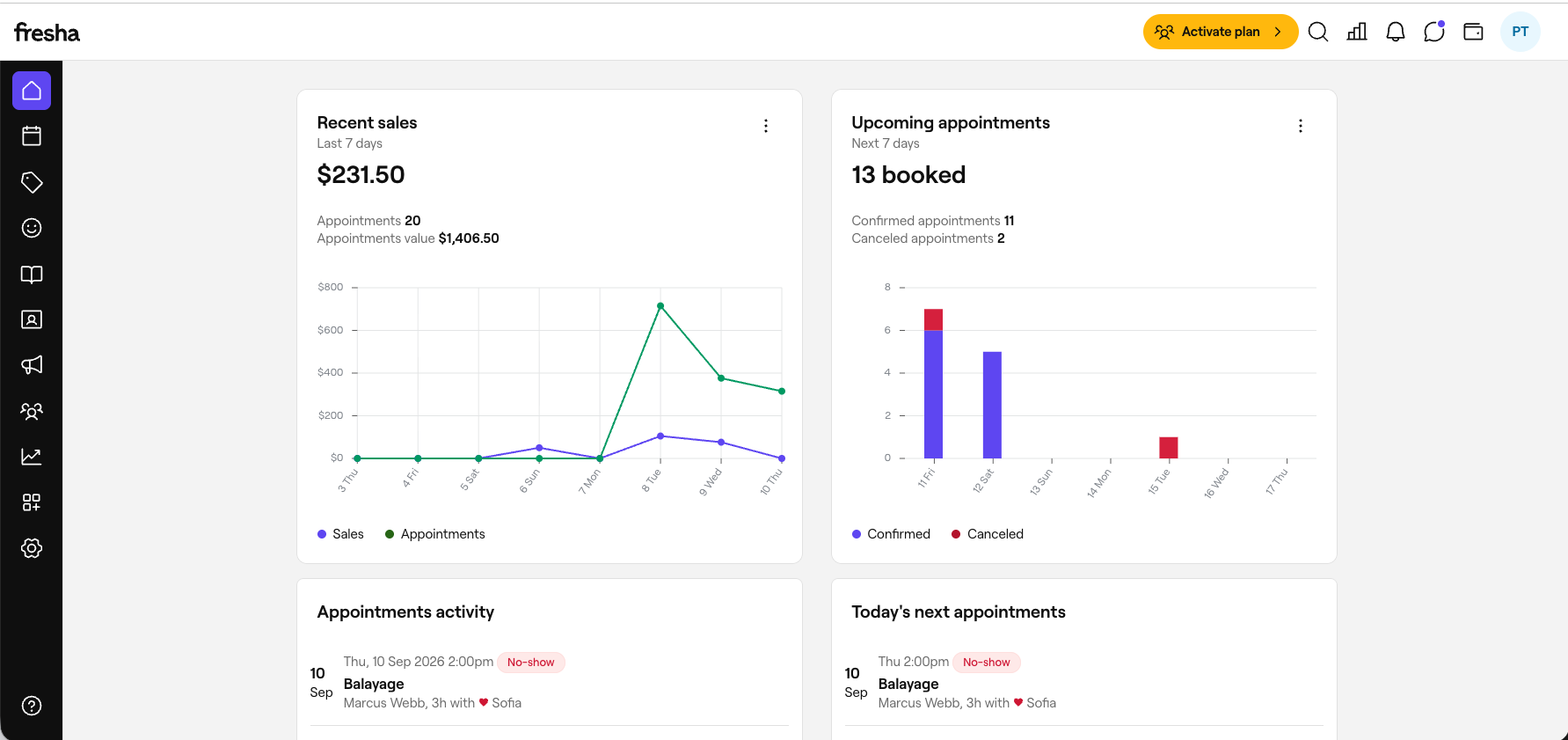
The same email rounded a $76.50 sale to $76, and reported nine clients served on a day when two had been checked out and seven were still just bookings. None of this is dishonest, but a desk owner reading that email over coffee is being told the week is fuller than it is, and the rounding means the email never quite matches the till.
The appointments export has a related habit. We exported the week with an end date of the last day and got nothing from that day; the range excludes its own end. We only noticed because we counted the rows against our script. A salon exporting its book to leave would lose the last day and not know.
Reporting also has a price tag Fresha’s pricing page does not mention.
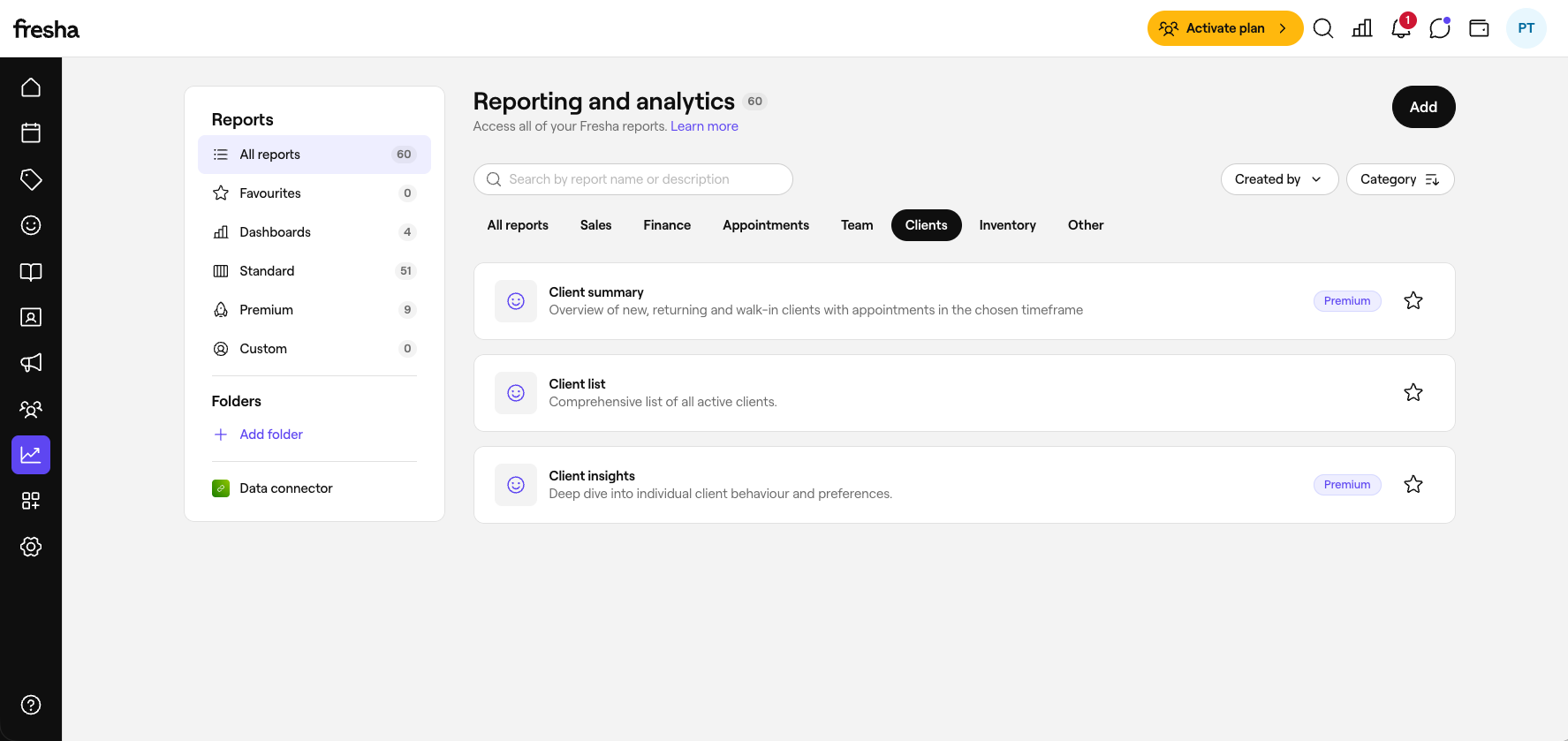
And the counter that does exist tells you something worth knowing. Three clients booked through our link that week. Fresha’s online dashboard reported one new online client. It was the one who had paid. The two who booked and had not yet transacted were not counted. Fresha’s idea of a new client follows the completed sale, not the booking, which is the definition a commission would want.
The bug we reproduced
One finding is not about money and we would not leave it out of a review that a salon owner might act on. On the first day, using Fresha’s own demo data, we switched off calendar bookings for a demo team member. The dialog said she had an upcoming appointment and offered to reassign it to another member. We chose one. The appointment did not move. It stayed booked to the disabled member, disappeared from every column of the calendar, and could only be found by opening the client’s record.
On the last day we reproduced it with real data.
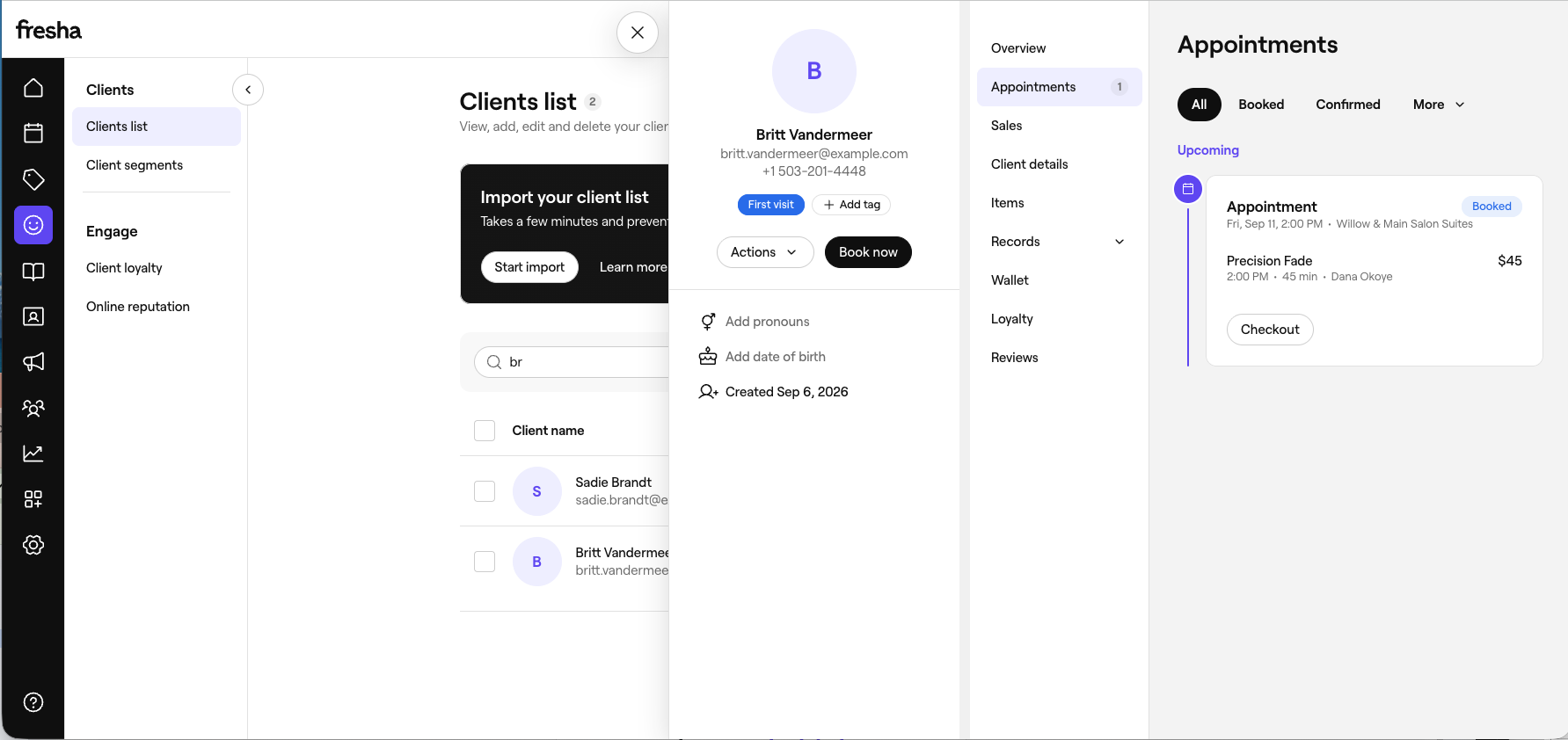
Two live appointments left the calendar. The desk, looking at that Friday, would have read both slots as free. Re-enabling the member brought them back untouched, which means the reassignment never happened at all. Our best guess is that the target member was not set up for those services and Fresha neither checked nor said so. A salon that disables a stylist on her last day, chooses a colleague to take over, and trusts the dialog, has just lost that stylist’s book.
Leaving
Both trials ended with a lesson about the exit, and they are opposite lessons.
GlossGenius we left in August. We cancelled the trial, requested deletion of the account and its data, and were told to expect it in 48 hours. The login died silently three days later, with no closure email, and the booking site went dark the day after that. Then the marketing started: seven emails over the following two weeks offering 50% off to come back, one of them warning that the booking site would go offline tomorrow, six days after it already had. One announced that tonight was the last night to use the discount code; a later one said they had extended it. On the eleventh day, the message finally matched reality.
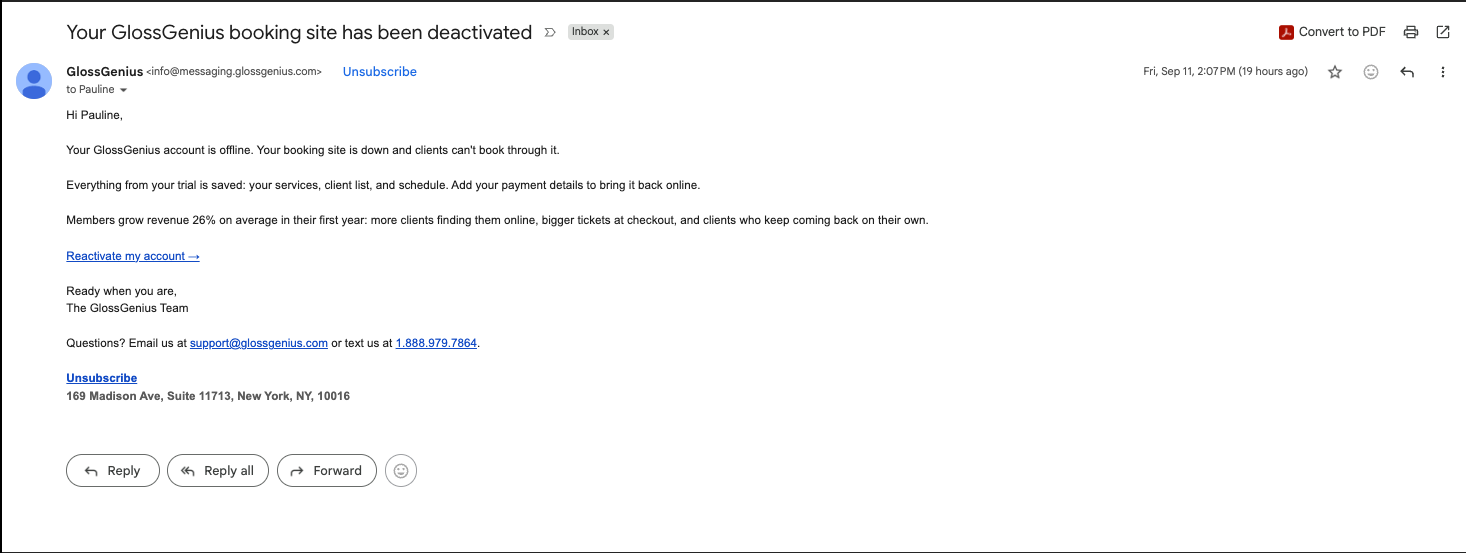
That is a downgrade, not a deletion. The client list of a salon that tried GlossGenius and left is, as far as we can tell from the outside, still on GlossGenius, being used as the reason to come back.
An eighth email arrived on day fifteen, as this piece was going out. It is the best one they have sent: no discount, no deadline, three plainly labelled options, one of which is “not the right time? we’ll check back in six months”, and an unsubscribe link at the bottom. It is also the second time in four days that GlossGenius has told us our data is still there — “your setup is still saved, pick up right where you left off” — fifteen days after we asked them to delete it.
Fresha we could not leave at all, in two senses.
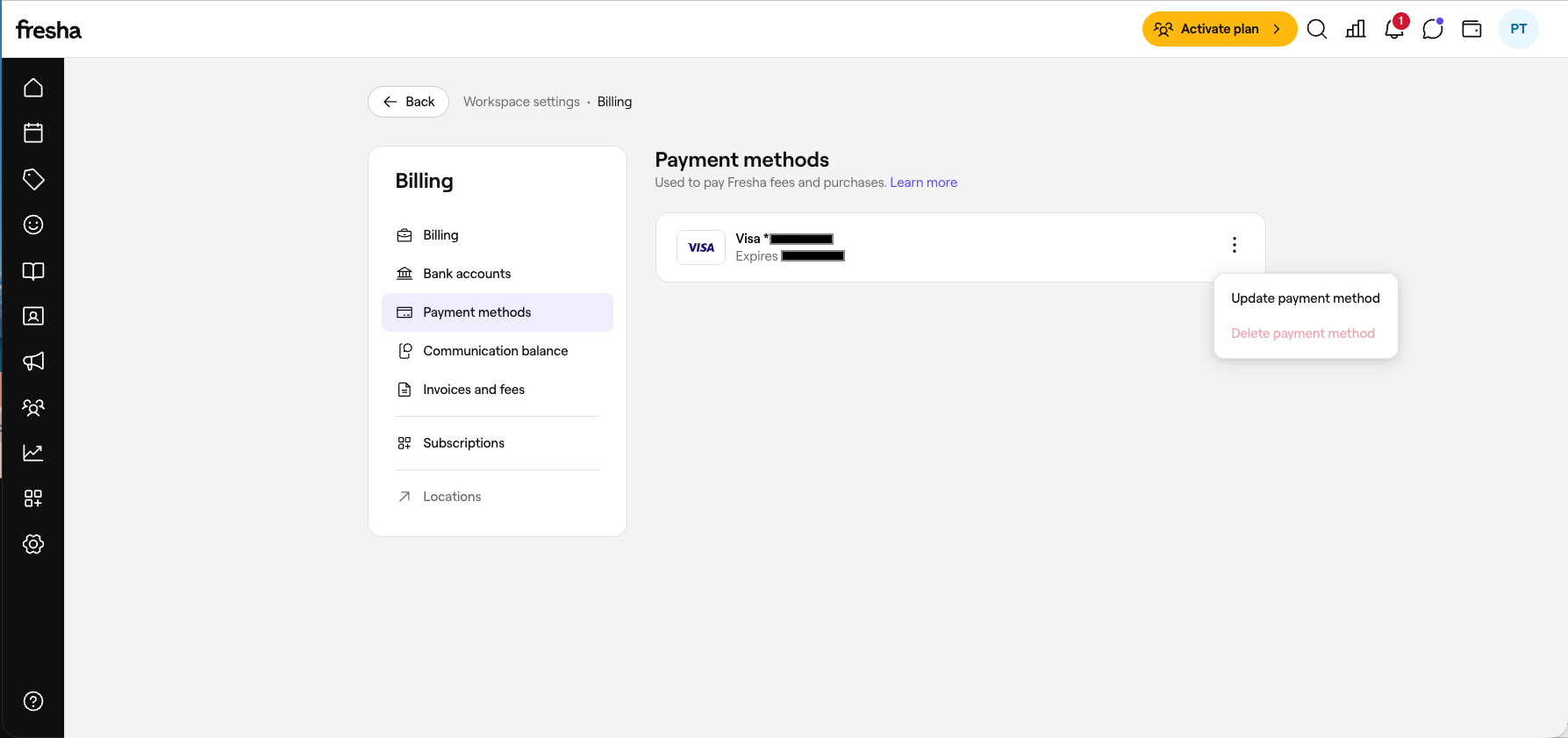
The card we entered to switch on online booking cannot be removed from the account. The option is there, in red, and disabled. We tried it on the last full day of the trial, after unlisting had made the commission unchargeable and before the trial ended, and it would not go. Cancelling the plan is possible and clearly offered, which is more than Vagaro managed, and it may well be what frees the card. We planned to cancel after capturing the expired state on the final morning.
We never saw the expired state.
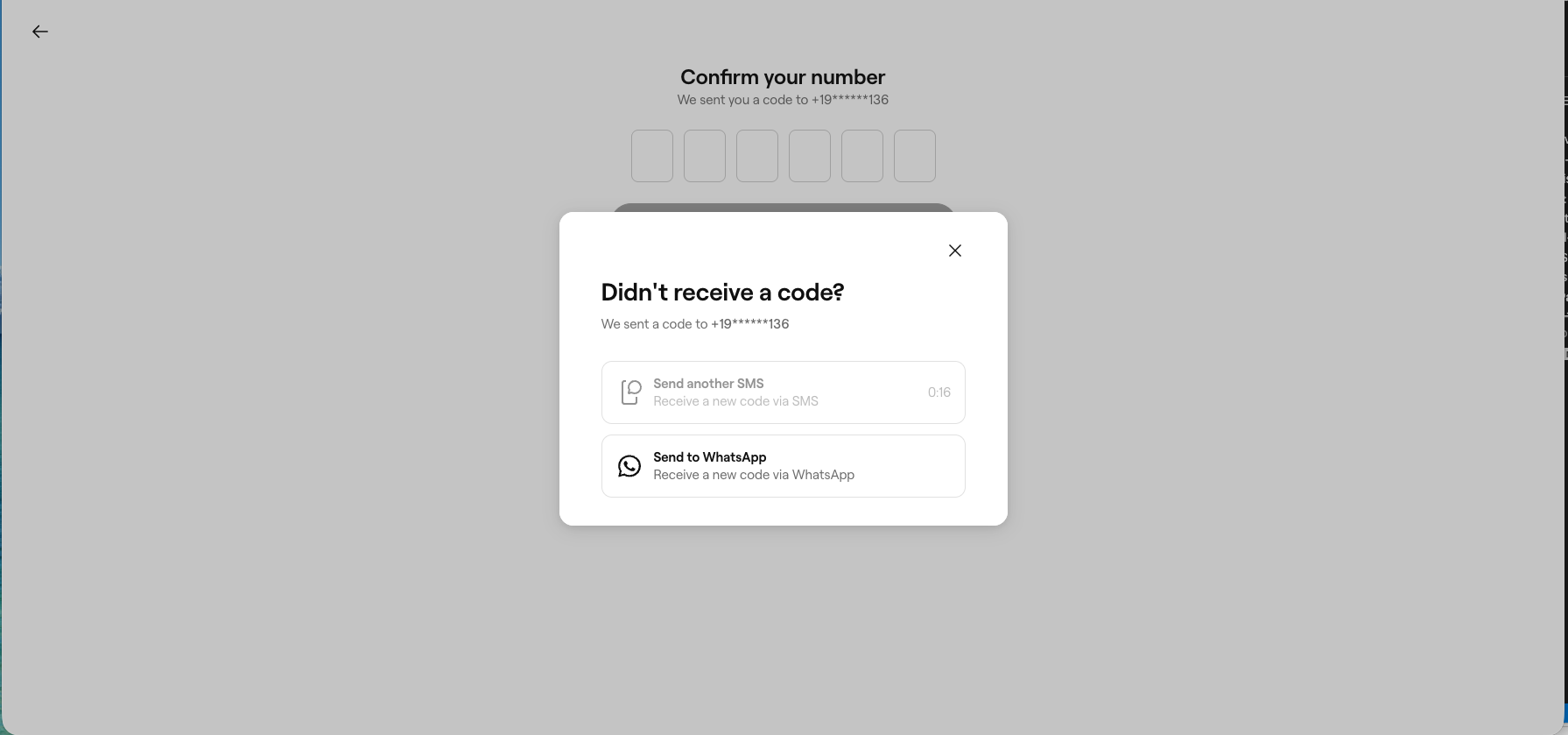
Gate five was a verified mobile number. On our last full day we replaced it with the salon’s fictional landline, as we do with every tool before closing, so that no real phone number stays on a vendor’s servers. The next morning Fresha asked for a text code to that number before it would let us in, and offered no email, no password, no recovery route: only another text, or a WhatsApp message, to the same number. The account is still there. The card is still on it. We have emailed Fresha’s support from the salon’s address asking them to cancel the subscription and delete the account, and we will report here what happens and how long it takes. Three days on, the only message back was a marketing email asking whether something held us back from activating our plan, offering a button to activate now and a button to say we do not plan to use Fresha. Neither of them was the thing we asked for.
The answer came three and a half days after we wrote, early on the Wednesday morning. A named person from Fresha’s customer experience team had read the situation, found the account from the address we wrote from, confirmed that there is no active subscription and that we have not been charged and will not be, and offered to permanently delete the account and its data on our say-so. We said yes, and asked three things in return: confirmation and a date when it is done, confirmation that the card we could not delete is destroyed with it, and whether anything is retained afterwards.
Eleven minutes later the account was gone. The workspace was permanently deleted, an automated notice confirmed it by name, and the reply said in one sentence that there is no active subscription, no further charge, and that every piece of information had been deleted including the card. That is the card the dashboard would not let us remove: the option present, greyed out, unexplained. Support destroyed in a line what the product refused to do at all. When we then tried to log in, Fresha no longer recognised the address and offered to start a new account instead. Three days and eleven hours, end to end.
One question went unanswered. Nothing was said about whether anything is retained after deletion, or for how long — and “everything has been deleted” is an assurance, not a retention policy. Vagaro, for all its faults on the way out, stated ninety days without being asked — though when we then asked its support to delete the account outright, the reply four days later quoted a policy that says “applicable statute of limitations” instead, and did not say whether anything had been deleted at all.
And one thing was not deleted. The next afternoon, thirty hours after “every piece of information,” the salon’s address received a Fresha email headed “Want to extend your free trial?” — an offer to extend a trial on a workspace that no longer exists, sent to an address the login page no longer recognises. The deletion reached the account. It did not reach the marketing list. That is the same gap GlossGenius shows, from a company that had, minutes earlier, done the rest of it properly.
Five days later it went further. A named member of Fresha’s customer success team wrote to Pauline directly — not a no-reply address but a person, with a signature — having noticed the subscription was never activated, and offered a link: reactivate your account and keep access to your bookings, clients, and tools.
So: every piece of information has been deleted, including the card. And: your bookings, clients and tools are there to come back to. Both from the same company, five days apart. We have not clicked the link and will not, because re-creating an account we deleted cleanly would cost us the only clean exit of the four trials. Which means we cannot say which of the two claims is false, only that one of them is. Either the data survived the deletion Fresha confirmed in writing, or the marketing is offering a restoration that no longer exists to be offered.
Set that against the other two. GlossGenius is sixteen days past a stated forty-eight-hour deletion promise with no acknowledgement of any kind and two separate emails saying our setup is still saved. Vagaro cannot delete a customer account without deleting the business account first, and the business account is closed — the only way back in is to restart billing. Fresha, the tool that locked us out of our own book, is the only one of the three that answered a deletion request with a person, a plan, and a yes.
Credit where it is due: the expiry notice itself, when it came fifteen hours later, was one email that said the trial had expired, the workspace could no longer be managed, and here is the button. No discount code, no invented deadline, no reminder that our data was being kept. After GlossGenius’s run of seven, it read like a different industry.
That sequence was our mistake, and we have changed our method so it does not recur. It is also exactly what happens to a salon owner who changes phone number. Fresha’s recovery has one door, and if you lose the key you are outside your own book.
The full scorecards
Scores are 0–2 per item: fails, works with friction, works well. The full item-by-item evidence — every screenshot, timing, and settings screen behind these numbers — lives in our published score files, and the dataset both tools were tested against is downloadable. GlossGenius’s scores are from the August trial and have not been re-run.
| Fresha | GlossGenius | |
|---|---|---|
| Mobile booking flow | 1 — 4 min, ~10 taps; account + phone required | 2 — guest-style, ~10 min |
| Booking page truth | 1 — prices, add-ons shown; policy contradicted on screen | 0 — no prices shown; a variant mispriced |
| Card + deposit at booking | 0 — nothing collected, nothing vaulted | 1 — card enforced, amountless; no deposit |
| Confirmations + reminders | 1 — every change emailed; reminder has no link | 2 — policy in email, no-login manage link |
| TOTAL | 3 | 5 |
| Fresha | GlossGenius | |
|---|---|---|
| T1 double booking | 1 — yellow flag, then saved anyway | 2 — warned, previewed, overridable |
| T2 no-show fee | 0 — "no policy applied"; honest zero | 0 — bank wall; $0 line; no obligation |
| T3 canceled deposit | 1 — no deposit existed; honest dialog | 1 — no deposit existed; good flow |
| T4 discount + gift card | 2 — exact, itemised, first try | 1 — exact but flaky; gift card dead-ends |
| T5 late reschedule | 1 — client refused, no reason; desk moves free | 1 — client blocked; desk moves free |
| T6 duplicate merge | 2 — detected unprompted; audit note | 2 — works, app-only, zero detection |
| TOTAL | 7 | 7 |
| Fresha | GlossGenius | |
|---|---|---|
| Day view + entry speed | 2 — 10 s walk-in; clean five-column day | 1 — 44 s; no-show nearly invisible |
| Setup fidelity | 1 — all native; orphaned-appointment bug | 1 — add-ons inexpressible (variants) |
| Membership lifecycle | 0 — cannot be created without Payments | 1 — sold for cash; redemption opt-in |
| Client records | 2 — intake + signature on the appointment; no-show tag | 1 — clean, but paid appointments shed forms |
| TOTAL | 5 | 4 |
| Fresha | GlossGenius | |
|---|---|---|
| Pricing honesty | 1 — as advertised, until online booking needs a card | 2 — as advertised; Gold-forced trial noted |
| Rates + fine print documented | 2 — every rate and the commission on the page | 2 — flat 2.6%, on the pricing page |
| TOTAL | 3 | 4 |
Fresha or GlossGenius: which should you buy?
If your book is mostly regulars and you want a bill you can predict, GlossGenius. You will pay a subscription and a flat rate, your clients will book without an account, and nothing in the product will surprise you until you try to leave, at which point expect a long tail of discount emails and no confirmation that your data has gone.
If you are opening in a city where the marketplace is how people find a chair, and 20% of a first booking is a price you would pay a referral source anyway, Fresha, with three conditions. Import your existing clients first, because imported clients are exempt from the fee. Keep a phone number you will not lose, because the account has one door. And understand that the card you enter to switch on online booking stays with Fresha until Fresha decides otherwise.
If what you actually want is the policy sheet enforced, the deposit held, the no-show charged, the late reschedule priced, then neither tool does it out of the box, and neither will until you move your card processing onto its rails. That is not a flaw of either product so much as the shape of the whole category, and we now have three tools’ worth of evidence for it. The next comparison we run will start there.
Filed under: fresha · glossgenius · salon software · comparison · pricing